
If you are dealing with car air conditioning not cooling on the first hot day of the year, the instinct is to book a regas and hope. That sometimes works. But plenty of warm-air faults turn out to be a blown fuse, a dead fan or a clogged filter that costs little or nothing to fix, so this guide takes you through the checks in the order a good technician would, before anyone connects a gas machine.
Table of Contents
Why is my car AC blowing warm air?
A car air conditioner does not make cold air. It moves heat. The compressor pressurises refrigerant into a hot gas, the condenser at the front of the car sheds that heat to the outside air, and the evaporator behind the dashboard lets the refrigerant expand and soak up heat from the cabin. The blower fan then pushes cabin air across the cold evaporator and out through the vents.
Warm air means one link in that chain has broken. Either not enough air is moving (blower, filter, blend door), not enough heat is being rejected at the front (condenser, cooling fans), or the refrigerant loop itself is not working (low charge, leak, compressor or clutch, pressure switch, electrical fault).
When you first notice car air conditioning not cooling, the pattern of the symptom tells you a lot before you pick up a tool:
- Cold on the motorway, warm in traffic: usually poor airflow over the condenser, a failed cooling fan or a marginal refrigerant charge.
- Strong airflow but no chill at all: compressor not engaging, often an electrical or low-pressure cut-out issue.
- Cold but barely any air: blower motor, blower resistor or a blocked cabin filter.
- Cold on one side only: on dual-zone cars, a stuck blend door actuator is a common culprit.
- Gradually weaker over a season or two: a slow refrigerant leak.
Car air conditioning not cooling: the home-check order
Run these checks in sequence with the engine idling, bonnet up, and the car parked safely out of the way. Keep hands, hair and loose clothing well clear of the fan and belts. None of these steps involves opening the refrigerant circuit.
- Controls and settings. Confirm the A/C button light is on, the temperature is set to fully cold and recirculation is selected. On climate-control cars, try an auto setting; a confused control module sometimes recovers after the car has been switched off for a few minutes.
- Blower speed. Cycle through every fan speed. If some speeds work and others do not, the blower resistor or control module is the likely fault, not the refrigerant.
- Compressor clutch. Look at the front of the compressor while a helper switches A/C on and off. On most belt-driven compressors the centre hub of the pulley should click and start spinning with the pulley. If it never engages, the problem is electrical or a low-pressure cut-out. Many newer cars use variable-displacement compressors with no visible clutch, so check the owner’s or workshop manual for your model.
- Cooling fans. With A/C on, the electric radiator fan or fans should run, at least intermittently. A dead fan means the condenser cannot shed heat, especially at idle.
- Condenser face. Shine a torch through the grille. Leaves, insects, road grime and bent fins all cut heat transfer. Rinse gently from the engine side outwards with a low-pressure hose; never use a pressure washer on the fins.
- Cabin filter. Pull it out (usually behind the glovebox) and look at it. More on this below.
- Fuses and relays. Check the A/C and blower fuses in both the cabin and under-bonnet boxes. Swap the A/C compressor relay with an identical relay from another circuit, such as the horn, to test it.
If all seven checks pass and the air is still warm, the fault is almost certainly inside the sealed refrigerant system. That is the point to book a proper diagnosis, not before.
8 proven causes of car air conditioning not cooling
Here are the faults that account for most warm-vent complaints, ordered from the cheapest to rule out to the most expensive to fix. Costs vary widely by car and region, so treat the last column as a guide rather than a quote.
| Cause | Typical symptom | DIY check? | Repair scale |
|---|---|---|---|
| Blown fuse or failed relay | No compressor engagement, sometimes no fan | Yes | Very low |
| Clogged cabin filter | Weak airflow, musty smell | Yes | Low |
| Blower motor or resistor | Fan dead or stuck on one speed | Partly | Low to moderate |
| Blocked or damaged condenser | Warm at idle, better when moving | Yes (visual) | Free clean to costly replacement |
| Failed radiator cooling fan | Warm at idle, engine may run hot | Yes | Moderate |
| Low refrigerant from a leak | Slow decline in cooling | No, needs gauges | Moderate to high |
| Compressor or clutch fault | No cooling, noise, clutch not engaging | Partly | High |
| Blend door actuator | Wrong temperature, clicking in dash | Partly | Low to high (access) |
Notice that low refrigerant sits in the middle, not at the top. It is the single most common cause, but it is also the one you cannot confirm without gauges, so it makes sense to clear the cheap, visible faults first.
A note on leaks
An air conditioning system is sealed. It does not use refrigerant the way an engine uses fuel, although a very small natural loss through hoses and seals over several years is normal. If your car needs topping up every summer, there is a leak, and the common spots are the condenser (exposed to stone chips), hose crimps, service valve cores and the compressor shaft seal.
Can a dirty cabin air filter stop AC cooling?
A blocked cabin filter will not switch the cooling off, but it can make a healthy system feel broken. Every bit of air reaching you has to pass through it first. When it is choked with dust, pollen and leaves, airflow drops sharply, so you feel little cold air even though the evaporator is doing its job.
There is a secondary effect too. With little air passing over it, the evaporator can get so cold that moisture freezes on its fins. The ice blocks airflow even further, and cooling fades after a long drive, then returns once the car has sat and thawed.
- Signs of a clogged filter: fan noise without much air, a musty or damp smell, and windows that are slow to demist.
- Replacement interval: follow your service schedule, but check it at least yearly if you drive on dusty roads or park under trees.
- Cost: on most cars it is a cheap part and a ten-minute job, which makes it the best-value check on this list.
How to tell if your AC really needs a regas
A regas (or recharge) means recovering whatever refrigerant is left, pulling a vacuum on the system, and refilling it to the exact weight on the label under the bonnet. It is the right fix when the charge is genuinely low, and the wrong fix for every other fault on this page.
Signs that point towards low refrigerant:
- Cooling has faded gradually over months rather than stopping overnight.
- The compressor clutch cycles on and off rapidly, every few seconds.
- The larger, low-pressure pipe near the firewall feels only cool, not properly cold, after a few minutes of running.
- Oily residue or dye traces around pipe joints, the condenser or the compressor.
- It has been several years since the system was last serviced.
A proper workshop check reads the high and low side pressures, measures vent temperature and runs a leak test with dye or an electronic sniffer. Ask whether the price includes a vacuum test, because a system that cannot hold vacuum has a leak, and simply refilling it will see the new gas escape again.
Refrigerant also carries the compressor’s lubricating oil around the circuit, so a very low charge can starve the compressor. That is one more reason to deal with a leak promptly. Our guide to the fluids your car depends on explains how this differs from engine oil and coolant.
Why the AC is still not cold after a recharge
Few things are more frustrating than paying for a regas, or spending money on a DIY can, and still finding your car air conditioning not cooling. There are several reasons this happens, and most come from guessing rather than measuring.
Why a DIY recharge can fail
- Overcharging. More gas is not better. Too much refrigerant raises high-side pressure, cuts cooling and can trip the pressure switch. Cans with low-side-only gauges cannot show you this.
- No vacuum, no dry system. A top-up leaves air and moisture inside. Moisture can react with the oil and refrigerant and shorten component life.
- The leak is still there. Topping up a leaking system buys days or weeks, not a fix.
- The real fault was never refrigerant. A dead cooling fan, failed clutch or blend door will still be there after any amount of gas.
- Sealer additives. Some stop-leak products can clog valves and the expansion device, and many workshops will refuse to connect their recovery machines to a contaminated system.
In the United States, small cans of R-134a sold for DIY use must have self-sealing valves, but read the label carefully. The EPA warns that hydrocarbon refrigerants are flammable and are not approved for car air conditioning; its guidance on motor vehicle air conditioning covers the risks and the approved refrigerants. Mixing refrigerants also contaminates the system and makes later professional servicing harder.
After a professional regas
If the system was evacuated and refilled to the correct weight and it still blows warm, go back to the electrical and airflow checks: compressor engagement, cooling fan operation, condenser condition and the blend door. A good shop will also have read the pressures, which can point towards a blockage or a weak compressor.
R-1234yf vs R-134a: what it means for cost
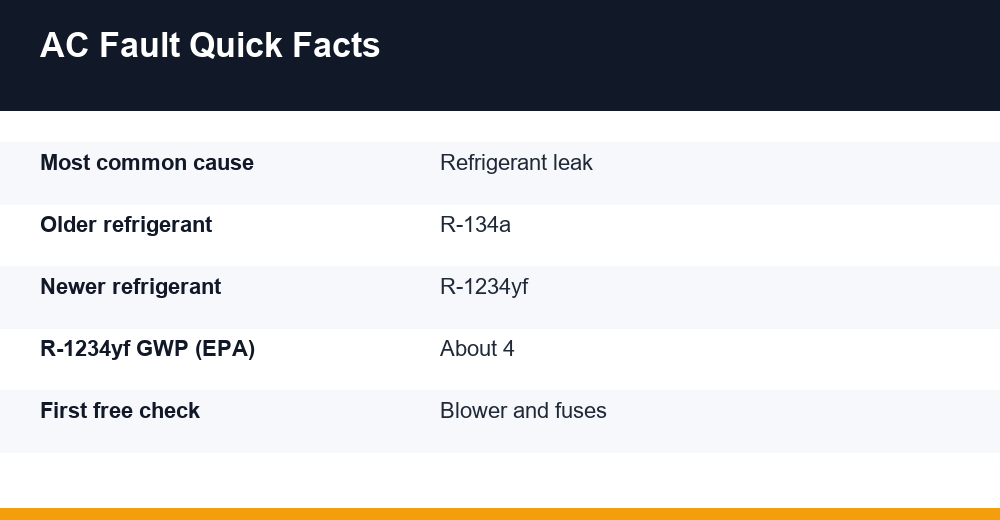
Older cars mostly use R-134a. Newer cars use R-1234yf, which the EPA lists with a global warming potential of about 4, compared with more than 1,400 for R-134a. In the EU, all new cars with air conditioning have had to use a low-GWP refrigerant since 1 January 2017, and most US manufacturers have also moved over in recent model years.
To find out which one your car uses, look for the label under the bonnet, usually on the slam panel or near a service port. The two refrigerants use different service fittings, so the wrong gas cannot easily be connected.
| Point | R-134a | R-1234yf |
|---|---|---|
| Typical cars | Older models | Most newer models |
| Global warming potential | Over 1,400 | About 4 |
| Flammability | Non-flammable | Mildly flammable |
| Service equipment | Widely available | Dedicated machines |
| Regas price | Lower | Often roughly double or more |
The newer gas costs more per kilogram and needs separate, more expensive equipment, which is why a regas on a recent car often costs roughly twice as much, or more. Converting a car built for R-1234yf to run on R-134a is not an approved shortcut.
How much does it cost to fix car AC?
The honest answer is anywhere from the price of a fuse to a large garage bill, depending on the fault. That is exactly why the diagnostic order matters. Prices change with region, refrigerant type and model, so the table below shows relative cost rather than exact figures; always get a written quote.
| Job | Relative cost | Notes |
|---|---|---|
| Fuse or relay | Very low | Often a DIY fix |
| Cabin filter | Low | Ten-minute job on many cars |
| Regas, R-134a | Moderate | Widely offered by chains and independents |
| Regas, R-1234yf | Roughly double R-134a | Dearer gas and equipment |
| Condenser replacement | Moderate to high | Plus a full regas afterwards |
| Compressor replacement | High | Usually with drier and valve |
| Evaporator replacement | Very high | Dashboard often removed |
When a garage diagnoses a refrigerant fault behind your car air conditioning not cooling, ask three questions: has the leak been found, is the quoted price for a top-up or a full evacuate and recharge, and will they guarantee the cooling for a set period? Be wary of a bundled “AC sanitiser” or “system treatment” added without explanation; our list of dealer service upsells worth refusing covers how to push back politely.
A compressor failure is the expensive outcome. It usually means replacing the compressor, receiver-drier or accumulator and expansion valve, and flushing the system, because debris from a failed compressor spreads through the circuit.
Keeping the system healthy
Most air conditioning failures are slow, so a few habits go a long way in preventing a repeat of car air conditioning not cooling next summer.
- Run it year-round. Use the A/C for a few minutes every week or two, even in winter. It circulates oil around the seals and helps stop them drying out. Many cars also use it to demist the windscreen.
- Change the cabin filter on schedule, and sooner on dusty roads.
- Rinse the condenser gently a couple of times a year, especially after long trips with lots of insects.
- Listen for new noises when the compressor engages; grinding or squealing deserves early attention.
- Ask for a pressure and leak check every few years rather than waiting for warm air.
In a heatwave, start a hot car with the windows down for the first minute to purge the trapped air, then close up and use recirculation. Our hot weather car care guide covers tyres, coolant and batteries too, which suffer in the same conditions that expose a weak AC.
Frequently Asked Questions
Why is my car AC blowing warm air?
The most common cause is low refrigerant from a leak, but cheaper faults produce the same symptom. A blown fuse or failed relay, a compressor clutch that will not engage, a dead radiator fan, a condenser clogged with debris or a stuck blend door can all leave the vents warm. Check those first, because none of them is fixed by adding gas.
How do I know if my car AC needs a regas?
Gradual loss of cooling over months, a compressor clutch that cycles on and off every few seconds, and a low-pressure pipe that never gets properly cold all suggest a low charge. Only a pressure reading confirms it. Ask the garage to evacuate and vacuum test the system, so a leak shows up before they refill it.
Can a dirty cabin air filter stop AC cooling?
It will not stop the refrigerant system, but it can make cooling feel poor. A blocked filter cuts airflow, so little cold air reaches the cabin, and the evaporator may ice over and block airflow further. Weak airflow, musty smells and slow demisting are the usual signs. A new filter is cheap and quick to fit on most cars.
Why is car air conditioning not cooling after a recharge?
The original fault may not have been refrigerant at all, so a failed fan, clutch or blend door remains. A DIY top-up can also overcharge the system, leave moisture inside, or hide an active leak that drains the new gas within weeks. A full evacuate, vacuum test and correct-weight recharge followed by electrical checks usually finds the cause.