
Knowing how to store a car long term can save you from a flat battery, flat-spotted tyres, a mouse nest in the air filter and an avoidable garage bill when you get home. Whether you’re working abroad for a year, avoiding the monsoon season or simply rarely drive, a few hours of preparation protects the car for months. Below are eight practical steps, plus a straightforward restart checklist for the day you return.
Table of Contents
How to Store a Car Long Term: Plan Before You Park
Think of “storage” as anything longer than about a month without driving. Beyond that, batteries go flat, fuel ages, tyres take a set and moisture creeps in.
Step 1: Pick the right spot
The first decision when working out how to store a car long term is where it will live. The ideal is a dry, secure, covered space: a private garage, a covered car park or a reputable storage facility.
Outdoors, choose firm, level ground away from trees (sap, droppings, falling branches) and long grass, which shelters rodents. In very humid regions, a sealed garage can trap damp, so some ventilation or a dehumidifier helps.
Match the effort to how long you’ll be gone. These timings are typical guidance; your owner’s manual comes first.
| Time away | Essential steps | Worth adding |
|---|---|---|
| 2-4 weeks | Secure parking, food cleared out, healthy battery | Battery maintainer if the battery is old or the car is packed with electronics |
| 1-3 months | Near-full tank, battery maintainer or disconnection, tyres slightly over-inflated, clean inside and out | Breathable cover, rodent deterrents |
| 3-12 months | All of the above plus oil change, fuel stabiliser, damp and pest protection, insurance and registration sorted | A trusted person to check on it every few weeks |
| Over 12 months | Everything above, plus a professional inspection before driving again | Ask a garage whether any fluids should be changed or drained beforehand |
Step 2: Sort the paperwork and insurance
Legal requirements for registration, road tax and insurance differ by country, and in places such as the US and Australia by state too. Check with your licensing authority and insurer before you leave.
In the UK, for example, a car kept off public roads can be declared off the road with a Statutory Off Road Notification (SORN). You then don’t need to tax or insure it for road use, but it must be kept off the road, and the only public-road journey allowed is to a pre-booked MOT. The car still needs insurance for that trip.
Before cancelling insurance entirely, remember that a parked car can still be stolen, catch fire or flood. Many insurers offer cheaper laid-up or storage cover that keeps fire and theft protection. Note any renewal or inspection due while you’re away, and take dated photos of the car and odometer in case of a claim.
Clean It Thoroughly and Change the Oil
Step 3: Wash, dry and freshen the fluids
Bird droppings, tree sap, road salt and sea spray left on paint for months can etch the clear coat or start corrosion. Wash the car, including the wheel arches if you live near the coast or salted roads, and let it dry completely before covering it. A coat of wax adds extra protection.
Inside, remove every crumb of food, plus wrappers and drinks. Vacuum, dry out damp floor mats and empty the boot (trunk).
If an oil change is due within a few months, do it before storage. Used oil carries acids and moisture that can slowly attack engine internals while the car sits. Most manuals also set a time limit for oil changes, commonly around a year, however few miles you’ve covered.
- Coolant: check the level, and make sure it protects against frost if storage temperatures can drop below 0°C (32°F).
- Brake fluid: check the level only. If it looks dark or is overdue for replacement, leave that job to a qualified mechanic.
- Washer fluid: top up, using a winter mix in cold climates.
- Wipers: lift them off the glass, or rest them on a soft cloth, so the rubber doesn’t stick or deform in heat.
Fuel, Stabiliser and EV Charge Levels
Step 4: Treat the fuel (or set the right charge)
Fuel is the step people most often skip when they plan how to store a car long term. Petrol (gasoline) slowly oxidises and loses its lighter components, and ethanol blends such as E10 absorb moisture from the air. After a few months, stale fuel can leave gummy deposits that cause hard starting, rough running or clogged injectors.
Diesel ages more slowly but can grow microbial “diesel bug” in a damp tank, especially in humid climates. Either way, a nearly full tank leaves less room for condensation.
For petrol cars parked longer than two or three months, the usual approach is:
- Buy a fuel stabiliser suited to your fuel type and read the dose on the bottle.
- Add it to the tank, then fill up to roughly 90 per cent so it mixes in well.
- Drive for 10-15 minutes, around 5-10 miles (8-16 km), so treated fuel reaches the lines and injectors.
- Park in your storage spot and leave the tank as it is.
Popular stabilisers claim up to 24 months of protection, but treat that as a best case, because heat speeds up fuel ageing. For diesel, ask a garage which additive suits your engine. Never drain or modify the fuel system yourself; that’s a job for a qualified mechanic.
For EVs and plug-in hybrids, manufacturers generally advise leaving the high-voltage battery partly charged, commonly around 50 per cent, rather than full or nearly empty. Some suggest staying plugged in with a charge limit set. Your manual has the exact figure. High-voltage parts (usually marked with orange cables) are strictly for trained technicians.
Keep the Battery Alive While You’re Away
Step 5: Choose a maintainer or disconnect
The 12-volt battery is the most common reason a stored car won’t start. Even locked and switched off, a modern car draws a small current for the alarm, keyless entry and control modules, which can flatten it within a few weeks to a couple of months.
If your battery already struggles after a night or two, sort that out before you go. Our guide to why a car battery dies overnight and how to fix it walks through finding the cause. Then pick one of these options:
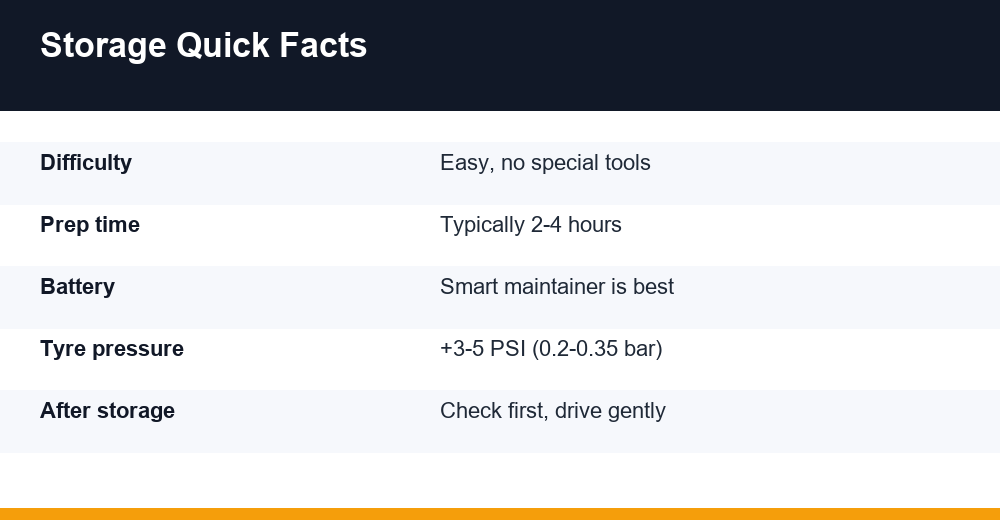
- Smart battery maintainer: plugs into the mains and only tops up when the voltage drops. It’s the best choice if your storage spot has a safe power socket. Older basic trickle chargers charge constantly and can overcharge a battery over months, so check yours has a maintenance or float mode.
- Disconnect the negative terminal: costs nothing and stops most of the drain. You may lose radio presets or seat and window memory, and some cars need a code or a relearn procedure afterwards. Check the manual first.
- Leave it connected: fine for a few weeks with a healthy battery, risky beyond that. A lead-acid battery that sits completely flat for weeks may never fully recover.
Hybrids and EVs still have a 12-volt battery, and it drains too. Follow the manual’s storage instructions closely, because some models top it up from the main battery and others don’t.
Keep sparks and flames away from the battery and wear eye protection. If you’d rather not handle terminals, a garage can fit a maintainer lead in minutes.
Prevent Flat-Spotted Tyres and Stuck Brakes
Step 6: Protect the tyres and free the brakes
When a car sits in one position for months, the patch of each tyre (tire, if you’re in North America) touching the ground can stiffen and flatten. Mild flat spots often ease after a few miles of driving, but severe ones caused by long storage, heat or low pressure can be permanent and leave a vibration.
- Inflate the tyres to the pressure on the door-pillar or fuel-flap sticker, then add roughly 3-5 PSI (about 0.2-0.35 bar). Never exceed the maximum pressure moulded on the sidewall.
- Put a note on the steering wheel reminding you to reset the pressures before driving.
- If someone can visit, ask them to roll the car a short distance on private ground every few weeks so a fresh part of each tyre bears the weight.
- Park on concrete or a sturdy board rather than bare earth, which holds moisture.
Some enthusiasts put cars on axle stands for very long storage. Most owners don’t need to, and lifting a car safely needs proper equipment, so leave that to a garage or storage facility.
Rubber also ages whether or not it’s used. Check how old your tyres are before and after storage; our guide on how to read a tyre date code shows where the four-digit code sits. Many tyre makers recommend a professional inspection once tyres reach about five or six years old.
Brakes are the other trap. Leaving the parking brake on for months, especially in damp or coastal air, can let pads or shoes rust onto the discs or drums.
Where it’s safe, park on level ground, leave an automatic in P or a manual in first gear, release the handbrake and put wheel chocks against the tyres. Electronic parking brakes vary, so follow the manual. If the brakes are seized or grinding afterwards, have a mechanic look rather than forcing the car to move.
Keep Out Rodents, Damp and Heat
Step 7: Seal, cover and control moisture
A quiet, sheltered car is an ideal home for mice, rats and, depending on where you live, squirrels, martens or snakes. They nest in air filter boxes and vents and can chew through wiring, which is expensive to repair.
- Remove all food, and don’t store pet food, bird seed or rubbish near the car.
- Loosely plug the exhaust tailpipe with steel wool or wire mesh, and put a bright reminder on the steering wheel to remove it before starting.
- Set traps around the car rather than using poison; a poisoned animal may crawl inside the vehicle to die.
- Keep the area tidy, with no long grass, cardboard or clutter around the wheels.
Damp brings mouldy seats, musty air conditioning and corroded connectors. In tropical or coastal areas, put moisture-absorbing tubs or desiccant bags in the cabin and boot. If the car is indoors and secure, a window open a few millimetres helps air circulate.
Choose a breathable, well-fitting cover. Plastic sheets and tarpaulins trap condensation against the paint and can rub in the wind. Outdoors, a cover also blocks UV, which fades paint, cracks dashboards and ages tyres faster.
In hot climates, a closed car parked in strong sun can get well above 50°C (122°F) inside, with the dashboard hotter still. Add a windscreen sunshade under the cover and park in shade if you can. Our guide to car care in hot weather covers protecting batteries, rubber and plastics from heat in more detail.
One firm rule: if the storage area floods while you’re away, don’t try to start the car. Water drawn into the engine can wreck it instantly, so have it towed to a qualified mechanic.
Should Someone Start the Car While You’re Away?
Ask around about how to store a car long term and someone will suggest getting a friend to start the engine every few weeks and let it idle. It’s well meant, but a short idle usually does more harm than good.
The engine never gets hot enough to drive off the water vapour from combustion, so moisture collects in the oil, and starting uses more battery charge than a few minutes of idling puts back.
If a trusted person can help, a proper drive is far better:
- Every two to four weeks, drive for at least 20-30 minutes, roughly 15-20 miles (24-32 km), so the engine reaches full temperature.
- Make sure they’re insured to drive it and the car is legally allowed on the road. That rules this out if you’ve declared it off the road.
- Ask them to check for obviously soft tyres, look underneath for fresh drips and glance inside for signs of pests or damp.
If nobody can drive it properly, prepare the car well and leave it alone. Either way, leave a spare key and copies of the paperwork with someone you trust in case it needs moving in an emergency.
Step 8: Your Restart Checklist After Storage
Knowing how to store a car long term is only half the job; waking it up carefully matters just as much. Before you turn the key or press the start button, work through these checks in order.
| Check | What to do | Call a mechanic if… |
|---|---|---|
| Reminder notes | Remove the exhaust plug, sunshade, chocks and cover | You can’t find or remove something you blocked |
| Under the bonnet (hood) | Look for nests, droppings and chewed wires; check oil and coolant levels | Any wiring or hoses are chewed |
| Under the car | Look for fresh drips or puddles | You spot fuel, brake fluid or coolant leaks |
| Tyres | Reset to the normal pressure; inspect for cracks, bulges and age | There’s cracking or bulging, or you’re unsure about older tyres |
| Battery | Reconnect it or unplug the maintainer; listen for normal cranking | It cranks slowly even after a full charge |
| Brakes | Test with gentle stops at walking pace before joining traffic | Grinding, pulling or a soft pedal doesn’t clear quickly |
| First drive | Drive gently for 10-15 minutes and watch the dashboard | A warning light stays on |
A thin film of orange surface rust on brake discs after weeks of storage is normal and usually clears within a few gentle stops. Persistent noise, vibration or a car that pulls to one side is not normal, so get it checked.
If the battery is flat, recharge it properly rather than relying on repeated jump starts. If it won’t hold a charge, it may simply be worn out.
After a year or more, or with untreated fuel, book a service before any long trip so a mechanic can check the fuel system, hoses, belts and brakes. Finally, fill up with fresh fuel and confirm insurance, tax or registration and any roadworthiness test are valid before returning to public roads.
Frequently Asked Questions
How long can a car sit without being driven?
Most healthy cars sit for two to four weeks without trouble. Beyond about a month, the battery usually suffers first, followed by fuel quality, tyre flat spots and damp. Once you know how to store a car long term and follow the steps above, a car can sit for a year or more, provided it gets a careful check before driving again.
Should I disconnect the battery or use a battery maintainer?
A smart maintainer is the better option if you have a safe power socket, because it keeps the battery charged and the car’s settings intact. Disconnecting the negative terminal works where there’s no power, but you may lose radio presets or need a security code afterwards. Check your owner’s manual first.
Is it bad to start a stored car and let it idle?
Usually, yes. A few minutes of idling doesn’t warm the engine enough to burn off moisture, so water can build up in the oil, and starting uses more battery charge than idling replaces. Either have someone take it for a proper 20-30 minute drive or leave it untouched.
What’s different about storing a car in a hot or humid climate?
Heat ages fuel, batteries and rubber faster, so treat the fuel, use a sunshade and a breathable cover, and park in shade. Humidity encourages mould and corrosion, so add moisture absorbers inside, allow some airflow and avoid plastic covers that trap condensation against the paint.