
If your car battery dies overnight, something is either draining it while the car sleeps or failing to refill it while you drive. Most causes can be traced at home with an inexpensive multimeter. Below are the eight most common causes, how to test for each, and when a simple maintainer makes more sense than a new battery.
Table of Contents
Why Your Car Battery Dies Overnight
Think of your car’s 12-volt battery as a storage tank rather than a power station. The alternator fills it while the engine runs, and anything that uses power with the engine off slowly empties it. A sluggish or silent morning start means the tank either drained faster than it should or was never properly full.
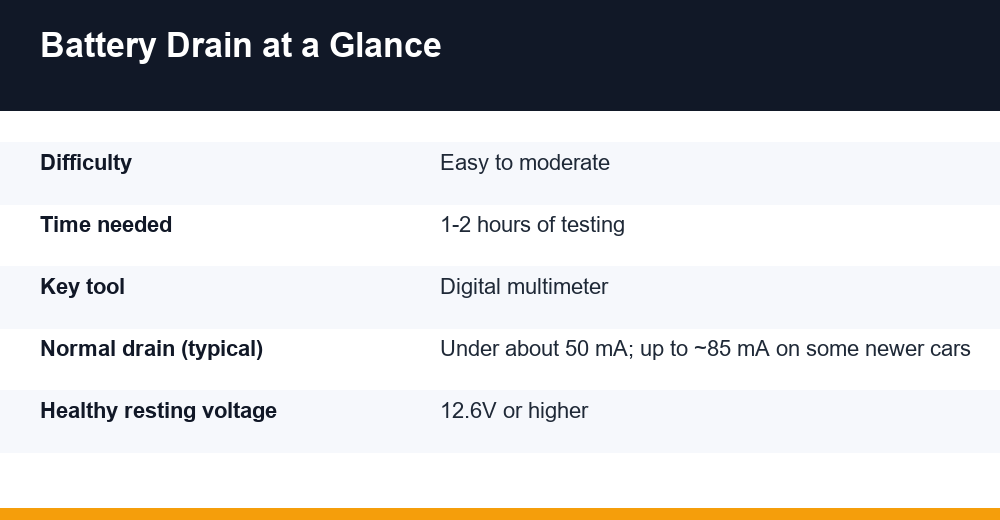
Even a locked car uses a little electricity. The alarm, clock, keyless entry receiver and engine computer memory all sip current around the clock. This is called parasitic draw. Once the electronics have gone to sleep, it typically settles below about 50 milliamps (mA), although some newer cars packed with electronics are specified at up to around 85 mA.
A little arithmetic shows why faults matter. A typical 60 amp-hour (Ah) battery losing 50 mA gives up roughly 1.2 Ah a day, which a healthy battery tolerates for a couple of weeks. A fault pulling 500 mA takes around 12 Ah a day. Pair that with an ageing battery holding half its original capacity, and the car battery dies overnight rather than over a fortnight.
Often it’s a combination, such as a tired battery plus a modest drain. That’s why testing beats guessing. You’re answering three questions:
- Is something drawing too much power while the car is switched off?
- Is the battery being properly recharged when you drive?
- Can the battery still hold a full charge?
8 Common Causes of a Flat Battery by Morning
1. A module that won’t go to sleep
Modern cars carry dozens of electronic control units, designed to power down in stages after you lock up. That can take from a few minutes to over an hour. If one stays awake because of a software glitch, faulty sensor or a door switch that thinks a door is open, it can pull hundreds of milliamps all night. A stuck relay keeping a fan or pump live does the same.
2. Lights and switches left on
Simple oversights still flatten plenty of batteries: a boot (trunk) light with a broken switch, a glovebox lamp that never turns off, a vanity mirror light, or headlights left on in an older car without a warning chime.
3. Aftermarket accessories
Hardwired dashcams in parking mode, trackers, extra alarms, amplifiers and chargers in always-live sockets all add to the overnight load. Many dashcam hardwire kits include a low-voltage cut-off, so check it’s set sensibly. On second-hand cars, accessories spliced into the wrong circuit by a previous owner are a common hidden cause.
4. Short trips that never refill the battery
Starting an engine takes a big gulp of energy, and a 10-minute crawl through town may not put it back, especially with lights, wipers or air conditioning running. Weeks of journeys under about 5 miles (8 km) leave the battery chronically undercharged. Stop-start systems and smart alternators, which deliberately charge less at times to save fuel, make this more likely.
Eventually there isn’t enough in reserve for a normal night’s draw, so the battery is flat by morning even though nothing is broken.
5. A heat-damaged or worn-out battery
Heat, not cold, does most of the long-term damage by speeding up internal corrosion and water loss. A widely quoted industry rule of thumb says lead-acid battery life roughly halves for every 15°F (about 8°C) of sustained temperature above 77°F (25°C). The harm often goes unnoticed until the weather cools and the weakened battery can no longer crank strongly.
Batteries typically last around 3-5 years in temperate climates, often less in places with fierce summers such as the Gulf, inland Australia or northern India. Our hot-weather car care guide explains how to protect the battery when temperatures soar.
6. A failing alternator
If the alternator isn’t charging properly, the battery runs down a little on every drive, and the overnight rest is simply when the shortfall shows. A faulty diode inside the alternator can also leak current with the engine off. Dimming lights, a whining noise or a battery warning light are the usual clues.
7. Corroded or loose connections
White or green crust on the terminals, a loose clamp or a corroded earth (ground) strap all add resistance. The battery then charges poorly and struggles to deliver starting current, which looks exactly like a dead battery.
8. The wrong battery, or one that wasn’t registered
Many newer cars, especially with stop-start, need an EFB or AGM battery and use a management system that adjusts charging as the battery ages. Fit a standard flooded battery, or skip the registration step some manufacturers require, and the car may undercharge or overcharge it. Your owner’s manual or a dealer can confirm what your car needs.
Quick Checks Before You Reach for Tools
Start with your eyes and ears; these checks take about ten minutes.
- Look after dark. Lock the car, wait 15-20 minutes, then check for any glow from the boot, glovebox, footwells or under the dashboard.
- Listen. A relay clicking, fan running or pump humming long after you’ve locked up suggests something is staying awake.
- Inspect the battery. Look for corrosion, loose clamps, or a swollen, cracked or leaking case. A bulging or leaking battery should be replaced, not charged.
- Find the date. Most batteries carry a date code on the case or label. Anything over about four years old in a hot climate is a prime suspect.
- Think back. Did the problem start after a dashcam, stereo, tracker or new battery was fitted?
| What you notice | Most likely cause | Next step |
|---|---|---|
| Dead after a night or two, fine after a jump and a drive | Parasitic drain or weak battery | Voltage test, then draw test |
| Slow cranking that worsens over weeks | Ageing battery or undercharging | Voltage test and load test |
| Battery light on while driving, dim headlights | Alternator or drive belt fault | Charging voltage test, then a mechanic |
| Flat only after weeks of short trips | Undercharging | Longer drives or a maintainer |
| Started after an accessory was fitted | Accessory draw or wiring fault | Disconnect it and retest |
| A brand-new battery also goes flat | Drain, charging fault or unregistered battery | Draw test and charging test |
The Simple Multimeter Test for Battery Drain
A basic digital multimeter answers most of these questions. You’ll do two checks: a resting voltage test to see how charged the battery is, and a current test to measure drain. If your car battery dies overnight more than once, both are worth the hour they take.
Safety first
- Wear eye protection and keep flames and sparks away; batteries can release flammable hydrogen gas.
- None of these tests need you under the car. Never work beneath a vehicle supported only by a jack.
- On hybrids and electric cars, test only the 12-volt battery and never touch orange high-voltage cables.
- Disconnecting the battery can reset the radio, clock and windows, and some radios need a security code. Check your owner’s manual first.
Test 1: Resting voltage
A standard 12-volt lead-acid car battery has six cells of roughly 2.1 volts each, which is why a full one reads about 12.6V.
- Leave the car off for at least a few hours, ideally overnight, so surface charge from driving settles.
- Set the multimeter to DC volts (the 20V range if it isn’t auto-ranging).
- Touch the red probe to the positive (+) terminal and the black probe to the negative (-) terminal.
- Compare your reading with the table below.
| Resting voltage | Approx. charge | What to do |
|---|---|---|
| 12.6V or higher | About 100% | Charged; if it still fails, suspect lost capacity or a drain |
| About 12.4V | About 75% | Usable, but give it a full charge |
| About 12.2V | About 50% | Charge soon; sitting this low damages plates |
| About 12.0V | About 25% | Charge now; some damage is likely |
| Below 11.8V | Nearly flat | Charge, then retest the next day |
These are typical figures at around 77°F (25°C); AGM batteries can read slightly higher. If a fully charged battery can’t hold about 12.4V after 24 hours with nothing switched on, it has probably lost too much capacity.
Test 2: Parasitic draw
- Switch everything off, remove the key, and close the doors and boot. If the bonnet must stay open, your manual may explain how to latch its switch. Keep a keyless fob several metres away.
- Set the meter to DC amps on the 10A range, with the red lead in the 10A socket.
- Loosen the negative battery clamp. Hold one probe on the negative post and the other on the clamp, then lift the clamp off so current flows through the meter without a break.
- Wait for the modules to sleep: often 20-60 minutes, longer on some cars. Don’t open doors or switch on the ignition, and never try to start the engine, which can blow the meter’s fuse.
- Read the figure. On many cars a settled draw under about 50 mA is normal, and some newer models allow up to around 85 mA, so check service information if you can. Anything well over 100 mA points to a fault.
If the draw is too high, pull fuses one at a time while watching the meter, using the fuse box legend in your manual. When the reading drops sharply, you’ve found the circuit. Refit each fuse before moving on, and leave any airbag fuse (often labelled SRS) alone. If no fuse makes a difference, the drain may be on an unfused circuit such as the alternator, which is a job for an auto electrician.
Is It the Alternator? Checking the Charging System
Next, check that the engine is putting charge back. Start the car, let it idle, and measure across the battery terminals again, keeping hands, hair and loose clothing well clear of belts and the radiator fan.
- About 13.7-14.7V: typical healthy charging on a conventional system.
- Below about 13V and staying there with lights and blower on: the alternator, belt or wiring may be failing.
- Consistently above about 15V: possible overcharging, which shortens battery life.
One caveat: many recent cars use smart charging, which lets voltage dip to around 12.5-13V while cruising and raises it when you lift off the accelerator or brake. On these, a low idle reading isn’t automatically a fault, and a garage with a scan tool can check the system properly.
A red battery symbol lit while driving usually signals a charging problem rather than a battery problem. Our guide to what dashboard warning lights mean explains how urgently to act. On many engines the same belt drives the water pump, so if the light comes with a squeal or rising temperature gauge, stop somewhere safe and get help. Alternator and belt replacement is best left to a qualified mechanic.
When a Maintainer Beats a New Battery
A new battery isn’t always the answer. If yours is sound but undercharged, a battery maintainer can solve the problem for far less money. Unlike an old-style trickle charger, a smart maintainer monitors voltage and tops up only when needed, so it can usually stay connected for weeks.
Where a car battery dies overnight only after a run of short, stop-start journeys, plugging in a maintainer once or twice a week often restores it. It can’t revive a battery with a failed cell or heat-damaged plates, though, and it won’t cure a 500 mA fault; it simply hides one. Let your test results decide:
| Your situation | Better choice | Why |
|---|---|---|
| Battery under about 4 years old, holds 12.6V, normal draw, mostly short trips | Maintainer | The battery is fine, just undercharged |
| Car regularly parked for weeks at a time | Maintainer | Offsets normal parasitic draw |
| Won’t hold about 12.4V a day after a full charge | New battery | It has lost capacity |
| Swollen, leaking, or fails a load test | New battery | Damaged and a safety risk |
| Over 4-5 years old in a hot climate, cranking slowly | Plan a new battery | Heat-aged batteries often fail suddenly |
| Draw well above specification | Fix the drain first | A new battery will go flat too |
Prices vary by country and car, but as a rough guide a smart maintainer often costs the equivalent of about US$30-80, while a replacement battery commonly runs from around US$100 to US$250 or more for AGM types.
Choose a maintainer with a setting for your battery type (standard, EFB or AGM). In the UK and many other places, trailing a cable across a public pavement without council permission can count as an obstruction, so check local rules first. If the car will sit for a month or more, our guide to storing a car long-term covers maintainers alongside fuel, tyres and other preparation. Recycle an old lead-acid battery through a retailer, garage or collection point.
How to Stop It Happening Again, Whatever the Climate
- Give the car a steady drive of at least 20-30 minutes once a week, or use a maintainer if most trips are short.
- Where temperatures regularly top 95°F (35°C), park in shade when you can and have the battery tested yearly once it’s two years old.
- In cold regions, test before winter; a weak battery usually gives up on the first mornings below 32°F (0°C).
- Keep terminals clean and tight, with a thin coat of terminal protector to slow corrosion.
- Store keyless fobs away from the car at home, as some cars keep waking when a fob is close.
After a long spell parked, check the tyres (tires, in North America) as well as the battery. Many family cars specify around 30-36 PSI (about 2.1-2.5 bar), but always use the figure on your door-frame placard or in the manual.
Finally, know when to step back. Drains on unfused circuits, anything involving airbags or hybrid and electric high-voltage systems, and electrical faults on a flood-damaged car belong with a qualified mechanic or auto electrician. Your owner’s manual is the final reference for your specific car.
Frequently Asked Questions
My car battery dies overnight but starts fine after a jump. Is the battery bad?
Not necessarily. A jump only proves the starter and engine work. Charge the battery fully, check it still holds about 12.6V the next day, then measure the parasitic draw. A healthy battery that keeps going flat usually points to a drain or a charging problem rather than the battery itself.
How long can a car sit before the battery goes flat?
A healthy battery in a modern car typically copes with somewhere between two and four weeks of normal parasitic draw. Older batteries, hot climates and cars packed with electronics or accessories shorten that. For longer breaks, a smart maintainer, or disconnecting the battery as your manual advises, is the safer option.
Will a 30-minute drive fully recharge a flat battery?
Usually not. A drive of that length replaces the energy used for starting and tops up a partly charged battery, but a deeply flat one can need many hours to recover fully. A proper mains charger or maintainer is the reliable way to restore a full charge.
Is it safe to leave a battery maintainer connected all the time?
A smart maintainer designed for long-term connection is generally safe to leave on, because it only charges when voltage drops. Choose the correct battery-type setting, keep the unit dry and ventilated, and follow its instructions. An old-style trickle charger without automatic control should not be left on indefinitely.