
A tyre date code is a four-digit number moulded into the sidewall that tells you when the tyre was made, and it takes less than a minute to read once you know where to look. Tread depth shows how worn a tyre is; the date shows how old the rubber is, and the two don’t always tell the same story. Here’s how to find the code, decode it, and use it to avoid paying for ‘new’ tyres that have already spent years on a shelf.
Table of Contents
What Is a Tyre Date Code?
Almost every road tyre carries a string of letters and numbers that starts with DOT, short for the US Department of Transportation. Its official name is the Tyre Identification Number, or TIN. You’ll also find it on tyres sold in the UK, India, Australia, the Gulf and South-East Asia, because most makers mark their tyres to meet US rules.
The early part of the string identifies the factory, plus some size and manufacturer details. The last four digits are the part owners actually need: the tyre date code, which records the week and year the tyre was made. In American English you’ll hear it called the ‘tire date code’, but it’s exactly the same marking.
Why does age matter if the tread still looks deep? Tyre rubber is a blend of natural and synthetic polymers, oils, waxes and chemicals that keep it flexible. Over time, oxygen, heat and sunlight slowly break that blend down. The rubber hardens, wet grip falls away, fine cracks appear, and in the worst cases the tread can begin to separate from the casing at speed.
This happens whether the car covers 20,000 miles (about 32,000 km) a year or barely moves. Tyres on a rarely used car can even age faster, because regular flexing helps the protective waxes in the rubber reach the surface.
What the date can and can’t tell you
- It can tell you how long the rubber has existed, which is the starting point for judging ageing.
- It can reveal mismatched tyres, such as one much older tyre fitted alongside newer ones.
- It can expose old stock being sold as new.
- It can’t tell you how the tyre was stored, driven or inflated, so a visual check and a tread measurement are still essential.
Step 1: Find the DOT Code on the Sidewall
Park on firm, level ground, switch the engine off and apply the handbrake (or select Park). For the front tyres, turning the steering to full lock before you switch off swings the tyre outwards and makes the sidewall much easier to see. There’s no need to jack the car up or reach underneath it.
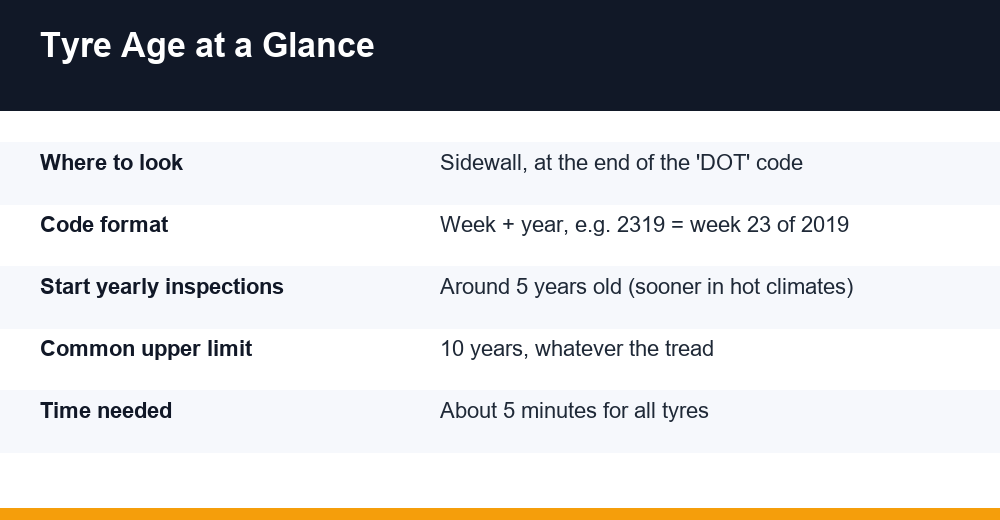
- Look at the sidewall close to the wheel rim for the letters DOT. They’re raised or pressed into the rubber, usually in small characters.
- Follow the string of letters and numbers to its end. The date is often set slightly apart, sometimes inside a small raised oval or box.
- If the string ends without a four-digit number, you’re looking at the short version of the code. US rules only require the full TIN, including the date, on one sidewall, and that side often faces inwards towards the car.
- For an inward-facing date, use a torch and your phone camera. Hold the phone low, take a photo of the inner sidewall, then zoom in on the screen.
- Wipe away road dirt first, and angle the torch from the side so faint characters stand out.
If the tyre date code isn’t visible from either side without crawling under the car, don’t crawl under it. Ask a tyre shop or garage to read it next time the car is on a ramp or lift. It only takes them seconds.
Step 2: Decode the Four Digits
The rule is simple. The first two digits are the week of manufacture (01 to 53) and the last two digits are the year. So 2319 means week 23 of 2019, which falls around early June that year.
The US road safety regulator, the National Highway Traffic Safety Administration, explains tyre labelling and wider tyre safety advice on its official site. The four-digit date format has been used since 2000. From 2015 the factory part of the code began moving from two characters to three, but the date is still the final four digits.
| Code on sidewall | Week | Year | Roughly when made | Age in October 2026 |
|---|---|---|---|---|
| 0525 | 5 | 2025 | Late January / early February 2025 | About 1 year 8 months |
| 4722 | 47 | 2022 | Late November 2022 | Nearly 4 years |
| 2319 | 23 | 2019 | Early June 2019 | About 7 years 4 months |
| 1016 | 10 | 2016 | Early March 2016 | Over 10 years |
| 128 (three digits) | 12 | A year ending in 8, before 2000 | Late March, 1990s or earlier | About 28 years or more |
Three digits instead of four
Tyres made before 2000 used a three-digit date: two digits for the week and one for the year. Tyres from the 1990s often added a small triangle after the code to tell them apart from 1980s tyres. If you find a three-digit date on any wheel, including a spare or a classic car, that tyre is well beyond any sensible service life and should be replaced.
Retreads and part-worn tyres
Retreaded tyres can carry two dates: the original casing date and a separate retread date, so ask to see both. Part-worn (used) tyres keep their original date, and a cheap one may be older than the car it’s going on.
Step 3: Work Out the Age and What It Means
Compare the week and year with today’s date and you have the age. What that means depends on the tyre’s condition, your climate and your vehicle maker’s advice.
There is no single worldwide expiry date for tyres. Common guidance from tyre and vehicle makers runs along these lines: have tyres inspected at least once a year from around five years old, consider replacement from about six years (some car makers give this figure in the handbook), and treat ten years as the upper limit even if the tread looks fine. Your owner’s manual always takes priority.
| Tyre age | What it usually means | Sensible action |
|---|---|---|
| Under 2 years | Fresh rubber | Normal monthly checks of pressure and tread |
| 2 to 5 years | Mid-life for most drivers | Keep up monthly checks; look for cuts and cracks |
| 5 to 6 years | Age starts to matter | Professional inspection every year |
| 6 to 10 years | Some car makers suggest replacing | Plan replacement, sooner in hot climates or if cracking appears |
| Over 10 years | Past most makers’ upper limit | Replace, spare included |
Age is only half of the check; the other half is wear. Pair the date with a proper tread depth check. In the UK and across the EU, the legal minimum for cars is 1.6 mm across the central three-quarters of the tread, and many US states use 2/32 inch (also about 1.6 mm). Wet grip drops noticeably well before that, so many owners replace at around 3 mm (roughly 4/32 inch).
Signs that age is catching up
- Fine cracks in the sidewall or in the grooves between tread blocks, often called weather cracking.
- A bulge or bubble on the sidewall, which means internal damage. Don’t drive on it; fit the spare if it’s safe to do so, or call for roadside help, and have a tyre professional look at it straight away.
- A tyre that keeps losing pressure with no obvious puncture.
- New vibration or a wobble through the steering wheel at speed.
Legal rules on tyre age differ by country. Most places, including the UK, don’t set an age limit for private cars. Since February 2021, though, the UK has banned tyres aged ten years or more from the front axles of lorries, buses and coaches, and from the rear axle of minibuses with single rear wheels. Gulf states following GSO standards generally don’t allow tyres more than two years old to be sold as new. Check your local rules or ask your testing station.
Step 4: Spot ‘New’ Tyres That Are Already Old
‘New’ simply means unused. Major tyre makers say a correctly stored, unused tyre can be sold as new for up to five years from production, unless local rules say otherwise. Stored well, that isn’t dangerous, but you’re buying fewer years of useful life.
The risk rises where stock is kept in a hot, sunny unit or a metal container, which is common in warm countries. Two years in a shed at 45°C (113°F) is not the same as two years in a cool, dark warehouse.
- Ask before you pay. A simple ‘What are the date codes on these?’ is a fair question. Many owners ask for tyres made within roughly the last year, and a good fitter will happily check.
- Look before they’re fitted. Ask to see the tyres while they’re still off the car. Once mounted, the date may end up on the inner side.
- Check they match. A set of four can come from different batches. A few months apart is normal; several years apart is worth querying.
- Be wary of unusually cheap deals. Clearance prices sometimes reflect old stock, especially online. Ask for the date in writing.
- Check again before you drive off. Read the codes in the car park. If they’re far older than agreed, raise it there and then.
Reading the tyre date code at the counter isn’t rude or awkward; it simply makes sure you get what you’re paying for.
The same check matters when buying a used car: read all four tyres plus the spare. A low-mileage car can look perfect yet run on rubber that’s eight or nine years old.
Why Heat and Sun Age Tyres Faster in Hot Countries
Rubber ages mainly through oxidation, a chemical reaction with oxygen in the air. Like most chemical reactions, it speeds up as temperature rises. A rough rule of thumb in chemistry is that reaction rates can double with every 10°C (18°F) increase, so a tyre living in the Gulf, northern Australia or much of India is under far more stress than one in Scotland.
Road surfaces add to the load. On a 40°C (104°F) day, dark tarmac in direct sun can exceed 60°C (140°F), and the tyre heats up further as it flexes on the move. NHTSA research into tyre ageing found a link between tyre age and failures in warmer states such as Arizona, Florida, Texas and southern California, so hot-climate drivers should pay closer attention to the date.
Ultraviolet light attacks the outer surface of the rubber, while ozone in the air causes the fine surface cracks you often see on sidewalls. Cars parked outdoors all day, every day, get a double dose.
| Situation | Why it ages tyres | Practical step |
|---|---|---|
| Hot, dry climate (Middle East, inland Australia, northern India, US South-West) | High heat speeds up oxidation; strong UV | Consider yearly professional inspections from about 3 to 4 years old |
| Hot, humid climate (South-East Asia, coastal India) | Constant heat plus heavy sun | Same as above; check for sidewall cracking at every wash |
| Temperate climate (UK, northern Europe) | Slower ageing, but it still happens | Follow standard age guidance |
| Car parked outside in strong sun | Daily UV and heat soak | Use shade or covered parking where possible |
How to slow the ageing down
- Keep pressures correct. Under-inflated tyres flex more and run hotter. Check them cold, before a drive, using the figures on the door-jamb sticker or in the handbook. Typical car pressures fall around 30 to 36 PSI (about 2.1 to 2.5 bar), but always use your vehicle’s own figures.
- Park in shade or under cover when you can, especially through the hottest months.
- Don’t overload the car; extra weight means extra heat.
- Clean tyres with water and mild soap. Skip harsh, solvent-based tyre dressings, which can dry the rubber.
For a fuller seasonal routine covering batteries, coolant and cabin heat as well as tyres, see our guide to looking after your car in hot weather.
Storage counts too. If a car is laid up for months, its tyres can develop flat spots and age faster in a hot garage. Our advice on storing a car long term covers pressures, positioning and keeping the rubber out of direct sun. Spare or seasonal tyres should be kept clean, cool, dry and dark, away from electric motors and other sources of ozone.
When to Replace Old Tyres, and Who to Ask
The right moment to replace a tyre comes from five things together: its age, its tread depth, its visible condition, your climate and your vehicle manufacturer’s advice.
Replace without delay if
- The tyre is more than ten years old, whatever the tread looks like.
- It shows a three-digit, pre-2000 date.
- There’s a bulge, a deep cut, or cracks that reach into the rubber rather than just marking the surface.
- The tread has reached the legal minimum where you live.
Low-mileage cars deserve special attention. If you drive around 3,000 miles (about 4,800 km) a year, your tyres will reach their age limit long before the tread wears out. Classic cars, campervans, caravans and trailers are the most common examples, because they spend long spells parked.
Space-saver spares are often forgotten. They’re usually limited to 50 mph (80 km/h), need a much higher pressure than a normal tyre (typically around 60 PSI, or about 4.1 bar; check the handbook), and an aged one copes even less well. Check the spare’s date along with the others.
Reading a tyre date code and spotting cracks are easy owner checks. Anything beyond that, such as judging internal damage, repairing a puncture, fitting, balancing or resetting tyre pressure sensors, is a job for a qualified tyre technician or mechanic. Tyres are a safety-critical part, and a proper inspection on a lift costs little compared with the risk.
A final, balanced point: a six-year-old tyre with good tread, no cracking and a life spent in a cool climate doesn’t have to be thrown away the day it turns six. Get it inspected, keep an eye on it, and follow your manual. In hot countries, or with any sign of ageing, it’s sensible to replace sooner rather than later.
Frequently Asked Questions
Where is the tyre date code if I can’t find it?
It’s the last four digits of the DOT string on the sidewall. If the outer side shows a shorter code with no date, the full version is on the inner side. Photograph it with your phone, or ask a garage to read it when the car is on a lift. Never crawl under a car to look.
How old is too old for a car tyre?
There’s no single legal limit for private cars in most countries. Common guidance is yearly inspections from around five years, replacement from about six years if your vehicle maker advises it, and ten years as the upper limit regardless of tread. Hot climates may justify replacing sooner. Always follow your owner’s manual.
Is it OK to buy ‘new’ tyres that are two years old?
Usually yes, if they’ve been stored somewhere cool, dry and dark, though you lose some useful life. It’s fair to ask the shop for recent stock, often under a year old, and to check the dates before fitting. Avoid tyres stored in hot, sunny units or showing any surface cracking.
Does a tyre age if it’s never been used?
Yes. Rubber oxidises from the day it’s made, whether it’s on a car or in storage. Good storage slows the process but doesn’t stop it. An unused spare or a tyre kept in a garage for years still needs its date and condition checked before it goes on the road.