
Getting the correct tyre pressure is one of the cheapest safety checks you can do, yet plenty of drivers guess, or copy the big number moulded into the tyre itself. This guide sets out six practical rules, from reading your door sticker and converting PSI to bar, to coping with frosty mornings and 40°C (104°F) afternoons. Whether you call them tyres or tires, the physics is the same on every road.
Table of Contents
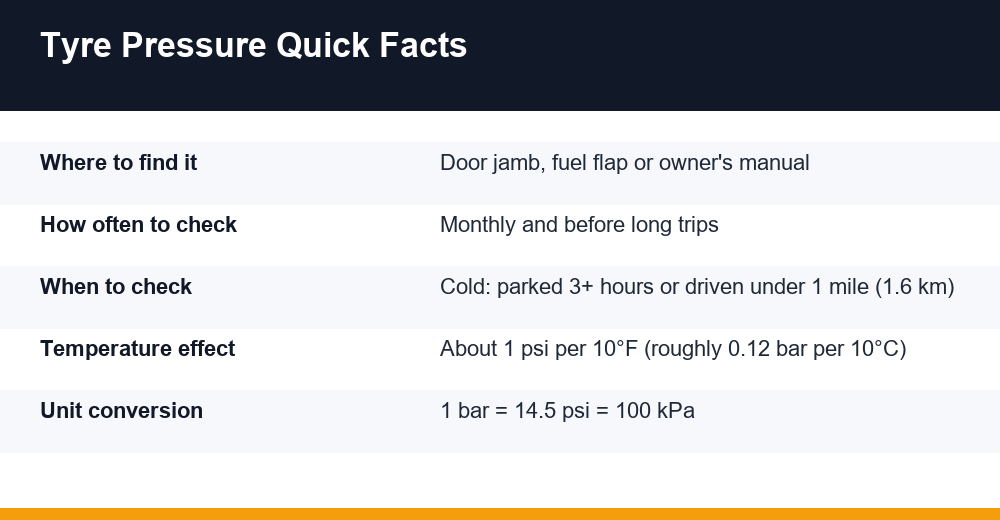
Rule 1: Find the Correct Tyre Pressure on the Placard, Not the Sidewall
Every car has a manufacturer-recommended inflation figure, worked out for that model’s weight, suspension and handling. It is printed on the tyre placard (a sticker or small plate) and repeated in the owner’s manual. This is the number to set, and it is always given as a cold figure, which we explain in Rule 3.
Common places to find it:
- The driver’s door jamb, or the edge of the driver’s door. This is the most common spot, and in the US the tyre and loading information label is required to be on the driver’s side door edge or door pillar, or nearby.
- Inside the fuel filler flap, which is popular on many European and Asian models.
- The glovebox lid or under the bonnet (hood) on some older cars.
- The owner’s manual, which often has a fuller table covering different loads, speeds and tyre sizes.
What the sidewall number really means
On the tyre itself you’ll find small print along the lines of “Max. Press. 51 psi (350 kPa)”. That is the maximum pressure the tyre’s structure can safely hold when carrying its maximum load. It is a ceiling, not a target, and it has nothing to do with your particular car.
Pumping tyres up to the sidewall figure makes the ride harsh and the car skittish over bumps. It also shrinks the patch of rubber touching the road, which can lengthen braking distances in the wet, and wears out the centre of the tread early.
As a rough guide, placard figures for ordinary passenger cars typically fall around 30–36 psi (about 2.1–2.5 bar), while sidewall maximums are often 44–51 psi (about 3.0–3.5 bar). If the number you’re about to use is close to the sidewall maximum, stop and double-check the placard.
Light load versus full load
Many placards list two sets of figures: one for everyday driving with a couple of people on board, and a higher one for a fully loaded car, towing or sustained high speed. Front and rear pressures can also differ. Use the higher set when the car is packed for a family trip, then drop back afterwards.
Running a different wheel or tyre size from standard? The placard may no longer apply exactly, so ask a tyre specialist to confirm the right figure.
Rule 2: Convert PSI, Bar and kPa Without Guessing
Tyre pressure is measured in three common units. Drivers in the US and UK still tend to think in PSI (pounds per square inch). Much of Europe, India and the Middle East uses bar, and Australia, Canada and many placards show kPa (kilopascals). Air machines at fuel stations may display any of them, sometimes with a button to switch.
The key relationships are simple: 1 bar = 14.5 psi = 100 kPa, and 1 psi is roughly 0.069 bar or 6.9 kPa. Rounding bar to one decimal place is fine for everyday use, since most home and forecourt gauges aren’t more precise than that anyway.
| PSI | Bar (approx.) | kPa (approx.) | Where you might typically see it |
|---|---|---|---|
| 26 | 1.8 | 179 | Rear axle of some small city cars |
| 28 | 1.9 | 193 | Small hatchbacks |
| 30 | 2.1 | 207 | Many small and mid-size cars |
| 32 | 2.2 | 221 | A very common family-car figure |
| 33 | 2.3 | 228 | Many saloons (sedans) |
| 35 | 2.4 | 241 | Larger cars and SUVs |
| 36 | 2.5 | 248 | SUVs and full-load settings |
| 38 | 2.6 | 262 | Full-load or high-speed settings |
| 40 | 2.8 | 276 | Vans and heavy loads |
| 44 | 3.0 | 303 | Light commercial vehicles |
| 60 | 4.1 | 414 | Typical space-saver spare wheel |
These are examples only. Your own car’s figures come from its placard, never from a chart.
Watch for one easy trap. A placard might say 2.2 bar while the air machine is set to psi. Type “2.2” into a psi machine and you’ve almost emptied the tyre. Always check the unit shown on the display before you press start.
Rule 3: Check Cold, and Never Bleed Air From Hot Tyres
Manufacturers’ figures are cold pressures. A tyre counts as cold when the car has been parked for at least three hours, or has been driven less than about 1 mile (1.6 km). Shade matters as well: a tyre that has been sitting in strong sun can read higher than the one on the shady side of the car.
Driving flexes the rubber and warms the air inside, so pressures climb after a run. A rise of a few psi is typical, often somewhere around 2–4 psi (roughly 0.15–0.3 bar), and more after fast motorway or highway driving on a hot day. That increase is normal, and manufacturers allow for it when they set the cold figure.
The classic mistake is letting air out to bring a warm reading down to the placard number. Once the tyres cool, they end up underinflated. Your correct tyre pressure is always a cold-tyre number, so a warm reading that looks a bit high is usually exactly what you’d expect.
If you can only check after driving
- Never let air out of warm tyres to match the cold figure.
- If a warm tyre reads below the placard figure, it is genuinely low. Top it up to at least the placard figure, then recheck first thing the next morning, because a warm tyre set exactly to the cold value will read a little low once it cools.
- Compare the two tyres on the same axle. A big gap between left and right, at the same temperature, can point to a slow puncture.
- Use the same gauge each time if you can. Forecourt gauges vary in accuracy, and a small handheld gauge kept in the car gives more consistent readings.
Rule 4: Expect Pressure to Swing With the Thermometer
Air expands as it warms and contracts as it cools. A widely used rule of thumb is that tyre pressure changes by about 1 psi for every 10°F change in temperature. In metric terms, that is roughly 0.12 bar (about 1.8 psi) for every 10°C. It’s an approximation, because the exact change depends on the tyre and its starting pressure, but it’s close enough to plan by.
A car set up on a warm afternoon and checked at a frosty dawn can be several psi down without any leak at all. The table shows what typical swings look like.
| Situation | Temperature change | Approximate pressure change |
|---|---|---|
| Mild spring day: 5°C to 15°C (41°F to 59°F) | +10°C / +18°F | About +1.5–2 psi (+0.1 bar) |
| Autumn into winter: 20°C to 0°C (68°F to 32°F) | −20°C / −36°F | About −3.5 psi (−0.25 bar) |
| Heated garage to freezing street: 20°C to −10°C (68°F to 14°F) | −30°C / −54°F | About −5 psi (−0.35 bar) |
| Gulf summer: 28°C night to 45°C midday (82°F to 113°F) | +17°C / +31°F | About +3 psi (+0.2 bar) |
| Air-conditioned car park to hot street: 25°C to 40°C (77°F to 104°F) | +15°C / +27°F | About +2.5 psi (+0.15–0.2 bar) |
These are rough estimates for a typical car tyre set to around 32 psi (2.2 bar), not precise measurements. The lesson: when the season changes, the tyres usually haven’t sprung a leak; the weather has simply moved.
Rule 5: Adjust for Winter Cold and Tropical Heat
Winter and frosty mornings
As temperatures fall through autumn, tyres lose pressure steadily over a few weeks with no puncture involved. The first real cold snap is when many dashboards show a tyre warning, which often clears by the afternoon as things warm up. Don’t ignore it: the tyres really are low at morning temperatures.
- Check more often during the seasonal changeover; every couple of weeks is sensible.
- Measure in the conditions you’ll actually drive in. If the car sleeps in a heated garage but heads straight out into sub-zero air, some drivers add roughly 1 psi per 10°F (about 0.12 bar per 10°C) of difference to compensate. Never exceed the sidewall maximum, and check whether your owner’s manual or a tyre specialist advises otherwise.
- Don’t let air out in the belief that softer tyres grip better on snow or ice. Stick with the placard figure.
- Some manuals list slightly different pressures for winter tyres. If yours does, follow them.
Pressure is only one part of getting ready for the cold. Our winter car preparation checklist covers the battery, screenwash, wipers and the other jobs worth doing before the first frost.
Hot and tropical climates
In places such as India, the Gulf, northern Australia and Southeast Asia, the problem flips around. Tyres run hotter, and road surfaces can be far hotter than the air. It’s tempting to run lower pressures to “leave room for expansion”, but that is backwards. An underinflated tyre flexes more, builds more heat and is the one more likely to fail on a long, hot highway run.
- Check early in the morning, before the sun has heated the car and before you set off.
- Stick to the placard figure, and switch to the full-load setting for long trips with passengers and luggage.
- Never release air in the afternoon simply because the gauge reads high.
- Look over the sidewalls for bulges, cracks and cuts. Heat ages rubber faster, and potholes add to the strain.
- In monsoon or heavy-rain seasons, the right pressure combined with healthy tread helps the tyre clear water and resist aquaplaning.
Rule 6: Check Monthly and Don’t Rely on the Warning Light Alone
Tyres slowly lose air even when nothing is wrong, through the rubber and around the valve and rim. US road safety regulator NHTSA’s tyre safety guidance recommends checking all tyres, including the spare, at least once a month while they are cold, which is a good habit wherever you live. Add a check before any long journey too.
Many newer cars have a tyre pressure monitoring system (TPMS). It’s a useful safety net, but it isn’t a gauge. In the US, the warning is designed to come on when a tyre is around 25% below the recommended pressure. By then grip, braking, tyre wear and fuel economy have already taken a hit. The light tells you something has gone wrong; it doesn’t confirm that you’re running the correct tyre pressure.
If the warning comes on, slow down and check all four tyres as soon as it’s safe to stop. On many cars, a light that flashes for a minute or so and then stays on signals a fault in the system itself rather than low pressure. Our guide to what your dashboard warning lights mean explains the tyre symbol and its neighbours.
Why it’s worth the five minutes
- Safety: soft tyres overheat, take longer to stop and make steering feel vague.
- Tyre life: underinflation wears the outer shoulders; overinflation wears the centre.
- Fuel: US government fuel economy guidance suggests mileage falls by roughly 0.2–0.3% for every 1 psi drop in the average pressure of all four tyres. Small per psi, but it adds up over a year.
Legal rules vary by country
The law on tyres differs from place to place. In the UK, a tyre pressure monitoring system that is malfunctioning or obviously not working is an MOT failure on cars first used from 1 January 2012; a lamp simply showing low pressure is not, in itself, a fail. Separately, driving on tyres not properly inflated for their use can bring a fine of up to £2,500 and three penalty points per tyre.
The US and EU require TPMS on new cars, while roadworthiness checks elsewhere may focus on tread and damage rather than pressure. Check the rules where you drive.
How to Check and Set the Correct Tyre Pressure Step by Step
You don’t need special skills or tools beyond a reliable pressure gauge and access to an air pump, and the job takes about ten minutes.
- Park on level ground away from traffic, with the engine off and the handbrake (parking brake) on. Make sure the tyres are cold.
- Find the placard figure for your current load, note the unit (psi, bar or kPa), and check whether front and rear differ.
- Unscrew the valve cap and put it somewhere you won’t lose it.
- Press the gauge firmly and squarely onto the valve until the hissing stops, then read the pressure.
- Add air in short bursts, rechecking as you go. If you overshoot, press the small pin in the centre of the valve briefly to release a little air, then measure again.
- Repeat on all four tyres. Check the spare too if you have one; space-saver spares often need a much higher pressure, shown on the placard or the spare itself.
- Refit every valve cap. They keep dirt and moisture away from the valve.
- Reset the TPMS if your owner’s manual says it’s needed.
While you’re crouched by each wheel, take a moment to look at the tread as well. Our guide on how to check tyre tread depth walks through the simple methods. Legal minimum tread depths vary by country; it’s 1.6 mm (about 2/32 inch) for cars in the UK and across much of Europe, for instance.
When to hand it over to a professional
Checking and topping up pressure is a basic job anyone can do. Beyond that, let a qualified tyre specialist or mechanic take over if you notice any of the following:
- A tyre that keeps losing pressure, which suggests a slow puncture, a leaking valve or a rim seal problem.
- Bulges, deep cuts, cracks or visible cords on the tread or sidewall. Don’t drive further than you must on a tyre like this.
- The car pulling to one side, vibrating or steering oddly even at the right pressures. This can point to alignment, suspension or brake issues.
- Any puncture repair, which should be done by someone who can remove the tyre and inspect it from the inside.
- A TPMS warning that won’t clear after you’ve set the pressures correctly.
Always treat your owner’s manual as the final word for your car. Set the correct tyre pressure cold, keep an eye on the weather, and a few minutes a month will pay you back in safer handling, longer-lasting tyres and lower fuel bills.
Frequently Asked Questions
Should I inflate my tyres to the pressure printed on the sidewall?
No. The sidewall figure is the maximum the tyre can safely hold at its maximum load, not a target for your car. Use the cold pressure on your car’s placard, usually found on the driver’s door jamb or inside the fuel flap, or in the owner’s manual.
How much does tyre pressure drop in cold weather?
As a rule of thumb, pressure falls by about 1 psi for every 10°F drop, or roughly 0.12 bar for every 10°C. A shift from a mild autumn afternoon to a freezing morning can easily cost 3–5 psi (0.2–0.35 bar), enough to trigger a tyre warning light.
Can I check my tyres at a fuel station after driving there?
Yes, as long as you allow for warm readings. Never let air out of warm tyres to match the placard figure. If a tyre reads below the recommended pressure while warm, it is genuinely low: top it up, then recheck when the tyres are cold.
What is the correct tyre pressure for my car?
It’s whatever your car’s manufacturer specifies on the tyre placard or in the owner’s manual. For many passenger cars it typically falls around 30–36 psi (about 2.1–2.5 bar), but it varies by model, tyre size and load, so always check your own car’s figure.