
Following the correct tyre rotation pattern is one of the cheapest ways to make a set of tyres last longer, wear evenly and keep a car feeling predictable in the wet. The right sequence depends on which wheels drive your car and on the type of tyres fitted. This guide sets out each pattern in plain tables, explains how often to rotate, and shows how tyre wear can flag pressure or alignment trouble early.
Table of Contents
Why Rotating Your Tyres Is Worth the Bother
Each corner of a car does a different job. On a front-wheel-drive car, the front tyres steer, put the power down and handle most of the braking, so they usually wear noticeably faster than the rears. Rear-drive cars shift some of that work backwards. Left alone, the four tyres drift apart in tread depth and the balance of grip between the axles changes.
Tyre rotation (spelled “tire rotation” in the US) simply means moving each wheel and tyre to a different position at set intervals so all four wear at a similar rate. The benefits are practical rather than dramatic:
- Longer overall tyre life, because no single pair is worn out early.
- More consistent grip front to rear, which you notice most on wet roads.
- A regular chance to inspect every tyre closely and catch nails, bulges or odd wear early.
- The option to replace all four at once later, which matters on many all-wheel-drive cars.
One caveat: not every manufacturer calls for rotation. Some carmakers, particularly in Europe, say little or nothing about it. Your owner’s manual is the final word. If it lists a tyre rotation pattern and interval, follow it; if it says not to rotate, as is common with staggered sizes, don’t.
Choosing the Right Tyre Rotation Pattern for Your Drivetrain
Start by confirming which wheels drive your car. The owner’s manual will say, and the model’s specification sheet will confirm it. Then check that the tyres are non-directional and the same size all round, because the patterns below assume both. Directional and staggered set-ups have their own section further down.
Front-wheel drive (FWD): forward cross
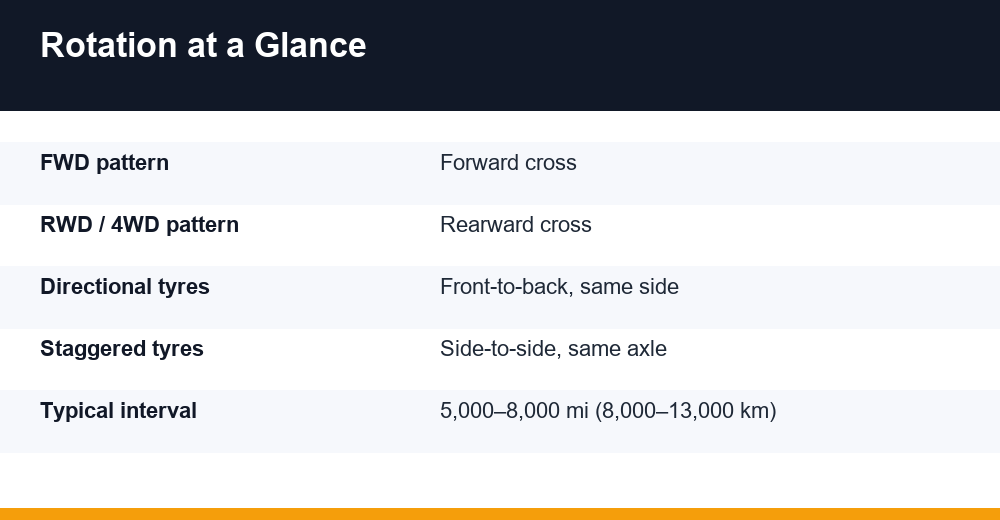
Most small and mid-size cars, from city hatchbacks to family saloons and many compact SUVs, are front-wheel drive. The harder-worked front tyres move straight back, while the rear tyres come forward and swap sides.
- Left front moves to left rear.
- Right front moves to right rear.
- Left rear moves to right front.
- Right rear moves to left front.
Rear-wheel drive (RWD) and part-time 4WD: rearward cross
This is the mirror image of the FWD pattern and suits many saloons, sports cars, pickups and traditional 4x4s. The driven rear tyres move straight forward, while the fronts go back and cross over.
- Left rear moves to left front.
- Right rear moves to right front.
- Left front moves to right rear.
- Right front moves to left rear.
All-wheel drive (AWD) and full-time 4WD
Many AWD cars use the rearward cross, although some manufacturers specify the X-pattern instead. What matters most on AWD is keeping all four tyres at a similar tread depth. Tyres with different rolling diameters make the centre differential or coupling work harder than intended, and some manuals set a strict limit on how far the depths may differ. That is why regular rotation is usually treated as essential, not optional, on these cars.
The X-pattern
Every tyre moves diagonally: left front to right rear, right front to left rear, left rear to right front and right rear to left front. It is an accepted alternative for FWD cars and is specified for some AWD models. Use it only with non-directional tyres.
| Drivetrain | Usual pattern | Front tyres go to | Rear tyres go to |
|---|---|---|---|
| Front-wheel drive | Forward cross | Rear, same side | Front, opposite side |
| Rear-wheel drive | Rearward cross | Rear, opposite side | Front, same side |
| AWD / full-time 4WD | Rearward cross or X-pattern (check manual) | Rear, opposite side | Front, same side (rearward cross) |
| Part-time 4WD | Rearward cross | Rear, opposite side | Front, same side |
| Any drivetrain (alternative) | X-pattern | Rear, opposite side | Front, opposite side |
If the tyre rotation pattern in your owner’s manual differs from this table, the manual wins. Manufacturers sometimes tailor the sequence to a particular suspension layout or factory tyre.
Including a full-size spare
If your car carries a full-size spare that matches the other four in make, model and size, it can join a five-tyre rotation, spreading wear over five tyres instead of four. Many manuals for 4x4s and pickups show the exact sequence. Never include a space-saver or temporary-use spare; those are meant for short emergency trips at reduced speed.
Directional, Asymmetric and Staggered Tyres
Tread design and wheel sizes can limit where a tyre is allowed to go, so read the sidewall before anything is moved.
| Tyre type | How to spot it | Allowed moves |
|---|---|---|
| Non-directional, same size | No arrow; same size on every corner | Any pattern for your drivetrain |
| Directional | Arrow and the word “Rotation” on the sidewall | Front to back on the same side only |
| Asymmetric | “Outside” and “Inside” marked on the sidewall | Standard patterns, as long as “Outside” faces out |
| Staggered, non-directional | Different sizes front and rear | Side to side on the same axle |
| Staggered, directional | Different sizes plus rotation arrows | None without remounting the tyres on the wheels |
Directional tyres
Directional tyres have a V-shaped or arrow-like tread designed to clear water in one rolling direction only. Moving one to the opposite side of the car would make it run backwards, which reduces wet grip and resistance to aquaplaning (hydroplaning).
The solution is a straight front-to-back swap on each side: left front with left rear, right front with right rear. If a side swap is genuinely needed, a tyre shop has to take the tyres off the wheels and refit them the other way round.
Staggered set-ups
Some performance and luxury cars run wider tyres at the rear than at the front. Because those tyres cannot swap axles, the options shrink to a left-right swap on each axle, and only for non-directional tyres. Cars with the same tyre size but different wheel offsets front to rear should be treated as staggered too.
On staggered cars, the rear tyres usually wear out first, so expect to replace them more often than the fronts rather than forcing an unsuitable swap.
How Often Should You Rotate Your Tyres?
The US National Highway Traffic Safety Administration suggests rotating every 5,000 to 8,000 miles (roughly 8,000 to 13,000 km) where the vehicle manufacturer recommends it, or sooner if uneven wear appears. You can read the full advice in NHTSA’s tyre safety guidance. Many owner’s manuals sit in the same range, and plenty of drivers simply rotate at every oil change.
| Situation | Typical interval (always check your manual) |
|---|---|
| Most FWD and RWD cars | 5,000–8,000 miles (8,000–13,000 km) |
| AWD, full-time 4WD and heavy EVs | Shorter end of the range, roughly 5,000–6,000 miles (8,000–10,000 km) |
| Towing, heavy loads, rough or unsealed roads | Shorter end of the range, with monthly visual checks |
| Low-mileage cars | At least once a year, mainly as an inspection opportunity |
| Visible uneven wear | Now, after finding and fixing the cause |
Electric cars deserve a special mention. Their extra weight and instant torque tend to wear the driven tyres faster, so many owners find the shorter interval suits them. Rotating wheels on an EV is ordinary wheel work, but anything involving the high-voltage system belongs with trained technicians.
Heat, potholes and gravel all speed up wear, so drivers in very hot climates or on rough roads may want to rotate sooner. To fit rotation into the rest of your servicing, our car maintenance schedule by mileage shows what to check at each interval.
What Uneven Wear Reveals About Pressure and Alignment
Rotation evens out normal wear, but it cannot cure abnormal wear. Moving a tyre that has a pressure or alignment problem simply spreads the damage to another corner. Before every rotation, look closely across the full width of all four tyres and run a hand lightly over the tread.
| What you see | Likely cause | What to do |
|---|---|---|
| Centre of the tread worn more than the edges | Over-inflation | Reset to the pressure on the vehicle placard |
| Both edges (shoulders) worn more than the centre | Under-inflation or overloading | Check pressures cold and respect load limits |
| One edge worn much more than the other | Camber misalignment or worn suspension parts | Have alignment and suspension checked by a qualified mechanic |
| Tread blocks smooth one way, sharp the other (feathering) | Toe misalignment | Book a wheel alignment |
| Cupped or scalloped dips around the tyre | Worn shock absorbers or struts, or wheel imbalance | Have suspension and balance inspected by a professional |
| Flat patch in one spot | Locked-wheel braking or long periods parked | Inspect, and seek advice if vibration persists |
Pressure problems are the easiest to fix yourself, and under-inflation is a leading cause of tyre failure. Check pressures when the tyres are cold, before driving, at least once a month. Typical passenger-car figures fall roughly between 30 and 36 PSI (about 2.1 to 2.5 bar), but the right number for your car is on the placard in the door jamb, fuel flap or manual, not the maximum moulded on the sidewall. Our correct tyre pressure guide explains how to read it.
Temperature matters as well. Pressure falls by roughly 1 PSI for every 10°F drop (about 0.07 bar for every 5–6°C), so a tyre set correctly on a mild afternoon can be low on a frosty morning, while desert heat pushes readings up during the day. Always compare cold readings.
Alignment and suspension faults are a different matter. Wear on one edge, feathering or cupping point to parts that affect steering and stability, so have a qualified mechanic or tyre specialist inspect the car rather than attempting adjustments yourself. A pull to one side, an off-centre steering wheel or vibration at speed all strengthen the case for a proper wheel alignment check.
Finally, measure what tread is left. A gauge or the wear bars moulded into the grooves will tell you, and our guide on how to check tyre tread depth walks through both methods. Legal minimums vary by country: 1.6 mm across the central three-quarters of the tread in the UK and EU, 1.5 mm in Australia and 2/32 in (about 1.6 mm) in most US states.
The legal limit is not a safe target. Wet stopping distances grow as tread wears, so many tyre makers suggest replacing tyres at around 3 mm (roughly 4/32 in). Check the rules where you live.
Getting the Rotation Done Safely
Because rotation means removing and refitting every wheel, most owners are best served by a tyre shop or a qualified mechanic. A shop has a lift, a calibrated torque wrench and a wheel balancer, and a trained eye can spot damage you might miss. Wheel fixings are safety-critical, so if you have any doubt about lifting the car or tightening the nuts correctly, leave the job to a professional.
A good professional rotation includes an inspection of each tyre for cuts, bulges and embedded objects, pressures set to the placard figures, wheel nuts tightened to the specified torque and a TPMS reset where needed.
If you have the right equipment and experience to do it at home, treat the job seriously:
- Work on firm, level ground with the parking brake on and wheel chocks in place.
- Lift only at the jacking points shown in the manual and support the car on rated axle stands. Never rely on a jack alone, and never put any part of your body under a car held up only by a jack.
- Loosen the wheel nuts slightly while the wheels are still on the ground, then raise the car.
- Chalk each wheel’s current position (LF, RF, LR, RR) on the inside of the tyre so you follow your tyre rotation pattern without mix-ups.
- Tighten the nuts in a criss-cross sequence and finish with a torque wrench set to the figure in your manual.
After any rotation: a quick checklist
- Reset the pressures. If your car uses different front and rear pressures, the tyres that moved need adjusting.
- Check the tyre pressure monitoring system (TPMS). Some systems need a relearn procedure so the dashboard shows the correct corner; your manual or the shop can handle it.
- Re-check wheel nut torque after the first 50–100 km (about 30–60 miles), especially on alloy wheels.
- Note the date and mileage so you know when the next rotation is due.
- Pay attention on the first drive. A new vibration may mean a wheel needs balancing.
If anything feels wrong afterwards, such as a shake, a pull or a warning light, stop somewhere safe and have a qualified mechanic check the car before driving further.
Common Rotation Mistakes to Avoid
Most rotation problems come from rushing or skipping a step. Watch out for these:
- Rotating instead of repairing. Moving tyres hides the signs of misalignment or worn suspension for a while, but the new positions soon start wearing the same way.
- Crossing directional tyres. If the arrows end up pointing backwards, wet grip suffers.
- Mixing tyres on AWD. Different brands, tread patterns or wear levels on an all-wheel-drive car can upset the drivetrain. Replace in sets where the manual says so.
- Putting two new tyres on the front. When only a pair is replaced, tyre industry guidance widely recommends fitting the newer tyres to the rear axle to help keep the back of the car stable on wet roads. Some vehicles have their own rules, so ask the fitter.
- Over-tightening with an impact gun. Hammering nuts on at full power can stretch studs and make wheels hard to remove at the roadside. Final tightening should always be done with a torque wrench.
- Leaving it too late. Rotation works best early. Once the fronts are far more worn than the rears, swapping them mostly moves the problem around.
- Ignoring the manual. Following a generic sequence from the internet when your handbook specifies something different is an easy mistake to avoid.
Rotation will not make a worn or damaged tyre safe. Done on time and in the right sequence, though, it helps all four tyres wear evenly and reach the end of their tread together.
Frequently Asked Questions
Does it matter which tyre rotation pattern I use?
Yes. The pattern is matched to which wheels drive the car and to the type of tyre fitted. Crossing directional tyres makes them roll backwards and reduces wet grip, while the wrong sequence on an AWD car can leave tread depths mismatched. Follow your owner’s manual first, then the drivetrain guidance above.
Do I need a wheel alignment every time I rotate my tyres?
No. Alignment is needed if you notice wear on one edge, feathering, a pull to one side or an off-centre steering wheel, or after a hard knock against a pothole or kerb. Many owners also have it checked when fitting new tyres, which is a sensible habit.
Can I rotate tyres on a car with different sizes front and rear?
Only side to side on the same axle, and only if the tyres are non-directional. Directional staggered tyres cannot be rotated unless a tyre shop removes them from the wheels and refits them. Many owners of staggered cars simply accept that the rear tyres will need replacing more often.
Will rotating my tyres affect the tyre warranty?
It can. Some tyre makers’ treadwear warranties require proof of regular rotation, so keep receipts or a simple log of dates and mileages. Terms differ between brands and countries, so read the warranty booklet that came with your tyres or ask the retailer who fitted them.