
A car maintenance schedule by mileage tells you what to service and when, but the right interval depends as much on how and where you drive as on the number on your odometer. This guide gives you one clear table in both miles and kilometres, split into normal and severe service, so you can pick the column that fits your roads, your climate and your habits. Your owner’s manual always has the final say; treat this as its plain-English companion.
Table of Contents
How to Read a Car Maintenance Schedule by Mileage
Every service plan runs on two clocks: distance and time. Manufacturers usually write intervals as whichever comes first, for example 10,000 miles (16,000 km) or 12 months. If you only cover 4,000 miles (6,400 km) a year, the calendar triggers your service long before the odometer does.
The figures here are typical ranges drawn from common manufacturer schedules, not promises for any single model. A petrol hatchback in Leeds and a diesel SUV in Dubai can need different things at the same mileage.
Before you plan anything, open your owner’s manual or the manufacturer’s online service booklet and note these details:
- The exact oil grade and specification (for example 0W-20 or 5W-30, plus any approval code the manual lists)
- Which items are marked inspect and which are marked replace
- Whether your engine has a timing belt or a timing chain
- How the manual defines severe or special operating conditions
- Any time limits for brake fluid, coolant and transmission fluid
Many modern cars also have a service indicator or oil-life monitor that adjusts the interval to how the engine is actually used. It is generally reliable, but it cannot see a slow oil leak, so keep checking the dipstick yourself.
We use the British spelling tyre throughout; US readers, it is the same as a tire.
Normal or Severe Service: Which Column Is Yours?
Most owner’s manuals print two schedules. The normal one assumes regular journeys on decent roads in a mild climate. The severe service schedule, sometimes called special or harsh operating conditions, assumes the engine works harder or never gets the chance to warm up properly.
Many drivers are surprised to learn that their everyday use fits the severe definition. Typical triggers include:
- Mostly short trips under about 5 miles (8 km), or under 10 miles (16 km) when it is below freezing, 0°C (32°F)
- Regular heat above roughly 35°C (95°F), common across the Gulf, much of India, inland Australia and the US Southwest
- Dusty, sandy or unsealed roads
- Heavy stop-start traffic or long periods of idling
- Towing, roof boxes, heavy loads or constant hill climbing
- Taxi, ride-hailing or delivery work
Short trips leave moisture and unburnt fuel in the oil. Heat ages oil, coolant, rubber and batteries faster. Dust clogs filters and can wear the engine. None of that shows on the odometer.
A practical rule: if two or more of those triggers describe your typical week, follow the severe column of your car maintenance schedule by mileage for oil, filters and inspections. Shorter oil intervals cost relatively little and protect the most expensive part of the car.
You do not have to halve every interval, though. Spark plugs and timing belts often keep the same figure; apply shorter numbers only where your manual lists them.
The Service Interval Table in Miles and Kilometres
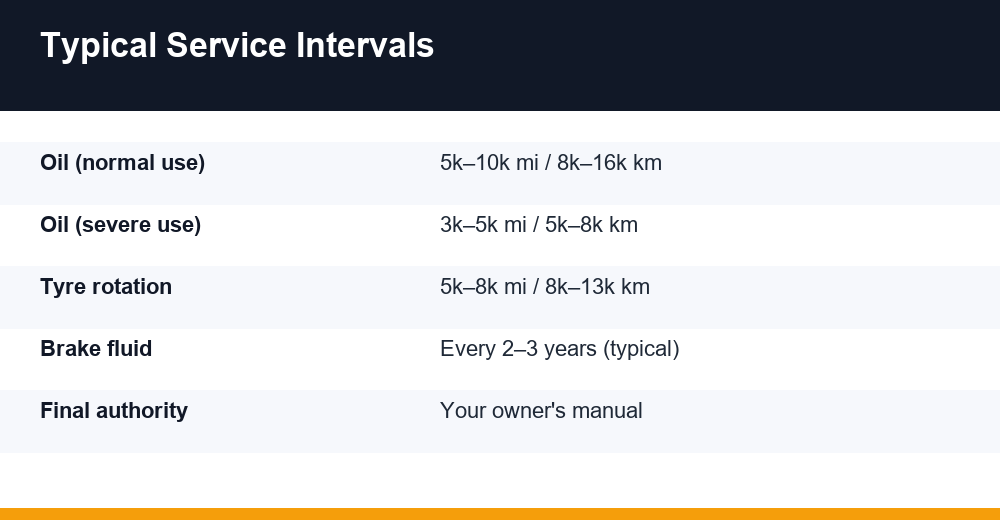
Use this table as a planning tool alongside your manual. Ranges are typical, not universal; where your manual gives a different figure, the manual wins. Kilometre conversions are rounded.
| Item | Normal service | Severe service (heat, dust, short trips) | Notes |
|---|---|---|---|
| Engine oil and filter | 5,000–10,000 mi (8,000–16,000 km) or 12 months | 3,000–5,000 mi (5,000–8,000 km) or 6 months | Some long-life schedules go further; always use the specified oil |
| Tyre rotation | Every 5,000–8,000 mi (8,000–13,000 km) | Same distance; check pressures more often | Not possible on some cars with different front and rear sizes |
| Engine air filter | 15,000–30,000 mi (24,000–48,000 km) | Inspect at every oil change; replace at 7,500–15,000 mi (12,000–24,000 km) | Dust and sand shorten its life sharply |
| Cabin (pollen) filter | 15,000–25,000 mi (24,000–40,000 km) or yearly | Every 6–12 months | Worth doing sooner in polluted cities |
| Brake pads and discs | Inspect every 10,000–12,000 mi (16,000–20,000 km) | Inspect every 5,000–6,000 mi (8,000–10,000 km) | Replace on wear, not on a fixed mileage |
| Brake fluid | Every 2–3 years, regardless of mileage | Every 2 years | Absorbs moisture over time, faster in humid climates |
| 12V battery | Test yearly from year 3 | Test yearly from year 2 | Often lasts 3–5 years; heat shortens that |
| Wiper blades | Every 6–12 months | Every 6 months in strong sun | UV and heat crack the rubber |
| Automatic or CVT fluid | 60,000–100,000 mi (96,000–160,000 km); some say lifetime | 30,000–50,000 mi (48,000–80,000 km) | Must match the exact fluid specification |
| Coolant | First change often at 5–10 years or 100,000–150,000 mi (160,000–240,000 km) | Check level and condition yearly | Never open the cap on a hot engine |
| Spark plugs (petrol) | Copper: 20,000–30,000 mi (32,000–48,000 km). Iridium or platinum: 60,000–120,000 mi (96,000–193,000 km) | Towards the lower end of the range | Diesels use glow plugs instead |
| Auxiliary drive belt | Inspect from 60,000 mi (96,000 km); replace around 60,000–100,000 mi (96,000–160,000 km) | Inspect yearly | Look for cracks, glazing or squeal |
| Timing belt (if fitted) | 60,000–105,000 mi (96,000–170,000 km) or 5–10 years | Follow any shorter figure in the manual | Many engines use a chain instead |
| Wheel alignment | Check yearly or after a hard pothole or kerb strike | Check more often on rough roads | Uneven tyre wear is the giveaway |
Oil is the item most people service most often, and the one surrounded by the most myths. Our synthetic oil change interval guide explains why modern oils can last longer and when they genuinely cannot.
Diesel owners should also look for fuel filter and water-separator intervals in the manual, and for any AdBlue (also sold as DEF) top-up guidance. These vary widely by engine, so we have not put a single figure on them.
What Usually Happens at Each Service Milestone
Grouping jobs into milestones keeps garage visits efficient and makes costs easier to predict. The familiar American 30-60-90 pattern lines up roughly with 50,000, 100,000 and 150,000 km in kilometre-based markets.
Every 5,000–10,000 miles (8,000–16,000 km)
- Oil and oil filter change
- Tyre rotation, pressure check and tread inspection
- Top up washer fluid and check other fluid levels
- Quick look at brakes, lights, wipers and the underside for leaks
Around 30,000 miles (48,000 km)
- Engine air filter and cabin filter (sooner in dust)
- Detailed brake inspection, plus brake fluid if it is due by time
- Battery and charging system test
- Inspection of steering, suspension, exhaust and the drive belt
Around 60,000 miles (96,000–100,000 km)
- Everything from the 30,000-mile visit
- Transmission fluid on many cars, particularly under severe use
- Spark plugs on engines using copper or older platinum types
- Coolant hoses, shock absorbers and wheel alignment checked
- Timing belt on some engines; check your manual
90,000–120,000 miles (145,000–193,000 km) and beyond
- Timing belt on most belt-driven engines, often with the water pump and tensioner
- Long-life iridium spark plugs
- First coolant change on many modern cars
- Engine mounts, suspension bushes and wheel bearings inspected
A well-kept car can comfortably pass 150,000 miles (240,000 km). That rarely comes down to one expensive service; it comes from sticking to your car maintenance schedule by mileage year after year without long gaps.
Prices for big milestone services vary hugely between countries and garages. Ask for an itemised quote in writing, compare it with your manual, and get a second quote for large jobs such as a timing belt.
Time, Climate and Low-Mileage Cars
Low mileage does not mean low maintenance. A car that covers 3,000 miles (5,000 km) a year still has oil that oxidises, brake fluid that absorbs water and tyres that age in the sun. That is why the time limits in your manual matter just as much as the distance.
- Change the oil at least once a year, even if the mileage is low
- Replace brake fluid every 2–3 years, or as the manual states
- Inspect older tyres for cracking; many manufacturers advise a professional check from around five years old and replacement at about ten years regardless of tread
- Find the tyre’s age from the four-digit date code on the sidewall (week, then year)
- Give the battery a proper drive or a smart charger if the car sits for weeks
Hot and dusty climates
Heat is hard on batteries, coolant and rubber. In the Gulf, northern India or the Australian interior, a battery may last only two or three years. Check the coolant level monthly and the air filter at every oil change.
Tyre pressure changes with temperature, by about 1 PSI for every 10°F (roughly 0.07 bar for every 5.5°C), and it also rises as tyres warm up on the road. Always check pressures cold, before driving, and set them to the figure on the door-jamb placard, not the maximum printed on the tyre. Many cars sit somewhere around 30–36 PSI (2.1–2.5 bar), but yours may differ.
Cold climates
Below freezing, short trips count as severe service. Make sure the antifreeze strength suits your winters, test the battery before the cold arrives, and rinse road salt from the underside regularly.
Humid, coastal and monsoon regions
Humidity speeds up moisture absorption in brake fluid, and salty air encourages rust. Never drive through deep floodwater. If water has entered the engine, do not try to start it; have it recovered and inspected by a qualified mechanic.
Hybrids, EVs and Turbo Engines: What Changes
A hybrid still has an engine that needs oil, filters and spark plugs. Because the engine often starts and stops in short bursts, it may never fully warm up, so many owners sensibly lean towards the severe oil interval. Some models also have a battery cooling-air filter that needs cleaning.
A fully electric car skips oil changes, spark plugs and timing belts altogether, but it is not maintenance-free:
- Tyres can wear faster because EVs are heavy and deliver instant torque, so rotate on schedule
- Regenerative braking means the friction brakes are used less, which can lead to corroded discs and sticking callipers; regular inspection matters
- Brake fluid still needs checking and changing on the time basis in the manual
- Cabin filter, wipers, suspension and the 12V battery still need attention
High-voltage parts on hybrids and EVs, usually marked by orange cables, can be lethal. Leave anything beyond basic checks to a technician trained in high-voltage systems.
Turbocharged petrol and diesel engines are fussier about oil. Use exactly the specification in the manual, avoid hard acceleration until the engine is warm, and consider the severe interval if you drive mostly in town. Modern diesels with a particulate filter (DPF) also need a regular longer run at steady speed; constant short hops can clog it.
What You Can Check Yourself and What Needs a Mechanic
Good maintenance is mostly noticing things early. A ten-minute routine once a month catches most problems before they get expensive. Our monthly car maintenance checklist has more detail; here is the core of it:
- Park on level ground with the engine cold and the handbrake on.
- Check the oil level on the dipstick (or the dashboard display, if your car has no dipstick) and top up with the correct oil only.
- Check the coolant level against the marks on the expansion tank. Never open the cap while the engine is hot.
- Top up the screen wash.
- Check tyre pressures cold, including the spare if you have one, against the door-jamb placard.
- Check tread depth. Legal minimums differ: 1.6 mm in the UK and EU, 1.5 mm in Australia, and 2/32 inch (about 1.6 mm) in most US states. Many safety organisations suggest replacing tyres at around 3 mm (4/32 inch) for better wet grip.
- Walk round the car to check lights, indicators and wipers, and note any warning lights on the dashboard.
Correct tyre pressures and a healthy engine also save fuel. The US Department of Energy’s advice on keeping your car in shape is a useful, non-commercial reference on that point.
Some jobs belong with a qualified mechanic, however handy you are:
- Brakes: pads, discs, callipers and brake fluid changes
- Steering and suspension components
- Tyre fitting, repairs and balancing, beyond basic pressure and tread checks
- Airbags or a lit airbag (SRS) warning light
- Any fuel smell, fuel leak or fuel system work
- Hybrid and EV high-voltage components
- Timing belts and anything inside the engine
- Any engine that has been in floodwater
And one firm safety rule: never get under a car supported only by a jack. If a job needs you underneath, it needs proper equipment, and often a professional.
Keeping Costs Honest: Records, Warranties and Upsells
Record every service: date, mileage, work done and parts or fluids used. A stamped book, digital record or folder of receipts proves the car has been cared for and helps at resale time.
If your car is under warranty, read the terms carefully. In many markets, including the US, UK and EU, rules generally allow you to use an independent garage without voiding the warranty, provided the work follows the manufacturer’s schedule and uses parts and fluids of the right specification. Rules differ by country, so check yours.
Remember too that a legal inspection is not the same as a service. Requirements differ by country and sometimes by state:
- UK: an annual MOT test once the car is three years old in Great Britain (four in Northern Ireland)
- India: a valid Pollution Under Control (PUC) certificate
- US: safety or emissions inspections that vary from state to state
- Australia: roadworthy or safety certificate rules that vary by state and territory
- Middle East: many countries link a technical test to annual registration renewal
Passing a roadworthiness test only shows the car met minimum standards on that day. Your car maintenance schedule by mileage is what keeps it reliable between tests.
Finally, watch for extras that are not in your manual. Engine flushes, fuel-system cleaning on a healthy engine, early fluid flushes and nitrogen tyre fills are common examples. Our guide to dealer service upsells you can safely refuse covers the most frequent ones. Three questions help in any garage:
- Where does this appear in my manufacturer’s schedule?
- What have you measured or seen that shows it is needed now?
- Can I have that in writing, with parts and labour listed separately?
Frequently Asked Questions
How often should I service my car if I barely drive it?
At least once a year, even at very low mileage. Oil degrades with time, brake fluid absorbs moisture and tyres age whether or not the car moves. Follow the time limits in your owner’s manual, and treat frequent short trips as severe service rather than easy use.
Is the severe service schedule just a way to sell more servicing?
No. Manufacturers publish it because short trips, heat, dust, heavy traffic and towing genuinely wear oil, filters and brakes faster. Plenty of everyday drivers qualify. Use it where it matches how you drive, but ask to see the item in your manual before paying for anything extra.
Do I really need an oil change every 3,000 miles (5,000 km)?
For most modern cars using the specified oil, no. Typical normal intervals are 5,000–10,000 miles (8,000–16,000 km) or 12 months, and severe use is often 3,000–5,000 miles (5,000–8,000 km). Older engines and some severe-use cases differ, so check your manual.
What if I miss a service by a few hundred miles?
A small overrun is rarely harmful; just book the service soon and record the actual mileage. Regularly stretching intervals is different, particularly for oil, timing belts and brake fluid, and it can complicate warranty claims. Getting back onto your car maintenance schedule by mileage quickly is what counts.