
Your synthetic oil change interval is almost certainly longer than the old windscreen sticker suggests, and probably shorter than the boldest claims on the bottle. Below are seven honest facts covering the myths, oil-life monitors, calendar limits and hot-climate driving, so you can book the right service at the right time without paying for work your car doesn’t need.
Table of Contents
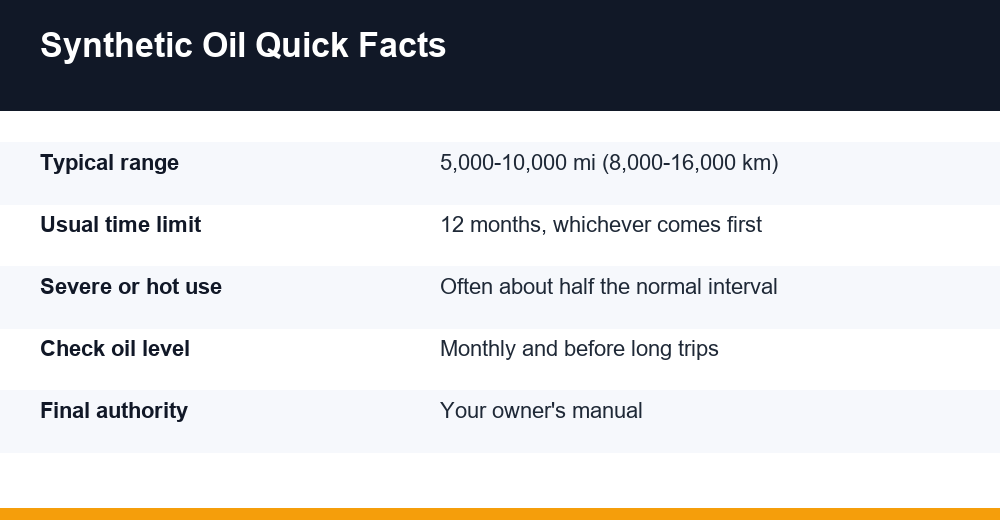
Fact 1: The 3,000-Mile Rule Is Out of Date
The idea that every car needs fresh oil every 3,000 miles (about 4,800 km) comes from an era of simpler mineral oils, looser engine tolerances and carburettors that washed unburnt fuel into the sump. For many engines built in the 1970s and early 1980s, it was sensible advice. For a typical modern car running synthetic oil, it rarely is.
The rule has survived mainly because it is easy to remember and because quick-lube reminder stickers keep repeating it. It is widespread enough that California’s state recycling agency, CalRecycle, ran a public campaign against the 3,000-mile myth, urging drivers to follow their owner’s manual instead.
Changing oil more often than needed won’t hurt the engine. It simply costs money and creates waste oil that has to be collected and recycled. If your handbook allows 10,000 miles (16,000 km) and you change at 3,000, you are paying for roughly three services where one would have done the job.
Why modern engines go further between changes
- Synthetic base oils resist oxidation, the heat-driven thickening and breakdown that once limited oil life, far better than older mineral oils.
- Fuel injection, better piston rings and tighter tolerances mean less fuel and combustion by-product ends up in the oil.
- Modern additive packages keep soot and sludge suspended for longer, so the filter can trap them rather than letting them settle.
- Many cars now calculate oil life from real driving data instead of relying on a single guess for every owner.
None of this means oil lasts forever. It means the right interval for your car is a specific number from its maker, not a one-size-fits-all figure from the 1980s.
Fact 2: 15,000-Mile Claims Come With Fine Print
At the opposite extreme, some bottles and service plans talk about 15,000 miles (around 24,000 km) or more between changes. Those figures aren’t made up, but they rest on conditions that are easy to overlook in the advert.
- The engine was designed and approved by its maker for extended drains, usually with one particular oil specification.
- Most driving is genuinely ‘normal’: longer journeys, moderate temperatures, no towing and little idling.
- The oil level is checked and topped up between services, because some engines use a little oil as they age.
- A time limit still applies, typically 12 or 24 months, whichever comes first.
Some European manufacturers, Volkswagen among them, offer variable or long-life service schedules that can stretch to roughly two years or 30,000 km (about 18,600 miles) in ideal conditions, but only with a specific approved oil. Switch the same car to a fixed schedule for harder use and it may need fresh oil every 15,000 km (around 9,300 miles) or 12 months. What makes the difference is the engine and its approved oil, not simply the word ‘synthetic’.
A bottle claiming protection for 15,000 miles is not the same as your engine maker approving 15,000 miles. Where the oil company’s marketing and your handbook disagree, follow the handbook. It is also what a warranty assessor will look at if something goes wrong.
It helps to know that ‘full synthetic’ is a broad label, and oils sold under it can use different base stocks. What really counts is whether the oil meets the specification printed in your manual, such as an API, ILSAC or ACEA rating or a manufacturer approval code, along with the correct viscosity (for example 0W-20 or 5W-30).
Fact 3: Your Manual Sets the Synthetic Oil Change Interval
The most reliable source for your synthetic oil change interval is the owner’s manual or service booklet for your exact car, engine and market. The same model can carry different schedules in the UK, India, the US, Australia or the Gulf, because fuel quality, climate and typical use differ from one country to the next.
Most manuals list two schedules: a normal one and a severe service one (sometimes called ‘special operating conditions’). Plenty of owners assume they are normal drivers without reading the severe list. Read it honestly, because a surprising number of everyday commutes fit it.
| Factor | Usually counts as normal | Often counts as severe |
|---|---|---|
| Trip length | Regular journeys over about 10 miles (16 km) | Mostly trips under 5 miles (8 km); engine rarely fully warm |
| Traffic | Flowing roads, motorways and highways | Heavy stop-start traffic and long periods of idling |
| Temperature | Moderate climate most of the year | Prolonged extreme heat or freezing winters |
| Road surface | Sealed, reasonably clean roads | Dusty, sandy, gravel or unsealed roads |
| Load | Normal passengers and luggage | Towing, roof boxes, heavy loads, steep hilly routes |
| Type of use | Private, everyday driving | Taxi, ride-hailing, delivery or other commercial work |
This table is a general guide; the exact definitions vary between manufacturers. Severe schedules commonly cut the normal interval roughly in half, but check the figure for your own car rather than assuming.
Lost the handbook? Most manufacturers publish manuals on their official website or owner app, and a franchised dealer can usually print the service schedule for your vehicle identification number (VIN). Make sure you are reading the version for your country, as export markets sometimes get shorter intervals.
Fact 4: Oil-Life Monitors Beat Stickers
Many cars built over the past two decades have an oil-life monitor: a percentage figure on the dashboard, or a ‘service due in X miles’ message. Most don’t analyse the oil itself. Instead, they run an algorithm using engine revolutions, operating temperature, trip length, cold starts and idling time to estimate how hard the oil has been worked.
That makes them far more useful than a fixed reminder sticker. A car doing long, steady motorway runs might be allowed 10,000 miles (16,000 km) or more, while an identical car used for short school runs in winter could be asked for a change much sooner. A few newer systems add oil-quality or oil-level sensors, but the principle is the same: the car tracks how it is actually used.
How to use an oil-life monitor sensibly
- Follow its reminder rather than an arbitrary mileage, because it is calibrated by the manufacturer for your engine.
- Book the change when it reads around 15-20% rather than waiting for 0%, so you have time to find a convenient slot.
- Respect the time limit. Many monitors will call for a service at about 12 months even if the percentage still looks healthy.
- Make sure the monitor is reset after every oil change. If it isn’t, the countdown for the following year will be wrong.
- Keep checking the actual oil level. The monitor estimates oil condition, not how much oil is in the engine.
If a garage forgets to reset the reminder, ask them to do it, or follow the reset steps in your handbook. On most cars it takes a minute through the dashboard menu or a simple key-and-pedal sequence.
One honest caveat: a monitor can only work with the information it has. If the car regularly sits in fine desert dust, or has had the wrong grade of oil put in, it cannot know that. In those cases, use the severe schedule in your manual as a backstop.
Fact 5: Low-Mileage Cars Still Need Regular Changes
Oil ages even when the car isn’t moving much. Condensation, traces of fuel from cold starts and the gradual breakdown of additives all take their toll over time. That is why almost every manual pairs a mileage figure with a time limit, using the words ‘whichever comes first’.
This matters most for low-mileage drivers: city flat owners, retirees, second cars, or anyone now working from home. Covering 3,000 miles (about 4,800 km) a year does not mean your oil is good for three years. Short trips are actually tough on oil, because the engine rarely gets hot enough to drive off moisture and fuel residue.
- Typical time limit: 12 months, occasionally 24 months on approved long-life schedules. Check yours.
- If the car mostly does short, cold journeys, look at the severe schedule’s time limit, which can be as short as six months.
- Laying up a car for several months? Some manuals recommend changing the oil before storage so old, contaminated oil isn’t left sitting in the engine.
- Hybrids deserve a mention: the petrol engine may run less, but frequent stop-start cycles mean it may seldom warm up fully. Stick to the time limit.
- Fully electric cars have no engine oil, though many use a small amount of gear oil in the drive unit and still need other servicing. Anything involving high-voltage components is strictly a job for a qualified technician.
A useful rule of thumb: if your yearly mileage is well under half the handbook figure, the calendar rather than the odometer will set your synthetic oil change interval. Put a reminder in your phone for the month the last service was done.
Low-mileage owners often worry they are wasting money with a yearly change on oil that has barely been used. In practice, one service a year is a modest cost compared with the engine wear that can come from oil that has sat full of moisture and fuel for two or three years.
Fact 6: Heat, Dust and Traffic Justify Shorter Intervals
High temperature is the biggest threat to oil. Hotter oil oxidises faster, which thickens it and uses up its protective additives more quickly. Synthetics handle heat much better than older mineral oils, which is one reason they are standard in many warmer markets, but they are not immune.
Picture regular summer driving in temperatures above roughly 40°C (104°F), as in the Gulf, northern India, inland Australia or the US Southwest, crawling through traffic with the air conditioning on full. That engine is working much harder than one cruising a mild British A-road. Add fine dust or sand, and the air filter and oil both have more grit to cope with.
This is where a shorter synthetic oil change interval makes sense. Many manuals place this kind of driving under severe service, and following that schedule costs far less than repairing heat-related engine wear.
| Driving pattern | Typical synthetic interval* | Typical time limit* |
|---|---|---|
| Mild climate, mixed or motorway driving | 7,500-10,000 miles (12,000-16,000 km) or as the monitor indicates | 12 months |
| Approved long-life engine, ideal conditions | Up to about 15,000-18,600 miles (24,000-30,000 km) | Up to 24 months |
| Hot climate (often 40°C / 104°F or more) with heavy traffic | 5,000-7,500 miles (8,000-12,000 km) | 6-12 months |
| Dusty, sandy or unsealed roads | 5,000-7,500 miles (8,000-12,000 km) | 6-12 months |
| Short trips, cold starts, low annual mileage | Time limit usually comes first | 6-12 months |
| Towing, taxi, ride-hailing or delivery work | Severe schedule in your manual | Often 6 months |
*Typical ranges drawn from common manufacturer schedules, not fixed rules. Your owner’s manual and oil-life monitor always take priority.
Shorter doesn’t mean going back to 3,000 miles. A modern car following its severe schedule in Dubai, Delhi or Phoenix traffic is generally well protected. And if your warm-weather driving is mostly open highway at steady speeds, the normal schedule may still be the right one.
Heat affects far more than oil. Coolant, batteries and tyres all work harder in summer, so our guide to car care in hot weather covers what to check before the next heatwave.
Fact 7: A Few Checks Before You Book Save Money
Once you know which interval applies, a few simple habits make the service smoother, keep your engine safe between visits and help you avoid paying for work you don’t need.
Easy checks between services
- Check the oil level about once a month and before long trips. Park on level ground, switch off, wait a few minutes (or as your manual advises), then read the dipstick or on-screen gauge. Top up with the specified grade if it’s near the minimum mark, without overfilling.
- Look at the ground where you usually park for fresh drips or dark spots.
- Take warning lights seriously. A red oil-pressure light means pull over safely and switch the engine off straight away, as low oil pressure can wreck an engine very quickly. Check the level once the engine has rested. If it looks fine, or the light comes back after a top-up, don’t drive on: have the car checked or recovered by a qualified mechanic.
- While you’re at it, check tyre pressures (tire pressures, in American manuals) with the tyres cold against the placard on the door frame or fuel flap. Many cars specify roughly 30-36 PSI (about 2.1-2.5 bar), but always use your car’s own figure.
Keep proper records
Keep receipts or digital records showing the date, mileage, oil grade and specification used. Many manufacturers ask for proof that servicing followed their schedule with approved oil before honouring an engine warranty claim. The rules on who may service a car under warranty, and what counts as proof, differ by country, so check your local consumer law and warranty booklet.
At the service desk
An oil change is a popular moment for add-ons. Some are genuinely due, such as an air filter at the interval in your schedule. Others, like engine flushes or fuel-system treatments on a healthy car, are rarely needed. Our list of dealer service upsells you can usually refuse explains which extras deserve a polite ‘no, thanks’.
To see where oil changes fit alongside brake fluid, coolant, spark plugs and timing belts, use our car maintenance schedule by mileage, then note your synthetic oil change interval alongside everything else so nothing slips.
One important exception: if your car has been through floodwater, or the oil looks milky, smells strongly of fuel or the level keeps rising, don’t just book a routine oil change. These signs can point to water, coolant or fuel contamination and need diagnosis by a qualified mechanic. The same goes for anything involving brakes, steering or the fuel system that you notice while doing your checks.
Frequently Asked Questions
Is it bad to change synthetic oil too early?
No, it won’t harm the engine, but it wastes money and creates extra waste oil. If your manual or oil-life monitor allows 10,000 miles (16,000 km) and you change at 3,000, you’re paying for extra services with no real benefit. The exception is severe use, where your manual may call for earlier changes.
Can I skip the yearly oil change if I hardly drive?
Usually not. Most manuals set a time limit of around 12 months, whichever comes first, and some severe schedules say six. Short, cold trips leave moisture and fuel in the oil, so a car that rarely moves can actually be harder on its oil than one doing long journeys.
Does a hot climate mean I should change synthetic oil sooner?
Often, yes, when heat combines with heavy traffic, idling, dust or towing. Many manuals class those conditions as severe service, typically around 5,000-7,500 miles (8,000-12,000 km) or 6-12 months. Steady highway driving in warm weather may still count as normal, so check your manual’s definitions.
Should I switch from conventional to synthetic oil?
Only if the synthetic oil meets the specification and viscosity listed in your manual. Many modern engines already require it. Switching can improve protection in heat and cold, but it does not by itself let you extend intervals beyond what your manufacturer approves for your engine.