
Windscreen wipers are the only safety component on a car that degrades slowly enough for the driver to adapt without noticing. Brakes announce themselves. A failing bulb is obvious. Wipers simply get a little worse each month, and because vision deteriorates at the same pace as the blades, most people are driving on rubber that should have been replaced a year ago and have no idea. They are also among the cheapest parts on the car and among the easiest to change without tools. These seven signs are the ones to check for, and one of them is frequently not the wipers at all.
Table of Contents
Why worn windscreen wipers are so easy to ignore
Rubber hardens with ultraviolet light, heat and ozone whether the wipers are used or not. A car parked outside all summer degrades its blades without a single wipe, which is why cars in dry climates often need them as frequently as cars in wet ones.
The deterioration is continuous, so there is no moment where performance obviously drops. Drivers compensate by leaning forward, peering through the clear patch and running the wipers more often, and none of that registers as a decision.
The test that resets your judgement
Fit new blades and drive in rain the same week. Almost everyone is surprised, because the comparison is the only reliable way to notice what had been lost. If it has been more than a year, assume they are worse than they feel.
The seven signs
Any one of these means the blades are due. Several together means they were due some time ago.
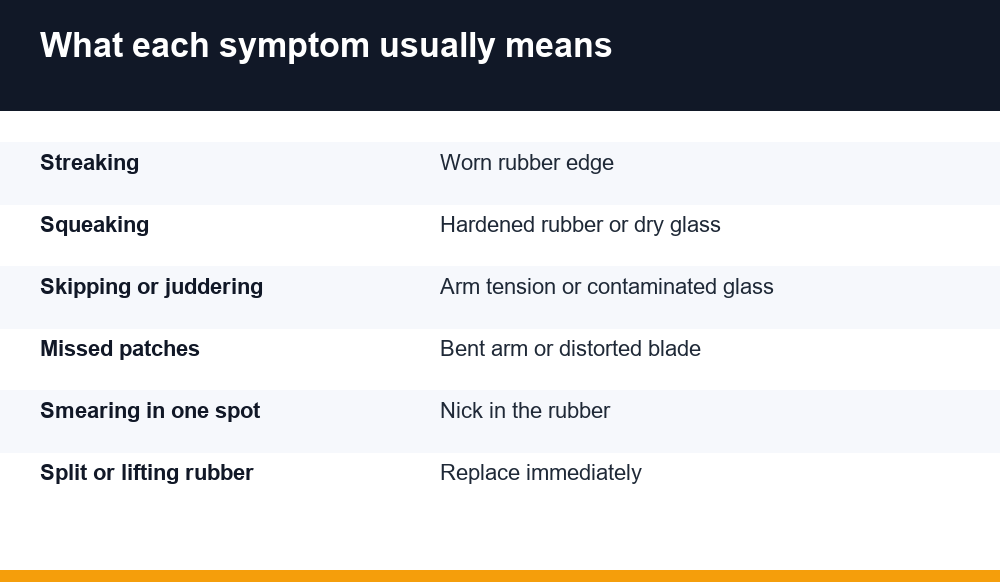
- Streaking. Lines of water left behind on each pass. The wiping edge has worn round.
- Squeaking or chattering. Hardened rubber dragging rather than gliding.
- Skipping. The blade juddering across the glass instead of moving smoothly.
- Missed patches. Areas the blade never contacts, usually from a bent arm or a distorted frame.
- Smearing in one position. A nick in the rubber, often from ice or a stone.
- Visible damage. Splitting, cracking or rubber lifting away from the frame.
- Noise on a dry screen. Normal; it only counts when the glass is wet.
That last one is included because it causes unnecessary replacements. Running wipers on a dry windscreen will squeal on any blade, including a new one, and tells you nothing about condition.
When the glass is the real problem
New blades that streak immediately are the clearest indication that the windscreen rather than the wiper was at fault, and it is a more common situation than people expect.
Glass accumulates a film of traffic grime, exhaust residue, tree sap and remnants of whatever was last sprayed on it. The surface feels smooth and is not, and a blade cannot form a clean edge against it.
The diagnostic takes ten seconds: run a fingertip across clean dry glass. If it catches or feels gritty rather than gliding, the screen needs decontaminating. A proper glass cleaner, or a clay bar for a badly affected screen, resolves streaking that three sets of blades would not have fixed.
Water repellent coatings are worth a mention here too. They work well and they do wear unevenly, and a partially worn coating can produce patchy behaviour that looks exactly like failing wipers.
How long they should last
Six to twelve months is the realistic range, and the variation is driven mostly by where the car sits rather than by how far it drives.
A car parked outside in strong sun ages blades fastest. Heavy winter use with ice and grit is similarly hard on them. A garaged car in a mild climate can reasonably reach eighteen months.
The practical approach is to replace them on a schedule rather than waiting for symptoms, because by the time the symptoms are obvious you have been driving with reduced vision for months. Autumn, before the wet season, is the sensible fixed point for most people.
Choosing replacements
Three types, and the differences are real without being dramatic.
| Type | Worth knowing |
|---|---|
| Conventional frame | Cheapest, metal frame, can ice up in winter |
| Flat or beam | Even pressure across the blade, better at speed, now standard on most new cars |
| Hybrid | A beam in a partial frame, splits the difference on price |
Sizes are frequently different front left to front right, often by several centimetres, and fitting two of the same length is a common and avoidable error. The handbook lists both, and any parts retailer will look them up from the registration.
On brand: the very cheapest unbranded blades are usually a false economy, hardening within months. Mid-range blades from an established manufacturer perform close to the original equipment at a fraction of the dealer price, and the premium above that buys relatively little.
Fitting them yourself
A five-minute job on most cars, needing no tools, and the main risk is to the windscreen rather than to you.
- Lift the arm away from the glass until it locks upright
- Lay a folded towel on the screen beneath it as insurance
- Press the release tab on the connector and slide the old blade off
- Slide the new one on until it clicks; tug gently to confirm it is seated
- Lower the arm onto the glass slowly rather than letting it go
Step two is the one to take seriously. A wiper arm with no blade attached, released under spring tension, will crack a windscreen, and that is a repair costing many times what the blades did. Never leave an unattached arm standing up.
Doing one side at a time also helps, since the old blade on the other side remains as a reference for how the connector fits.
Winter, and the mistake that ruins new blades
Cold weather accounts for most premature failures, and nearly all of it comes from one habit: using the wipers to clear ice.
A blade frozen to the glass and then switched on either tears its rubber edge or strips the motor linkage. Either way a new set is ruined in a single morning. Scrape the ice first, or let the demister do the work, and only then use the wipers.
Lifting the blades away from the glass overnight is widely recommended and genuinely helps, with one caveat: leaving arms standing in high wind risks them slamming back down onto the screen. A piece of cardboard or a folded towel under the blades achieves the same thing without that risk.
Winter washer fluid matters as well. Summer fluid, or plain water, freezes in the reservoir and lines, and a frozen washer system paired with a salted road is one of the more unpleasant visibility situations to find yourself in. Our guide to maintenance by mileage covers where this sits among the other seasonal jobs.
Making a set last longer
None of this is laborious and together it adds months to a set.
- Wipe the rubber edge with a damp cloth monthly; grit is what cuts it
- Clean the windscreen properly rather than relying on washer fluid
- Park in shade where you can, since ultraviolet does more damage than use
- Never run them dry; use the washers first
- Clear ice and snow before switching them on
The monthly wipe is the highest-value item on that list and takes about twenty seconds per blade. Most wear comes from abrasive particles trapped against the rubber rather than from the wiping action itself, and removing them is almost all of the maintenance there is.
One final point worth keeping in proportion: of everything on a car that affects whether you can see out of it in bad weather, this is the cheapest and the easiest to fix. A set of decent blades costs less than a tank of fuel and takes five minutes, which makes driving on worn ones a poor trade however busy the month has been.
When new windscreen wipers do not fix it
Occasionally a fresh set changes nothing, and at that point the problem is mechanical rather than consumable.
A bent arm is the usual cause. Arms are sprung steel and they distort from ice loads, car washes and being pulled upright carelessly, after which the blade no longer sits flat and contacts the glass along only part of its length. The symptom is a clean strip with an untouched band beside it, and no new blade will cure it.
Weak spring tension is the other. An old arm loses pressure, which shows up as lifting at motorway speed while working acceptably around town. If the blades clear well at 30mph and streak badly at 70, suspect tension rather than rubber.
Both are repairable. Arms can sometimes be bent carefully back true, and replacements are inexpensive and bolt on. It is worth checking before buying a third set of windscreen wipers to solve a problem that was never about the blades.
One further check: the washer jets. Blocked or misaimed jets deliver fluid to the wrong part of the screen, so the blade smears dry grime instead of lifting it. A pin clears a blocked jet in seconds and aiming them slightly high lets airflow carry the fluid to where it is needed at speed.
A note on the rear wiper, which gets forgotten entirely on most cars. It does less work and therefore wears more slowly, and it also sits exposed to sun at an angle that ages the rubber quickly. On a hatchback or estate it is frequently the worst blade on the car by a wide margin, simply because nobody has ever replaced it.
It is usually the cheapest blade to buy and fits the same way. Worth doing at the same time as the fronts rather than on its own trip, and worth checking even if you rarely use it, since the one occasion it matters is reversing in heavy rain.
Finally, keep the old front blades rather than binning them immediately. A set that is worn but intact is a usable emergency spare if a new blade is torn by ice or stolen, and it costs nothing to leave them in the boot until the next change.
If you take one thing from this page, make it the schedule rather than the symptoms. Replacing blades every autumn, whether or not they seem to need it, costs very little and removes the whole category of problem.
Frequently Asked Questions
How often should windscreen wipers be replaced?
Six to twelve months for most cars, driven more by where the car is parked than by mileage. Ultraviolet light and heat degrade the rubber whether the wipers are used or not, so a car parked outside in strong sun needs them as often as one in a wet climate.
My new wipers still streak. Why?
Usually the glass rather than the blades. Traffic film, sap and residue build an invisible layer that stops the blade forming a clean edge. Run a fingertip across clean dry glass; if it catches or feels gritty, the screen needs decontaminating properly.
Can I fit wiper blades myself?
Yes, on most cars it is a five-minute job with no tools. The one real risk is the bare arm snapping back onto the glass under spring tension, which cracks windscreens, so lay a folded towel on the screen before removing the old blade.
Are expensive wiper blades worth it?
Mid-range blades from an established manufacturer perform close to original equipment for far less than dealer prices. The very cheapest unbranded ones harden within months and are a false economy, while the premium above mid-range buys relatively little.
Why did my wipers fail suddenly in winter?
Almost always from being used to clear ice. A blade frozen to the glass will tear its rubber edge or strip the motor linkage the moment it is switched on. Scrape or demist first, and use winter washer fluid so the system does not freeze.