
Here are the essential car fluids explained in one place: the seven liquids that keep a modern car running, stopping, steering and seeing clearly. For each one you get what it does, how to check it, what healthy and worn-out fluid looks like, and a sensible change window. There is also a leak-colour chart for that puddle on the driveway, plus notes for electric steering and electric cars.
Table of Contents
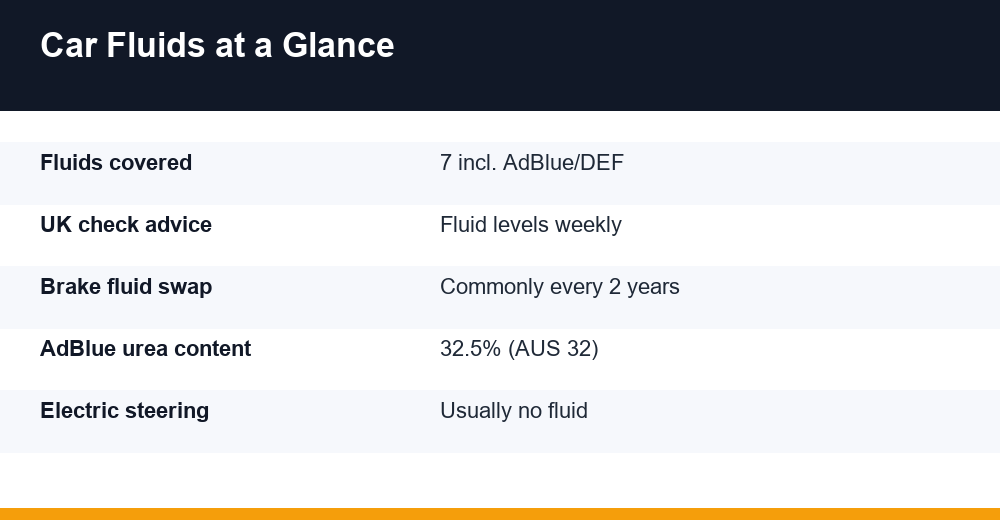
Essential car fluids explained: the seven at a glance
Most cars carry the same core set of liquids, even if the reservoirs sit in different places. Four of them are safety or survival fluids (oil, coolant, brake fluid, transmission fluid). The rest either make the car easier to drive, help you see, or keep a diesel within its emissions limits.
Your owner’s manual is the final word on type and interval. The table below is a quick orientation so you know what you are looking at when you open the bonnet.
| Fluid | Main job | Healthy colour | Worn or problem sign |
|---|---|---|---|
| Engine oil | Lubricates and cools moving parts | Amber to light brown | Black and gritty, milky, or below MIN |
| Coolant (antifreeze) | Carries heat away, prevents freezing and corrosion | Green, orange, pink, blue or yellow (brand-dependent) | Rusty brown, oily film, or sludge |
| Brake fluid | Transfers pedal pressure to the brakes | Clear to pale amber | Dark amber to brown, level dropping fast |
| Transmission fluid | Lubricates gears, operates automatic gearboxes | Usually red (ATF); some are green, blue or amber | Brown or dark with a burnt smell |
| Power steering fluid | Assists steering on hydraulic systems | Red, pink, amber or green (spec-dependent) | Dark, foamy, whining pump |
| Screenwash | Cleans the windscreen | Often blue, but any colour | Frozen jets in winter |
| AdBlue / DEF | Cuts NOx in modern diesel exhaust | Clear, like water | Crystals, contamination, warning light |
Colour is a clue, not proof. Coolant and transmission fluid in particular come in several shades depending on brand and chemistry, so always read the label on the bottle and the cap of the reservoir. Once you have the essential car fluids explained at this level, the detailed sections below make far more sense.
What fluids should you check, and how often?
The UK Highway Code advises drivers to check fluid levels at least weekly and to recognise any low-fluid warning lights fitted to the car. You can read the wording in Annex 6 of the Highway Code on GOV.UK. With the essential car fluids explained, that weekly look takes minutes, because you know where each reservoir sits.
Do the checks with the car on level ground and the engine off. Coolant should only ever be checked cold. If you want a printable routine that bundles fluids with tyres and lights, use our monthly car maintenance checklist.
- Engine oil: dipstick or dashboard oil-level menu, weekly and before long trips.
- Coolant: expansion tank between MIN and MAX, engine cold.
- Brake fluid: translucent reservoir near the bulkhead, level and colour.
- Screenwash: top up whenever it is low, using a winter-rated mix in cold months.
- Power steering fluid: only if the car has hydraulic steering (see below).
- AdBlue: watch the gauge or range warning on diesels that use it.
- Transmission fluid: usually left to the workshop, as many modern gearboxes have no dipstick.
Typical change intervals
Intervals vary widely by maker, engine and driving style. The ranges below are approximate and reflect common manufacturer schedules, not rules. For a mileage-by-mileage plan, see our car maintenance schedule by mileage.
| Fluid | Check | Typical change window (approx.) |
|---|---|---|
| Engine oil | Weekly | Roughly 5,000-10,000+ miles or 12 months; follow the service indicator |
| Coolant | Weekly (cold) | Long-life types often 5 years or more; older types about 2-3 years |
| Brake fluid | Weekly | Commonly every 2 years; some makers allow 3 |
| Automatic transmission fluid | At services | Roughly 30,000-100,000 miles, or per manual; some claim “lifetime” |
| Power steering (hydraulic) | Monthly | Often no fixed interval; change if dark or contaminated |
| Screenwash | Weekly | Top up as used |
| AdBlue / DEF | Gauge | Refill as used; consumption is a small fraction of diesel use |
Engine oil: the fluid that protects everything
Oil keeps metal surfaces apart, carries heat away from pistons and bearings, and holds dirt in suspension until the filter catches it. Run an engine low on oil and wear accelerates fast. An oil pressure warning light while driving means stop as soon as it is safe.
How to check it
- Park on level ground and switch off. Wait a few minutes so oil drains back to the sump, unless your manual says otherwise.
- Pull the dipstick, wipe it, reinsert fully, pull again and read the level between the two marks.
- No dipstick? Many newer cars show oil level in the instrument menu instead.
- Top up in small amounts with the exact grade and specification in the manual, such as 0W-20 or 5W-30 with the maker’s approval code.
Fresh oil is amber and see-through. It darkens with use, which is normal, especially in diesels. Warning signs are a milky residue under the filler cap (possible coolant contamination, or simply condensation on short trips), a fuel smell, or a level that drops noticeably between changes.
Service intervals have stretched with synthetic oils. Many cars now use a variable service indicator that calculates the interval from how you drive. Short journeys, towing and dusty roads count as severe use and justify changing oil earlier than the maximum.
Coolant: keeping temperatures in check
Coolant, or antifreeze mixed with water, circulates through the engine and radiator. It stops the engine overheating in summer, stops the water freezing and cracking parts in winter, and carries corrosion inhibitors that protect aluminium, rubber hoses and the water pump. A typical premix is around 50/50 antifreeze to water, but check the bottle.
Check the expansion tank with the engine fully cold. Never open the cap on a hot system: it is under pressure and can spray scalding liquid. The Highway Code makes the same point, advising drivers to let an overheated engine cool naturally before removing the coolant filler cap.
A level that keeps dropping with no visible drip points to a hidden leak, a failing head gasket or a faulty cap. If your gauge climbs and then falls back, read our guide to a car overheating then going back to normal, as low coolant is a common cause.
Can you mix different types of coolant?
It is best not to. Coolants are built on different inhibitor chemistries: older inorganic (IAT), organic acid (OAT) and hybrid (HOAT, Si-OAT and similar). Mixing incompatible types can make additives drop out of the liquid and form sludge or gel that blocks the radiator and heater matrix, and it can cut the service life of a long-life coolant.
- Match the specification in the manual, not the colour. Colour is a dye and varies by brand.
- “Universal” coolants claim to mix with most types, but the safest top-up is the exact spec.
- In an emergency, plain water is better than nothing. Get the mix corrected soon after, especially before winter.
- If incompatible coolants have been mixed, have the system flushed and refilled.
How often should brake fluid be changed?
Brake fluid transmits the force of your foot to the callipers. Most cars use glycol-based fluid (DOT 3, DOT 4 or DOT 5.1), which is hygroscopic: it absorbs moisture from the air over time. That water lowers the boiling point, so under heavy braking the fluid can boil and the pedal can go soft.
Because of that slow moisture pickup, many manufacturers specify a change every two years regardless of mileage, and some allow three. Workshops can also test water content with a meter. A level reading is not enough, because old fluid can sit perfectly at MAX while carrying too much water.
Checking the reservoir
- The reservoir is usually a translucent pot at the back of the engine bay, near the bulkhead, marked MIN and MAX.
- Fresh fluid is clear to pale amber. Dark amber or brown suggests it is due.
- The level falls slowly as pads wear. A sudden drop means a leak and the car should not be driven until it is inspected.
- Only use the DOT grade printed on the cap. Never add DOT 5 (silicone) to a glycol system.
Brake fluid damages paint, so wipe any spill immediately. The Highway Code warns that low brake fluid may result in brake failure and a crash, which is why this reservoir deserves a look every time you open the bonnet.
Transmission and power steering fluid
Manual gearboxes use gear oil that many makers never schedule for replacement. Automatic, CVT and dual-clutch gearboxes depend on their fluid not only for lubrication but also for hydraulic operation and cooling, so condition matters more.
Automatic transmission fluid (ATF) is commonly red when new, though some brands use other dyes. It darkens with age. Brown fluid with a burnt smell suggests overheating or internal wear. Many modern gearboxes are sealed with no dipstick, and some are checked hot with the engine running. Leave those to a workshop with the correct procedure.
Some makers describe their fluid as lifetime fill. Many independent specialists still suggest a change somewhere in the range shown in the interval table, especially for towing or stop-start city use. If your manual gives a severe-service interval, that is a reasonable guide.
Does a car with electric steering have power steering fluid?
Usually not. Most new cars now use electric power steering (EPS), where a motor on the column or rack provides assistance. There is no pump, no hoses and no fluid to check.
- Hydraulic steering: engine-driven pump and a reservoir, often with a steering-wheel symbol on the cap.
- Electro-hydraulic steering: an electric motor drives a hydraulic pump, so it still has fluid.
- Fully electric steering: no reservoir at all. If you cannot find one, the manual will confirm you have EPS.
On hydraulic systems, use only the fluid the maker specifies. Some take ATF, others a dedicated fluid. A whining noise on full lock often means the level is low.
Screenwash and AdBlue (DEF)
Screenwash is the least technical fluid but matters for safety. Plain water freezes in winter and does little against road grime and insects. Use a proper screenwash at the strength printed on the bottle, rated for your coldest temperatures. Household washing-up liquid can leave smears and is best avoided.
What AdBlue does
Many modern diesel cars and vans use selective catalytic reduction (SCR) to cut nitrogen oxides. They inject AdBlue, sold in North America as diesel exhaust fluid (DEF), into the exhaust. It is a solution of 32.5% high-purity urea in deionised water, made to the ISO 22241 standard (also called AUS 32).
- It has its own tank, normally with a blue filler cap next to the diesel filler or in the boot.
- Consumption depends on the system and driving, but is a small percentage of diesel use, so refills typically come every few thousand miles.
- The car warns you well in advance. If it runs dry, most cars will not restart until it is refilled.
- Never put AdBlue in the diesel tank. If it happens, do not start the engine; call for help.
- AdBlue freezes at about -11 C. The system has heaters, so this is normally handled automatically.
Buy AdBlue that states ISO 22241 on the container. Contaminated or diluted fluid can damage the SCR system, which is expensive to repair.
What colour is that leak under your car?
A drip under a parked car is worth investigating early. Slide a sheet of white card or kitchen paper under the car overnight. In the morning, note the colour, smell, texture and where it sits relative to the wheels. This chart is the practical side of essential car fluids explained: matching a stain to its source.
| Colour | Texture and smell | Likely fluid | Urgency |
|---|---|---|---|
| Clear, watery | No smell, dries quickly | Air-con condensation | Normal after A/C use |
| Green, orange, pink, yellow or blue | Thin, slightly slimy, sweet smell | Coolant | Fix soon; check level before driving |
| Light blue (sometimes pink or green) | Watery, smells like glass cleaner | Screenwash | Low |
| Red or pink | Oily, can smell slightly sweet or burnt | Automatic transmission or power steering fluid | Book a check promptly |
| Amber to dark brown or black | Slippery, oily | Engine oil (or old gear oil) | Check level; repair soon |
| Clear to brown, near a wheel | Slippery, slightly oily | Brake fluid | Do not drive; get it inspected |
| Clear, near the diesel or AdBlue filler | Ammonia smell, leaves white crystals | AdBlue / DEF | Repair soon |
Position helps. Front-centre drips are often oil or coolant. Leaks by a wheel suggest brakes. Mid-car drips can be transmission. A puddle that smells of petrol or diesel is a fire risk: do not start the car and get professional help.
What fluids does an electric car need?
An electric car drops several fluids entirely. There is no engine oil, no oil filter, no AdBlue and usually no hydraulic power steering. That is a big part of why EVs need less routine servicing, but they are not fluid-free.
- Brake fluid: still hydraulic and still absorbs moisture. Regenerative braking saves pads and discs, but the fluid still ages, so follow the maker’s change interval.
- Battery and motor coolant: many EVs use a liquid loop to keep the battery and electronics in range. Some specify very long intervals, others set fixed changes. Coolant work on high-voltage cars is a job for a trained technician.
- Reduction gear oil: the single-speed gearbox has a small amount of lubricant, often with a long or no fixed interval.
- Screenwash: exactly the same as any car.
- Air-con refrigerant: sealed, but on many EVs the system also helps cool the battery, so A/C faults can matter more.
Hybrids sit in between. They keep all the engine fluids, often add a separate coolant loop for the hybrid electronics, and use a transmission fluid suited to their gearbox design.
With essential car fluids explained for petrol, diesel and electric drivetrains, the habit stays the same: look at the reservoirs regularly, use the exact specification, and treat any new puddle as a question worth answering.
Frequently Asked Questions
What fluids should I check in my car and how often?
Check engine oil, coolant, brake fluid and screenwash regularly; the UK Highway Code says to check fluid levels at least weekly. Add power steering fluid if your car has hydraulic steering, and watch the AdBlue gauge on diesels that use it. Transmission fluid on modern sealed gearboxes is usually checked at services. Always follow your owner’s manual.
How often should brake fluid be changed?
Many manufacturers specify a brake fluid change every two years, regardless of mileage, and some allow three. The fluid absorbs moisture over time, which lowers its boiling point and can cause a soft pedal under hard braking. A full reservoir does not mean the fluid is healthy, so follow the time-based interval or have its water content tested.
Can you mix different types of coolant?
It is best avoided. Coolants use different inhibitor chemistries, such as IAT, OAT and HOAT, and mixing incompatible ones can cause sludge or gel that blocks the radiator and heater. It can also shorten coolant life. Top up with the specification in your manual rather than matching colour, and flush the system if types have been mixed.
What fluids does an electric car need?
An electric car has no engine oil or AdBlue, but it still needs brake fluid, screenwash and a small amount of gear oil in its reduction gearbox. Many EVs also use liquid coolant to manage battery and motor temperatures. Follow the maker’s schedule, and leave coolant work on high-voltage systems to trained technicians.