
A car overheating then normal is one of the most confusing warning signs an owner can see, because the needle climbs, you start to worry, and a minute later it settles as if nothing happened. That brief spike is not random: it usually points to a part that works some of the time, or coolant that is not circulating the way it should. This guide walks through the seven honest causes, a safe roadside routine, and the fixes ranked from cheapest to most expensive.
Table of Contents
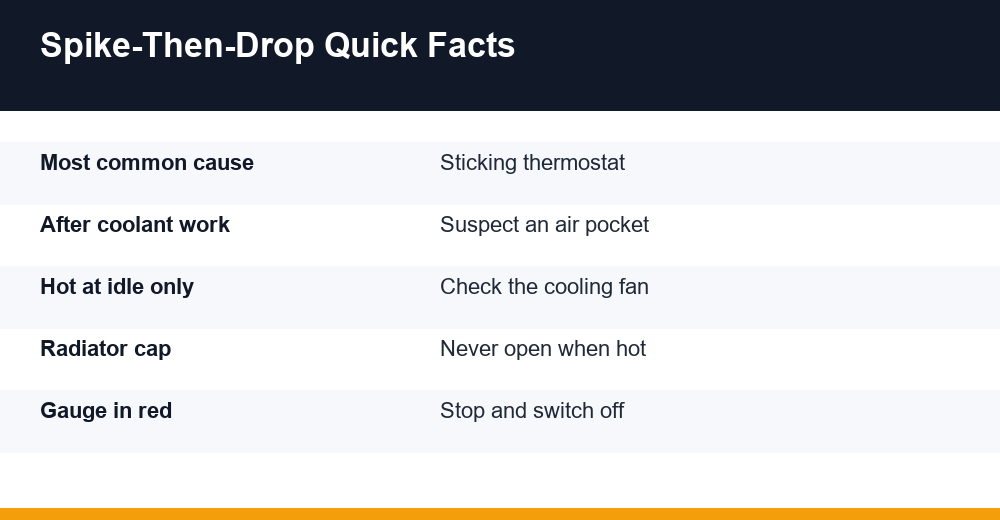
Car overheating then normal: what the pattern means
Why does the temperature gauge go up and then back down? Because something in the cooling system is working intermittently. A healthy engine reaches operating temperature, the thermostat opens, and the needle parks in roughly the same spot for the rest of the drive. Small movements are normal. A climb toward the hot end followed by a drop is not.
The cooling system has a simple job: the water pump pushes coolant through the engine, the thermostat decides when that coolant is allowed through the radiator, and the radiator (helped by the fan and by air flowing through the grille) sheds the heat. If any of those links falters for a moment and then recovers, you get the spike-then-drop pattern.
That is also why the problem is easy to ignore. The car feels fine, the warning disappears and the drive continues. But an intermittent fault rarely stays intermittent. A thermostat that sticks once a week tends to stick more often, and a slow leak only gets lower. Treat the first episode as an early warning, not a false alarm.
7 causes of a gauge that rises and falls
These are the causes mechanics check first when an owner describes a car overheating then normal a minute later. They are listed roughly from most to least common for this specific pattern.
1. A sticking thermostat
Can a bad thermostat cause overheating then normal? Yes, and it is the classic culprit. As thermostats age, the wax element and spring can bind. The valve stays shut too long, the engine runs hot, then it finally opens, cooler coolant from the radiator rushes in and the needle drops. Repeat that cycle and the gauge bounces. A thermostat stuck open does the opposite: the engine runs cool and the heater feels weak.
2. An air pocket after coolant work
If the spikes began shortly after a coolant flush, a hose change, a water pump job or a radiator replacement, suspect trapped air. An air lock stops coolant reaching part of the engine or the sensor. When the bubble moves, the temperature recovers; when it collects again, the needle climbs. A heater that blows cold one minute and hot the next is a strong supporting clue. Many generic overheating guides skip this, yet it is a frequent reason for the problem on a recently serviced car.
3. Can low coolant make the gauge fluctuate?
Yes. When the level drops, air takes the place of liquid, and the sensor may sit in coolant one moment and in steam or air the next. Look for a reservoir below the MIN mark, a sweet smell, damp hoses or crusty residue around joints. Our guide to the fluids every car depends on shows where to check and what the right level looks like.
4. A cooling fan that fails at low speed
An electric radiator fan with a worn motor, a failing relay, a blown fuse or a faulty control module may not switch on when the car is stationary. At speed, air through the grille does the fan’s job, so the temperature stays normal. In traffic, it climbs. More on this pattern in the next section.
5. An early water pump problem
Water pumps usually fail gradually. A weeping seal leaks small amounts of coolant, often visible as a drip or stain near the pump’s weep hole, and an eroded impeller moves less coolant at low revs. The result can be heat at idle that clears as engine speed rises. A whining or grinding noise from the front of the engine points the same way.
6. A faulty temperature sensor or wiring
If the needle jumps instantly from normal to hot and back, faster than metal and coolant could ever change temperature, the sensor, its connector or the instrument cluster is the more likely cause. Real overheating builds gradually; electrical faults tend to be abrupt.
7. A tired radiator cap or partly blocked radiator
The cap holds the system under pressure, which raises the boiling point of the coolant. A weak seal lets coolant boil sooner and escape to the overflow tank. A radiator clogged inside with scale, or outside with leaves and insects, may cope in gentle driving but struggle under load or on hot days.
A less common but serious cause is a failing head gasket, which can push combustion gases into the coolant and create bubbles. Persistent bubbling in the reservoir, white exhaust smoke with a sweet smell, or unexplained coolant loss all justify a professional pressure or combustion-leak test.
Why a car overheats at idle but not while driving
This is the most specific version of the spike-then-drop problem, and it narrows the search a lot. When you drive at a steady road speed, a large volume of air is forced through the radiator for free. When you sit at lights, in a drive-through queue or in stop-start traffic, that airflow disappears and the electric fan has to do the work.
So if the needle rises only when stationary and falls as soon as you pick up speed, the radiator fan circuit is the prime suspect. Check it like this:
- Warm the engine fully, then let it idle with the bonnet up, keeping hands, hair and clothing well clear of the fan. Electric fans can start even with the engine off.
- Watch for the fan to start as the gauge passes its normal point. On many cars, switching on the air conditioning also triggers the fan.
- If it never runs, check the fan fuse and relay listed in the owner’s manual before assuming the motor is dead.
- If it runs but slowly or noisily, the motor or its resistor may be failing.
Other idle-only causes include a low coolant level (the pump moves less coolant at idle, so marginal levels show up first), a worn water pump impeller and, on older cars with an engine-driven fan, a slipping viscous fan clutch. A radiator with a debris-covered front face can also cope at speed but fail in a queue.
A safe roadside routine when the needle climbs
When the gauge heads toward hot, your priority is to protect yourself first and the engine second. Most manufacturers give the same core advice. Nissan’s owner’s manual, for example, explains what to do if your vehicle overheats, warning drivers not to keep driving an overheating engine and not to open the bonnet while steam is escaping. A practical routine looks like this:
- Switch off the air conditioning to remove extra load from the engine.
- Turn the heater to maximum heat and full fan. It feels unpleasant, but the heater core acts as a small second radiator and can pull the temperature down.
- If the needle keeps rising, signal, find a safe place to stop and pull well off the road.
- Once safely stopped, switch off the engine if the gauge is in the red, steam appears or a warning light is on, and follow your owner’s manual for your model.
- Do not open the bonnet if steam is pouring out. Wait until it stops.
- Keep everyone away from the front of the car and do not touch the radiator cap or reservoir cap.
- Once everything has cooled, check the coolant level in the reservoir and look under the car for drips.
If a red temperature light or message appears, treat it as a stop-now warning, not a suggestion. Our guide to what dashboard warning lights mean explains how the colours are ranked and which ones demand an immediate stop.
If topping up brings the level back and the gauge behaves, you may be able to drive gently to a garage. If the reservoir is empty again quickly, coolant is visibly pouring out, or the needle climbs within minutes, call for recovery instead. A car overheating then normal after a top-up still needs a proper diagnosis, because the coolant went somewhere.
How long to wait before opening the radiator cap
A hot cooling system is under pressure, and coolant inside it can be well above the temperature at which water normally boils. Open the cap too soon and that pressure is released all at once as a jet of scalding coolant and steam. Owner’s manuals consistently warn against removing the cap while the engine is hot.
There is no single official number that applies to every car, but as general guidance allow at least 30 minutes after switching off, and longer on a hot day or after a severe overheat. Better than the clock, use these checks:
- The bonnet and the top of the radiator feel only warm, not hot, to a light touch.
- The upper radiator hose can be squeezed easily; a hard, swollen hose means the system is still pressurised.
- No steam, hissing or bubbling from the reservoir.
- The temperature gauge, if you switch the ignition on without starting, sits at or near cold.
When you do open it, cover the cap with a thick cloth, turn it slowly a quarter turn to let any remaining pressure escape, pause, then remove it. On most modern cars you check and top up at the plastic expansion tank rather than a cap on the radiator itself. Use the coolant type specified in the owner’s manual; plain water is an emergency stopgap only and should be corrected soon after.
Is it safe to drive after it returns to normal?
Is it safe to drive if your car overheats then goes back to normal? Sometimes, briefly and carefully, but it is never safe to ignore. The honest answer depends on how high the needle went and what you find when you check.
| What you see | Risk level | Sensible action |
|---|---|---|
| Needle rose slightly above normal, then settled; coolant level fine | Low to moderate | Drive gently, book an inspection soon |
| Needle reached the red briefly, then dropped | High | Stop, cool down, check coolant; drive only a short distance to a garage |
| Steam, boiling reservoir or sweet smell | High | Switch off and wait; arrange recovery if coolant is lost |
| Red warning light stays on or needle climbs again quickly | Severe | Do not drive; call for recovery |
| Needle jumps instantly from normal to hot with no smell or steam | Unclear (possibly electrical) | Have the sensor and gauge checked before trusting the car |
The real danger of repeated overheating is cumulative damage. Heat can warp the cylinder head, damage the head gasket and break down the oil, and those repairs cost far more than any thermostat or fan relay. A single brief spike often does no lasting harm; driving for weeks with a car overheating then normal on every commute is how small faults become big bills.
Narrowing down the cause at home
You do not need a workshop to gather useful clues. Note when the spikes happen and what else is going on, then compare with the table below. Bring these notes to the garage; they save diagnostic time.
| Symptom pattern | Most likely cause | Quick check |
|---|---|---|
| Started after coolant or hose work | Air pocket | Heater blows hot and cold; bubbles in reservoir when warm |
| Hot in traffic, fine at speed | Cooling fan | Fan does not run when hot or with A/C on |
| Hot on motorway or under load, fine in town | Blocked radiator or weak water pump | Debris on radiator face; coolant stains near pump |
| Needle swings slowly up and down while cruising | Sticking thermostat | Upper hose stays cool, then suddenly gets hot |
| Needle jumps instantly, no other signs | Sensor or wiring | Diagnostic scan for coolant sensor codes |
| Reservoir level keeps falling | Leak or head gasket | Look for drips, damp hoses, white sweet-smelling exhaust |
A basic OBD-II scanner, which plugs into the diagnostic port on most petrol cars built from the late 1990s or early 2000s onward (1996 in the US), can read stored fault codes and, on many models, live coolant temperature. If the live reading stays steady while the dash needle swings, the problem is in the gauge circuit rather than the engine.
A garage will usually add a pressure test to find hidden leaks and may run a combustion-gas test on the coolant if a head gasket is suspected. Both are inexpensive compared with the repairs they can prevent.
Fixes ranked from cheapest to costliest
Prices vary widely by country, model and labour rate, so the tiers below are approximate and relative rather than quotes. The point is to check and rule out the cheap causes before agreeing to expensive work.
| Fix | Approximate cost tier | DIY friendly? |
|---|---|---|
| Top up correct coolant | Very low | Yes, when cold |
| Replace fan fuse or relay | Very low | Usually |
| Bleed air from cooling system | Low (mostly time) | Often, model-specific |
| New radiator cap | Low | Yes |
| Coolant temperature sensor | Low to moderate | Sometimes |
| Thermostat replacement | Low to moderate | Depends on access |
| Hose or clamp replacement | Low to moderate | Often |
| Radiator fan motor or module | Moderate | Sometimes |
| Water pump replacement | Moderate to high | Rarely, often timing-belt driven |
| Radiator replacement | Moderate to high | Rarely |
| Head gasket repair | Very high | No |
Two money-saving tips. If the water pump is driven by the timing belt, replacing both together avoids paying the same labour twice. And when the system is drained for any reason, fitting a new thermostat at the same time is cheap insurance, since most of the cost is labour. Treat radiator stop-leak additives as a get-home measure only, and only if your manufacturer allows them.
Stopping it from coming back
Once the fault is fixed, a few habits keep the cooling system healthy and catch the next problem early:
- Check the coolant reservoir level monthly with the engine cold, and before long trips.
- Replace coolant at the interval in your service schedule; old coolant loses its corrosion protection.
- Ask for the system to be bled properly after any cooling work, and watch the gauge closely for the first few drives.
- Rinse bugs and leaves from the front of the radiator, gently, during washes.
- Glance at the temperature gauge regularly so you know exactly where "normal" sits on your car.
- Listen for the fan cycling on after a hot drive; silence where there used to be a whirr is worth investigating.
Summer heat, heavy loads, towing and long queues all push a marginal cooling system over the edge. Our hot-weather car care guide covers the extra checks worth doing before a heatwave or road trip.
The bottom line: a car overheating then normal is giving you a warning while repairs are still cheap. Note when it happens, check the coolant safely, rule out the fan and air pockets, and get the thermostat and sensor tested before the spikes become a breakdown.
Frequently Asked Questions
Why does my temperature gauge go up and then back down?
Usually because part of the cooling system is working intermittently. A thermostat that sticks and then opens, an air pocket that moves, a fan that only runs some of the time or low coolant can all cause it. If the needle jumps instantly with no steam or smell, a faulty sensor or wiring is more likely than real overheating.
Can a bad thermostat cause overheating then normal?
Yes. A sticking thermostat stays closed too long, so the engine heats up, then suddenly opens and lets cooler coolant from the radiator flow in. The gauge rises and then drops back, often repeatedly. It is one of the most common causes of this pattern and is usually a relatively inexpensive part to replace.
Is it safe to drive if my car overheats then goes back to normal?
Only cautiously and for a short distance to a garage, and only if the coolant level is fine and no warning light remains. If the needle reached the red, steam appeared or coolant is being lost, stop and arrange recovery. Repeated overheating can warp the cylinder head and damage the head gasket.
How long should I wait before opening the radiator cap?
As general guidance, wait at least 30 minutes after switching off, and longer on hot days. More reliable than time is checking that the upper hose is soft and the bonnet only warm. Then cover the cap with a thick cloth and turn it slowly to release any remaining pressure before removing it.