
The safest way to remove tree sap from car paint is to start with the gentlest method that could work and only step up when it fails. Most sap comes off with warm water, patience and a little isopropyl alcohol; only stubborn, baked-on drops need a dedicated remover, clay or polish. This guide walks through each rung of that ladder, what to keep away from your clear coat, and how to deal with any marks left behind.
Table of Contents
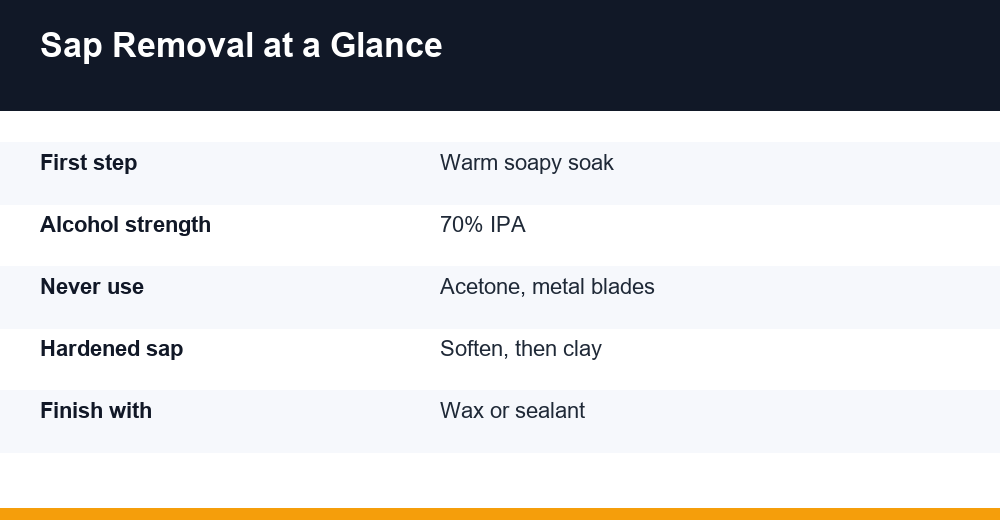
Can tree sap permanently damage car paint?
Yes, if it is left long enough. Fresh sap is a sticky mix of sugars, resins and water. As the water evaporates, especially in sun, the resin hardens into a glassy bead that grips the clear coat far more tightly than it did when it landed.
Carmakers’ own care advice is consistent on the basics: remove foreign matter such as sap promptly, and use gentle washing or a product made for automotive paint rather than scraping. The Mazda exterior care guidance is a good example, and it is exactly where our ladder starts.
The damage usually happens in two ways:
- Etching: over days or weeks in hot weather, some sap leaves a dull, slightly sunken ring in the clear coat after the bead is gone.
- Mechanical scratching: owners pick, scrape or scrub at hard sap and grind grit into the paint. This is often worse than the sap itself.
How quickly you act matters more than which product you own. As a rough guide:
| Sap condition | What it looks like | Where to start |
|---|---|---|
| Fresh (hours) | Clear, tacky, smears when touched | Rung 1: warm soapy soak |
| Dried (days) | Firm bead, no longer sticky | Rung 2: isopropyl alcohol |
| Baked on (weeks) | Hard, amber, glassy | Rung 3 or 4: remover, then soften and lift |
| Gone, mark remains | Dull ring or faint dip | Rung 6: finishing polish |
Sap is generally slower-acting than bird droppings, which can mark paint quickly in hot weather. If your car parks under trees, it collects both, so it is worth reading our guide on how to remove bird droppings from car paint as well. The rule for both is the same: deal with it soon, and soften before you wipe.
Before you start: test spots and the right kit
Every method below is safe on modern factory paint when used correctly, but resprays, older single-stage paint, wraps and matte finishes behave differently. That is why the test-spot rule matters before you try to remove tree sap from car paint with any solvent.
Test-spot rules
- Pick a hidden painted area: inside a door jamb or the lower edge of a rear bumper.
- Apply the product exactly as you plan to use it, for the same dwell time.
- Wipe off, dry and inspect in good light from several angles.
- Look for dulling, softening, colour on the towel or a change in texture. Any of these means stop.
- On vinyl wraps, PPF or matte paint, check the film or paint maker’s care instructions before using any solvent.
What to have ready
- Car shampoo (pH-neutral) and a bucket of warm water
- Several clean, soft microfibre towels
- 70% isopropyl alcohol (often sold as rubbing alcohol)
- A dedicated bug, tar and sap remover labelled safe for automotive paint
- A clay bar or clay mitt with lubricant
- A plastic razor blade, only for thick, raised blobs
- Wax, sealant or spray detailer to re-protect the area
Work in the shade on a cool panel. Heat makes solvents flash off before they can work and turns sap gummy and smeary. Wear gloves when handling solvents, and keep them away from rubber seals and unpainted plastic trim where you can.
How to remove tree sap from car paint: the ladder
Think of this as escalation, not a menu. Try each rung, and move up only if the previous one has clearly failed. Most fresh drops never get past rung two.
| Rung | Method | Best for | Risk to paint |
|---|---|---|---|
| 1 | Warm soapy soak | Fresh, still-tacky sap | Very low |
| 2 | 70% isopropyl alcohol | Small dried drops | Low if wiped off and re-protected |
| 3 | Tar and sap remover | Many drops, older sap | Low; follow label |
| 4 | Soften, then plastic blade | Thick, raised blobs | Moderate; technique matters |
| 5 | Clay bar | Flat residue after removal | Low with plenty of lube |
| 6 | Polish | Etching and dull rings | Removes a thin layer of clear coat |
Rung 1: The warm soapy soak
Wash the car normally first so you are not dragging dirt across the spot. Then soak a microfibre towel in warm, soapy water and lay it over the sap for five to ten minutes, re-wetting as needed.
Lift the towel and wipe gently in one direction. Fresh sap often rolls away. If it smears but shrinks, repeat. If it does not move at all after two soaks, go to rung two.
Rung 2: Isopropyl alcohol
Dampen a folded microfibre with 70% isopropyl alcohol and hold it on the drop for 30 to 60 seconds. Alcohol dissolves the resin rather than tearing it off. Wipe lightly, refold to a clean face and repeat until the spot is clear.
Wash the area afterwards. Alcohol strips wax and sealant, so that patch is now unprotected.
Rung 3: A dedicated tar and sap remover
If you have lots of drops, or they have been there a while, a remover sold for automotive paint is the most efficient tool. These are formulated to break down resin without attacking cured clear coat, provided you follow the directions.
Spray or apply to a towel, let it dwell for the time on the label, wipe, then wash and rinse. Never let it dry on the panel or sit in the sun. Used this way, it is a reliable way to remove tree sap from car paint without touching a blade.
A few habits make every rung work better:
- Use a fresh face of the towel for each wipe so you are not spreading dissolved resin around.
- Treat one drop at a time rather than flooding a whole panel.
- Wash, rinse and dry the area after any solvent, then inspect before moving up a rung.
How do you remove hardened tree sap?
Sap that has baked on for weeks can look like amber. The mistake is trying to chip it off. Instead, soften first, lift second.
Rung 4: Soften, then lift with plastic
- Lay a towel soaked in sap remover or alcohol over the blob for a few minutes, keeping it wet.
- If the panel is cool, a short pass with a hairdryer on low can help soften resin. Keep it moving and never make the paint too hot to touch comfortably. Never combine heat with a flammable solvent still on the panel; wipe it off first.
- Once the outside is soft, re-wet it with remover and use a fresh plastic razor blade at a very shallow angle to shave off the raised bulk.
- Stop when the blob is level with the paint. Do not try to scrape the last film; dissolve it instead.
If you are not confident with a blade, skip it. Repeated soaks will get there, just more slowly.
Rung 5: Clay the residue
After the bulk is gone, the paint often still feels rough. A clay bar with plenty of lubricant glides over the surface and pulls out bonded remnants that wiping cannot reach. Use light pressure and knead the clay often.
Claying is mildly abrasive and strips protection, so it is not something to do weekly. Our guide on how often to clay bar a car explains sensible intervals.
Rung 6: Polish
Polish is only for marks left after the sap is completely gone. It is covered in the etching section below, because it removes paint rather than sap.
Will rubbing alcohol or WD-40 damage paint?
Rubbing alcohol
Used briefly and wiped off, isopropyl alcohol does not harm cured factory clear coat. Advice online conflicts on strength: some guides use 90%, others dilute 70% further with water. Starting with 70% is a sensible middle ground because it works and, with more water in the mix, evaporates a little more slowly.
The genuine risks are:
- Leaving a soaked towel on paint for long periods, which can soften fresh resprays
- Using it on vinyl wraps, matte finishes or freshly painted panels without testing
- Forgetting that it removes wax, sealant and some coating toppers
Does WD-40 remove tree sap safely?
WD-40 is a multi-use lubricant, not a dedicated paint-care product. Many owners report it loosening fresh sap, while others in detailing circles advise against it on paint because of the oily film it leaves.
If you do try it on fresh sap, use a little on a towel, wipe, then wash the area thoroughly with car shampoo to remove the residue and re-protect it. For anything beyond fresh drops, a dedicated sap remover is the better choice.
What never to use on sap
Conflicting advice online includes some genuinely harmful ideas. These are the ones to avoid when you remove tree sap from car paint:
| Avoid | Why |
|---|---|
| Acetone, nail polish remover | Can soften or dissolve paint and clear coat |
| Paint thinner, lacquer thinner | Aggressive solvents for stripping finishes |
| Metal razor blades or knives | Cut straight through clear coat |
| Fingernails on hard sap | Lifts paint and grinds in grit |
| Kitchen scourers, abrasive pads | Leave deep swirl scratches |
| Pressure washer up close | Can lift edges, chips and trim |
| Household cleaners (degreasers, bleach) | Not designed for automotive finishes |
Owner’s manuals routinely warn against harsh solvents and abrasive cleaners on painted surfaces. When in doubt, check your own manual before reaching for anything not sold for car paint, and remember that slower and gentler almost always wins.
Fixing etching and dull marks left behind
Sometimes you remove tree sap from car paint successfully and still see a faint ring or dull patch. That is etching in the clear coat, not leftover sap. Check by wiping with alcohol: if the mark is still there when clean and dry, it is in the paint.
- Wash and dry the area.
- Apply a small amount of fine finishing polish to a soft foam applicator or machine pad.
- Work in overlapping passes with light to moderate pressure.
- Wipe off and inspect. Repeat once or twice if improving.
- If the mark is fading, finish and re-protect. If not, stop.
Light etching usually responds to a finishing polish. Deeper marks may need a more cutting compound, and that is where a professional detailer is worth paying, because clear coat is thin and cannot be replaced by polishing.
If you can catch a fingernail in the mark, or you see the colour coat beneath, polishing will not fix it. That needs a paint repair.
Keeping sap off in the first place
The easiest sap to remove is the sap that never bonds. A slick layer of paint protection gives it something to sit on other than your clear coat.
- Park smart: avoid parking under trees in spring and summer when they drip most, if you have a choice.
- Check daily during sap season and spot-clean fresh drops with quick detailer and a soft towel.
- Keep protection up: a good wax, sealant or ceramic coating makes drops easier to lift.
- Use a cover if the car must sit under trees for long periods, but only on a clean car to avoid scratching.
Protection choices last very different lengths of time, so read our comparison of ceramic coating vs wax vs sealant before choosing. Whatever you use, re-apply it to any spot where you used alcohol, remover or clay.
Do that, and the next time you need to remove tree sap from car paint, a warm soapy towel will probably be all it takes.
Frequently Asked Questions
What is the best way to remove tree sap from a car?
Start gently. Wash the area, then lay a towel soaked in warm soapy water over the sap for several minutes and wipe. If that fails, use 70% isopropyl alcohol on a microfibre, then a dedicated tar and sap remover. Wash and re-wax afterwards, because these solvents strip protection from the treated patch.
Will rubbing alcohol damage car paint?
Brief use of 70% isopropyl alcohol, wiped off and followed by a wash, does not harm cured factory clear coat. It does strip wax and sealant, so re-protect the spot. Test first on fresh resprays, matte paint and vinyl wraps, and never leave a soaked towel on the panel for long periods.
Does WD-40 remove tree sap safely?
Many owners say WD-40 loosens fresh sap, but it is a multi-use lubricant rather than a dedicated paint-care product, and some detailers advise against it. If you use it, apply sparingly with a towel, then wash the area with car shampoo to remove the oily film and re-apply wax. A dedicated sap remover is the better option.
How do you remove hardened tree sap from a car?
Soften it first. Keep a towel soaked in sap remover or alcohol on the blob for several minutes, then shave off the raised bulk with a plastic blade held almost flat while the surface is still wet. Dissolve the remaining film rather than scraping, clay any roughness, and polish only if a dull ring remains.