
Ceramic coating vs wax is usually framed as a cheap old tin against an expensive high-tech miracle, but the honest answer comes down to what each one costs you per year of real protection. This guide breaks down wax, sealants, DIY spray ceramics and professional coatings using clearly labelled illustrative prices, then shows how heat, sunlight and your washing habits shrink the lifespans printed on the bottle. There are no brand plugs here, just the numbers and trade-offs you need to choose well.
Table of Contents
Four Types of Paint Protection, Explained Simply
Every product in this guide does the same basic job. It puts a thin, sacrificial layer on top of your car’s clear coat (the transparent top layer of paint) so that sun, grime and chemicals attack the protection first instead of the paint. What differs is how that layer is made, how firmly it holds on and how long it survives.
- Wax: traditionally based on carnauba, a natural wax from the leaves of a Brazilian palm, usually blended with oils, solvents and synthetic ingredients. It gives a warm gloss, goes on easily and wears off fairly quickly.
- Synthetic sealant: a polymer-based liquid that bonds more firmly than wax and typically lasts several months rather than several weeks.
- DIY spray ceramic: a spray-on, wipe-off product containing silicon dioxide (SiO2), the same compound found in glass and quartz. Easier to use than a true coating, but the layer it leaves is much thinner.
- Professional ceramic coating: a concentrated liquid that cures into a hard, glass-like film bonded to the clear coat. It is normally applied by a trained detailer after the paint has been machine polished.
Before getting into ceramic coating vs wax pricing, one clarification clears up a lot of marketing confusion: a coating is not armour. It will not stop stone chips, keying, deep scratches or car-park dings. That job belongs to paint protection film, a different and pricier product. Coatings mainly resist chemicals, UV and light wash marks, and they make the car noticeably easier to clean.
Check your owner’s manual before applying anything. Matte or satin paint, vinyl wraps and some special factory finishes need specific products, and the wrong one can leave permanent shiny patches that cannot be polished out without damaging the finish.
Protection also cannot fix paint that is already failing. If the clear coat is peeling, cracking or turning chalky, or you spot rust bubbling under the paint, no wax or coating will hold. Have a qualified body shop assess it first, because applying products over damaged paint simply seals the problem in.
Ceramic Coating vs Wax: The Cost-per-Year Maths
Comparing sticker prices is misleading, because a $20 tin and a $1,200 coating buy very different lengths of time. Divide the cost by how long the protection realistically lasts, add the hours you will spend, and the picture changes.
The figures below are illustrative ranges in US dollars, rounded, for a medium-sized car. They are not quotes. Labour rates, import duties and product availability vary enormously between countries. In India, for example, professional coatings are commonly advertised from roughly ₹10,000 to ₹50,000 depending on car size and package, often before any paint correction is added. Always get local quotes before deciding.
| Option | Upfront cost (illustrative) | Realistic lifespan | Applications per year | Approx. cost per year |
|---|---|---|---|---|
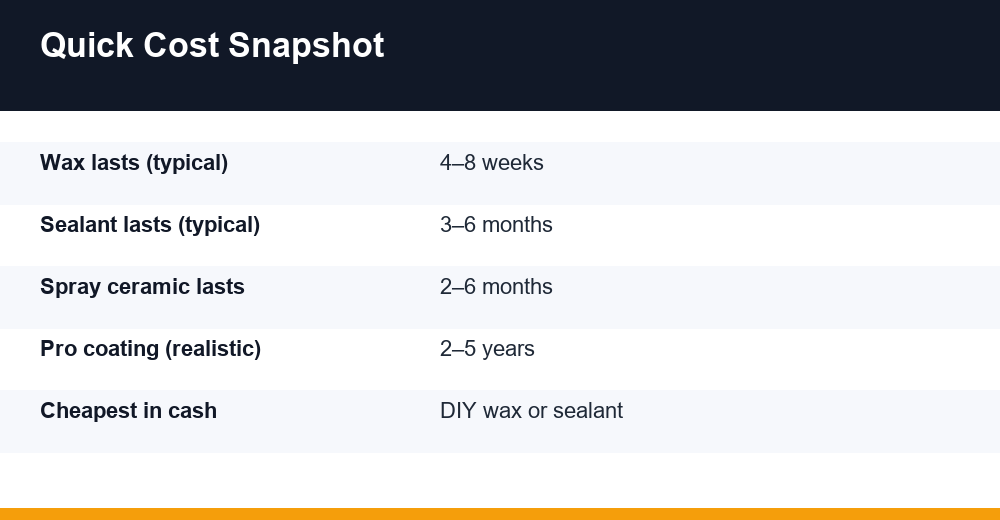
| DIY wax | $15–40 per tin (many uses) | 4–8 weeks | 6–10 | $20–50 plus 6–15 hours |
| Wax by a detailer | $50–150 per visit | 4–8 weeks | 4–8 | $200–1,200 |
| DIY sealant | $20–50 per bottle | 3–6 months | 2–4 | $20–60 plus 3–8 hours |
| DIY spray ceramic | $15–40 per bottle | 2–6 months | 2–4 | $20–60 plus 2–6 hours |
| DIY ceramic coating kit | $50–200, plus $50–150 prep supplies | 1–2 years | Under 1 | $50–350 plus a long weekend |
| Professional coating | $500–2,000+ including prep | 2–5 years | Under 1 | $100–1,000 |
DIY wax and sealant are the cheapest options in cash terms by a wide margin. What you pay instead is time. If a waxing session takes 90 minutes, eight sessions a year adds up to 12 hours, which is more than a full working day spent on your driveway.
A worked example
Imagine a professional coating costs $1,200 and the installer quotes five years. On paper, that is $240 a year. But if your car lives outdoors in a hot, sunny climate and the coating realistically performs well for three years, the true figure is $400 a year, before any top-up products or annual inspections the warranty might require.
Now compare that with paying a detailer $80 to wax the car six times a year: $480. Against that, the coating looks like decent value. Against doing it yourself for around $40 of product a year, it does not, unless you place a high value on your free time. That is the honest core of the ceramic coating vs wax debate: coatings usually beat paid waxing, while DIY wax and sealant win on cash.
There is also a middle ground. A DIY sealant or spray ceramic applied three or four times a year delivers much of a coating’s easy-clean convenience for a small fraction of the price, and you can stop at any time without anything to strip off.
Why Real-World Durability Rarely Matches the Label
Lifespans on bottles and installer brochures tend to assume favourable conditions: a garaged car, careful hand washing and moderate weather. Three things eat into those numbers faster than anything else.
Heat
Pure carnauba has a melting point of roughly 82–86 °C (180–187 °F). That sounds safely high, but a dark roof or bonnet (hood) in strong sun gets far hotter than the surrounding air, and consumer waxes are blended with softer oils and solvents, so they can soften at lower temperatures than pure carnauba. Synthetic sealants and ceramics cope with heat far better, which is one reason they are popular in the Gulf, Australia and much of India.
Heat also speeds up water spotting. Hard water drying on a hot panel concentrates calcium and magnesium in one small area, and if those spots are left to bake, they can etch through any protection, coatings included.
UV light
Ultraviolet light gradually breaks down organic waxes and polymer sealants. Ceramic coatings resist UV better, yet they still degrade over time; nothing makes paint immune to the sun. A car parked outdoors near the equator will use up its protection much faster than the same car kept in a garage in northern Europe.
Washing habits
This is the factor you control most, and in any ceramic coating vs wax comparison it often matters more than the product itself. Strong degreasers, traffic-film removers, washing-up liquid and brush-type automatic washes all strip or scuff protection quickly.
- pH-neutral car shampoo is the gentlest choice for wax, sealant and coatings alike.
- Pressure washers are fine used sensibly. Domestic units commonly run at around 1,500–2,000 PSI (roughly 100–140 bar); use a wide 25–40 degree fan nozzle, keep it about 30 cm (12 in) from the paint and never use the narrow, pencil-point or turbo jet on bodywork, rubber seals or tyre sidewalls.
- Washing too rarely causes damage too. Bird droppings, tree sap and insect remains can mark protection within days in hot weather.
If a bird has already left its mark, soften the deposit and lift it gently rather than scrubbing it dry, which drags grit across the finish. Our guide on how to remove bird droppings from car paint safely walks through the full method.
How Your Climate and Driving Change the Maths
Because durability shrinks in harsh conditions, the cost per year rises for every product. The useful question is which one shrinks least. The table below shows illustrative real-world lifespans in different settings. Treat these as rough guides based on typical owner and detailer experience, not as promises.
| Conditions | Wax | Sealant or spray ceramic | Professional coating |
|---|---|---|---|
| Mild climate, garaged, gentle hand wash | 6–10 weeks | 4–6 months | 3–5+ years |
| Hot and sunny, parked outdoors (Gulf, Australia, much of India) | 3–6 weeks | 2–4 months | 2–4 years |
| Humid tropics with heavy rain (SE Asia, monsoon regions) | 3–6 weeks | 2–4 months | 2–4 years |
| Cold winters with road salt (UK, northern US, Canada) | 4–6 weeks | 3–4 months | 2–4 years |
| High mileage plus weekly brush washes | 2–4 weeks | 1–3 months | 1–3 years |
Distance matters as well. A car covering 30,000 km (about 19,000 miles) a year collects far more road film, tar and grit than one doing 8,000 km (about 5,000 miles), and it needs washing more often, which wears any protection faster. For high-mileage drivers, the gap between a quick-to-reapply sealant and a long-life coating narrows.
In hot regions, the advice is the same whatever you use: wash and apply products in the shade, on a cool panel, early or late in the day. Product labels usually state temperature limits, so read them first. Our hot weather car care guide covers this alongside tyres (tires, if you are in North America), coolant and interiors.
Cold and damp weather brings the opposite problem. Many coatings and sealants list a minimum application temperature, often somewhere around 10–15 °C (50–59 °F), and high humidity slows curing. Most coatings need roughly 12–24 hours before they get wet and a week or so before the first wash, but the label is the final word. A coating applied in a cold, damp garage may never cure properly.
Hidden Costs and Catches Worth Knowing
The headline price is rarely the full price, particularly for coatings. Ask about each of these before you pay.
- Paint correction: a coating locks in whatever sits underneath, swirl marks included. Machine polishing beforehand is often the largest part of a professional bill, and older cars usually need more of it.
- Warranty conditions: many coating warranties require annual inspections or approved maintenance products, sometimes at extra cost. A long warranty with strict conditions can be hard to claim on, so read the terms.
- Top-up products: coated cars still benefit from a compatible spray topper every few months, which adds a modest yearly cost.
- Removal: wax simply wears away. A tired coating may need polishing off before a new one goes on, and that is skilled labour.
- Resale: few buyers pay extra for protection they cannot see. If you plan to sell within a year or two, the payback may never arrive.
DIY coating kits carry their own catch: mistakes are hard to undo. A high spot, where excess product is left to cure, can leave a dark smear that often needs machine polishing to remove. Work in good light, one small section at a time, and follow the instructions exactly, including cure times.
Safety matters too. Coating liquids contain solvents, so wear nitrile gloves, keep the area well ventilated and read the safety information on the pack. Keep products off rubber seals and textured trim unless the label says they are suitable. Lower panels can be reached by kneeling on a pad; never crawl under a car supported only by a jack.
Keep every product away from brake discs, pads and tyre treads, because a slippery film there can reduce grip and braking. If wax, sealant or coating does get onto the brakes, do not simply wipe it and drive off; have a qualified mechanic inspect and clean them before the car goes back on the road.
Ceramic Coating vs Wax: Which Suits Your Situation?
There is no universal winner. Match the product to your car, your climate and the time you genuinely have, not to the most persuasive advert.
Wax makes sense if you:
- Enjoy hands-on car care and find a waxing session relaxing.
- Want the lowest possible cash outlay.
- Live somewhere mild and can keep the car garaged or covered.
- Are selling soon and want the paint looking its best for viewings.
A sealant or spray ceramic makes sense if you:
- Want months, not weeks, between applications.
- Park outdoors in strong heat, heavy rain or salty winters.
- Have a tight budget and busy weekends.
- Want to try the slick, easy-clean feel before committing to a full coating.
A professional coating makes sense if you:
- Plan to keep the car for several years.
- Would otherwise pay someone to wax it regularly.
- Have new or well-kept paint that needs little correction.
- Are happy to follow the washing and maintenance routine the installer specifies.
For many everyday owners, the most practical choice is a sealant or spray ceramic applied two to four times a year. It handles heat better than wax, costs a fraction of a coating and does not demand a full weekend of preparation. If you later decide you want more, nothing stops you upgrading.
How to Make Any Paint Protection Last Longer
Whatever you choose, the routine around it decides how long it survives. These steps work for wax, sealant and coatings alike.
- Wash every one to two weeks with a pH-neutral shampoo, and more often in dusty, sandy or salty conditions.
- Use separate wash and rinse buckets so grit is not dragged back onto the paint. Our two-bucket wash method guide explains the full routine step by step.
- Rinse thoroughly, then dry with a clean, soft microfibre towel or an air blower to prevent mineral spots, especially in hard-water areas.
- Remove bird droppings, sap and bug splatter as soon as you spot them, rather than waiting for the next full wash.
- Park in shade or under a breathable car cover whenever you can, making sure the car is clean first so the cover does not rub grit into the paint.
- Check water behaviour monthly. When tight beads turn into flat, clinging patches, it is time to top up or reapply.
- Decontaminate with a clay bar or iron remover once or twice a year before reapplying wax or sealant, following the product instructions.
Keep a simple note of application dates on your phone. After a year, you will know exactly how long each product really lasts on your car, in your climate, which beats any marketing claim.
One last honest point: the best protection is the one you will actually keep up. A budget sealant applied on schedule beats an expensive coating that is neglected, scrubbed in a brush wash and left under bird droppings for a week.
Frequently Asked Questions
Is a ceramic coating worth it over wax for a daily driver?
In most ceramic coating vs wax comparisons, it depends on who would otherwise do the waxing. If you would pay a detailer several times a year, a professional coating often costs less per year over three to five years. If you wax the car yourself, wax or sealant is far cheaper in cash, though it takes more time.
Can I put wax on top of a ceramic coating?
You can, but it rarely helps. Wax sits on top, masks the coating’s water-beading behaviour and wears away within weeks. Most installers suggest a compatible SiO2 spray topper instead. Check your coating’s warranty terms first, as some specify approved maintenance products to keep cover valid.
Does a ceramic coating stop scratches and stone chips?
No. Coatings are hard but extremely thin, so at best they resist light wash marks. They will not stop stone chips, keying or deep scratches. Paint protection film is the product designed for impact protection, and it costs considerably more than a coating to fit.
How do I know when my wax or coating has worn off?
Watch the water after a wash. Tight, round beads and quick run-off mean the protection is working. When water sits in flat patches or clings to the paint, especially on the bonnet and roof where the sun hits hardest, it is time to reapply or have the coating checked.