
If you want to remove bird droppings from car paint without leaving a dull, ghostly outline behind, timing matters far more than the cleaner you reach for. In strong sun a fresh dropping can start marking the clear coat within hours, and tree sap and bug splatter are not far behind. Below you will find a five-step roadside method, a cheap kit to keep in the boot (trunk), and honest advice on fixing light etching if you got there too late.
Table of Contents
Why bird droppings damage paint so quickly
Your car’s colour sits beneath a transparent top layer called the clear coat. On most modern cars it is remarkably thin, often somewhere around 35 to 60 microns, which is roughly half the thickness of a sheet of printer paper. It is the only barrier between the weather and the coloured basecoat.
Droppings are usually blamed on “uric acid”. The white part is mostly uric acid and its salts (urates), mixed with darker digestive waste from the gut. For your paint, the important point is that the mix is mildly acidic, gritty and sticky. Seeds, grit and berry pigments in some droppings can also scratch or stain if they are wiped across the surface.
Heat speeds everything up. On a hot day the clear coat softens and expands slightly while the dropping dries into a hard crust on top. When the panel cools in the evening, the paint contracts around that crust, which can leave a dull, wrinkled imprint even before any chemical attack. That is why the same splat can be harmless in cool drizzle yet leave a mark by late afternoon in Dubai, Chennai or Phoenix.
| Conditions | Aim to clean within | Why |
|---|---|---|
| Cool and cloudy, below 20°C (68°F) | The same day if possible | Slower drying, less paint movement |
| Warm, 20–30°C (68–86°F) | A few hours | A crust forms quickly in direct sun |
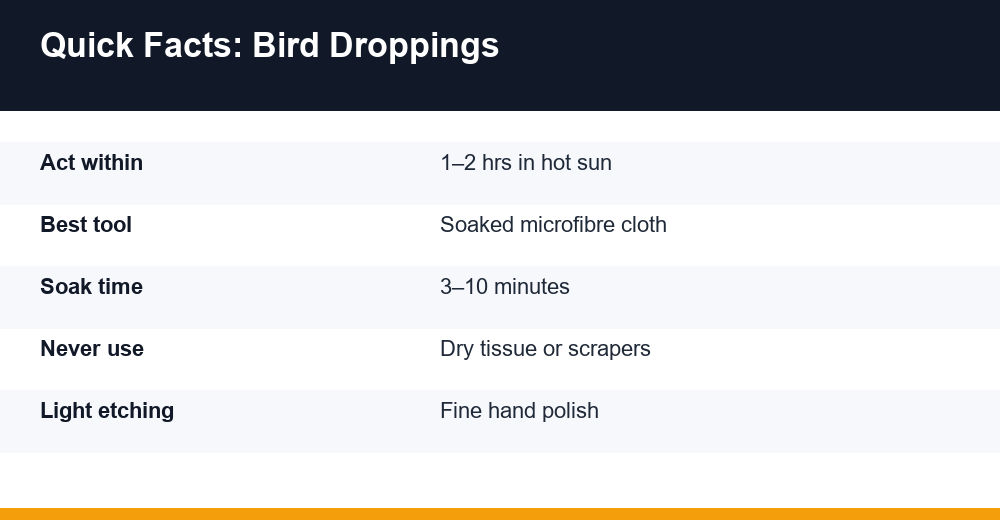
| Hot, above 30°C (86°F), or dark paint in direct sun | 1–2 hours, sooner if you can | Softened clear coat bakes the deposit in |
| Freshly waxed, sealed or ceramic-coated | Same urgency, easier removal | Protection buys time, not immunity |
Treat these as rules of thumb rather than lab figures, because paint quality, colour and protection all shift the timeline. The simple takeaway: the sooner you remove bird droppings from car paintwork, the less there is to fix later. If your summers are brutal, our guide to car care in hot weather covers smart parking, cooling systems and cabin protection as well.
Build a cheap on-the-go cleaning kit
Most etching happens because the owner spots the mess in the office car park, has nothing suitable to hand, and decides it can wait until the weekend wash. A small kit in the boot solves that. It lets you remove bird droppings from car panels within minutes instead of days.
| Item | What it is for | Typical cost (rough) |
|---|---|---|
| Quick detailer or waterless wash spray | Softens and lubricates the deposit so it lifts rather than scratches | Low |
| 3–4 clean, plush microfibre cloths in a zip bag | Soaking and lifting; the bag keeps them dust-free | Low |
| 500 ml (about 17 fl oz) bottle of plain water | Backup soaking liquid and for rinsing | Very low |
| Spare empty bag | Keeps used cloths away from clean ones | Very low |
| Disposable gloves | Hygiene; droppings can carry germs | Very low |
| Optional: small labelled spray of diluted isopropyl alcohol | Hardened tree sap (see the sap section) | Low |
Prices vary a lot between countries, so the bands above are only a rough guide. You do not need anything premium; a basic product from a supermarket or motor factor works fine as long as it is designed for car paint.
Storage tips for hot climates
- A closed car in strong sun can easily exceed 60°C (140°F) inside, so keep sprays in the boot rather than on the dashboard or rear shelf.
- Check the label for storage temperature limits and replace sprays that have separated or smell odd.
- Wash microfibre cloths after each use, without fabric softener, which clogs the fibres and reduces how well they grip dirt.
- Never reuse a cloth that has been dropped on the ground; trapped grit will scratch.
The 5-step method to remove bird droppings from car paint
This method works at home, at work or on a fuel station forecourt. The whole idea is to soak and lift, never rub. Rubbing drags the gritty seeds and stones in the deposit across the clear coat like sandpaper.
- Check the panel temperature. If the paint is too hot to keep your palm on, move into shade or wait a few minutes. Liquid flashes off a hot panel before it can do its job, and softened paint marks more easily.
- Soak, don’t scrub. Spray the dropping generously with quick detailer or water. Fold a microfibre cloth, soak it, and lay it over the spot for 3–5 minutes for a fresh deposit or up to 10 minutes for a dried crust. Re-wet the cloth if it starts drying out.
- Lift it away. Gently pinch the softened mass into the folded cloth and lift upwards, or draw the cloth in one straight line away from the spot with almost no pressure. Avoid circular motions.
- Flip and repeat. Turn to a clean face of the cloth for every pass. If residue remains, soak again rather than pressing harder.
- Rinse, dry, inspect, protect. Mist the area once more, pat it dry with a fresh cloth, then look at it from a low angle against the light. If it looks dull, read the etching section below. Finish with a quick detailer or spray sealant to restore some protection to that spot.
No kit with you?
Use plain bottled water and the cleanest soft fabric you have, such as an unused cotton handkerchief. Soak it, lay it on top, wait, then lift. Avoid paper napkins and tissues: they break up, leave lint and offer no cushion between grit and paint. A soaked cloth that softens the mess is always better than a quick dry wipe.
Droppings on the windscreen
A big splat in your line of sight is a safety issue. Use plenty of washer fluid before switching the wipers on, as dry wipers just smear it across the glass and wear the blades. In many countries driving with an obstructed view is an offence; the exact rules differ, so pull over somewhere safe and clean it properly if needed. If the washer jets will not spray or the wipers keep smearing after new blades, have the system checked by a qualified mechanic.
Done promptly, this routine is the safest way to remove bird droppings from car paint without adding swirl marks of your own.
Tree sap and bug splatter: different messes, different tactics
Bird mess gets most of the attention, but sap and insects cause plenty of damage too, especially on summer road trips and in tropical climates. Each needs a slightly different approach.
| Contaminant | Why it harms paint | Best first approach | Avoid |
|---|---|---|---|
| Bird droppings | Mildly acidic, gritty, bakes on in heat | Soak for 3–10 minutes, then lift | Dry wiping, scraping |
| Bug splatter | Insect remains harden and can etch over days | Soak with bug remover or warm, mild car shampoo, then lift | Scouring pads, dryer sheets, stiff brushes |
| Fresh tree sap | Sticky; hardens and can stain | Car shampoo or quick detailer while still soft | Picking at it with a fingernail |
| Hardened sap | Glassy blob bonded to the clear coat | Diluted isopropyl alcohol or a dedicated sap remover, short dwell, gentle dabbing | Metal blades, nail polish remover (acetone) |
| Honeydew mist (from aphids on trees such as limes) | Sticky film over whole panels, attracts dirt | A full wash | Leaving it for weeks |
Bug splatter after long drives
After a long motorway or highway run of, say, 200 miles (about 320 km) in summer, the front bumper, bonnet, mirrors and number plate can be coated. Aim to clean them within a day or two. Soak first: a cloth soaked in warm, mildly soapy water and laid over the area for a few minutes softens most remains. Dedicated bug removers work faster but should be rinsed off promptly.
Hardened sap: go gently
Isopropyl alcohol (IPA) dissolves sap well. Dilute it roughly 1:1 with water, or use a ready-mixed product no stronger than about 70%. Test on a hidden area first, dab rather than rub, and expect several short rounds for old blobs. IPA strips wax and sealant, so re-protect the spot afterwards.
Check your owner’s manual before using solvents, as some manufacturers list approved cleaners. Take extra care with matte or satin paint and vinyl wraps: they must never be polished or waxed, and you should follow the finish or wrap maker’s care instructions instead of the advice here.
Mistakes that turn a stain into a scratch
Most permanent damage is caused not by the bird but by a hurried clean-up. Watch out for these common errors:
- Dry wiping with a tissue, sleeve or paper towel. This is the most common cause of fine scratches around an old dropping.
- Using the forecourt windscreen squeegee or brush on paint. They are full of grit from hundreds of other cars.
- Reaching for household products such as kitchen sprays, strong washing-up liquid mixes, ammonia glass cleaners, vinegar or nail polish remover. They can dull trim, strip protection or soften the clear coat.
- Multi-purpose lubricant sprays. They are not designed for paint, leave an oily film and attract dust.
- Scraping with a fingernail, a bank card or anything metal.
- Cleaning in full midday sun, when products dry instantly and the paint is at its softest.
- Holding a pressure washer nozzle too close. Home units often run at around 1,500–2,000 PSI (roughly 100–140 bar), which is plenty; keep the nozzle at least 30 cm (12 in) away, use a wide fan tip and avoid pinpoint jets.
- Hoping an automatic brush wash will sort it out. Brushes can drag the grit across the panel and add swirl marks.
- Waiting for rain. Monsoon or tropical downpours rarely rinse a baked deposit away, and repeated wetting and drying can make etching worse.
How to spot and fix light etching afterwards
Once the area is clean and dry, look at it from a low angle under a bright light. A surface stain looks whitish or dull, but the reflection passes through it cleanly. A true etch distorts the reflection: you will see a ring, a wrinkled outline or a shallow crater where the clear coat has been reshaped.
| Level | What you see | Typical fix | DIY or pro? |
|---|---|---|---|
| Surface stain | Dull or whitish mark, reflection still sharp | Re-soak, quick detailer, possibly a clay treatment | DIY |
| Light etch | Faint outline that warps the reflection, cannot be felt | Fine finishing polish by hand, then protect | DIY with care |
| Moderate etch | Clear ring or crater visible from a metre or two | Machine polishing or professional paint correction | Professional recommended |
| Severe | Clear coat broken, colour faded, cracked or peeling | Panel refinish or smart repair | Professional |
Polishing out light etching by hand
- Wash the panel properly so no grit is present, then dry it. If the paint feels rough, use a clay bar or clay mitt with plenty of lubricant.
- Work in shade on a cool panel. Apply a pea-sized amount of fine finishing polish to a foam applicator.
- Work a small area with moderate pressure in short, overlapping straight passes for 30–60 seconds, then wipe off with a clean microfibre.
- Inspect under light. Repeat two or three times at most. Every pass removes a tiny amount of clear coat, and it cannot be put back.
- Finish with wax, sealant or a coating top-up to protect the freshly levelled area.
Be extra gentle on older cars. Clear coat spread through the industry during the 1980s, but some solid colours stayed single-stage into the 1990s, so older paint may show colour on your applicator. That is normal, but it means you are removing pigment directly. Repainted panels can also be thinner or softer than factory paint.
If the mark has not improved after a few careful passes, stop. A detailer can measure paint thickness and machine-polish safely, and a spot correction usually costs far less than a respray, though prices vary widely by country and region, so get a quote first. Learn to remove bird droppings from car paint promptly and you will rarely need this section.
Prevention: protection, parking and washing habits
You cannot stop birds, but you can make their mess easier to deal with. A layer of sacrificial protection sits between the deposit and your clear coat, gives you extra time and makes removal far easier. Our comparison of ceramic coating vs wax vs sealant explains how long each lasts and what it really protects against. None of them makes paint immune.
Smarter parking
- Avoid spots under trees where birds roost, lamp posts, overhead cables and building ledges.
- Steer clear of sap-heavy trees such as pines, maples and limes (lindens) in late spring and summer.
- Shade from a building or a covered car park is better than shade from a tree.
- A breathable car cover helps at home, but only fit it over a clean car; a cover on dusty paint will scratch it, especially when it flaps in the wind.
Regular washing
A clean, protected car resists contamination better than a dirty one. Every one to two weeks is a sensible routine in hot, dusty or coastal areas. The two-bucket wash method keeps grit out of your wash mitt, and a separate mitt for wheels and tyres (tires, if you are in the US) stops brake dust ending up on the paint.
Local rules differ by country and even by town. Parts of the UK and Australia impose hosepipe or water restrictions during droughts, and some cities limit soapy run-off into storm drains. Check what applies where you live; a waterless spray wash or a commercial wash bay is often a compliant alternative.
Combine these habits with a kit in the boot, and you will soon remove bird droppings from car paint out of routine, long before the sun has a chance to bake them in.
Frequently Asked Questions
How long can bird droppings stay on a car before they damage the paint?
There is no guaranteed safe window. In cool, cloudy weather you usually have a day or so, but in direct sun above 30°C (86°F) marks can appear within hours. Aim to clean within one to two hours in heat. Wax, sealant or a ceramic coating buys extra time but does not remove the risk.
Can I just use water and a tissue?
Water is fine as a soaking liquid, but tissues and paper towels drag grit across the paint and leave lint behind. Soak the deposit, lay a wet soft cloth on top for a few minutes, then lift it away. A clean microfibre cloth is the safest choice because its fibres trap grit.
Will a car wash remove bird dropping etching?
No. Washing removes the residue, but etching is a physical change in the clear coat. Light marks can usually be levelled with a fine hand polish; deeper rings need machine polishing by a professional. Automatic brush washes can also add swirl marks, so they are not a fix.
Does a ceramic coating stop bird droppings damaging paint?
It helps a lot, but it is not total protection. Coatings are slicker and more chemically resistant than wax, so deposits lift off more easily and you get more time. A dropping left to bake for days can still mark the coating itself, so clean it off just as promptly.