
Choosing between all season vs winter tyres comes down to one honest question: how cold, how snowy and how icy do your winters actually get? Most buying guides are written by shops that profit from selling you a second set, and many blur the line between “all-season” and “all-weather”. This guide sorts the four tyre types by climate, so you can match rubber to roads rather than to a sales pitch.
Table of Contents
Summer, All-Season, All-Weather and Winter Tyres
Before comparing anything, it helps to know that there are really four categories on sale, not two. Each one is built around a temperature range and a road surface, and the differences come from two things: the rubber compound and the tread pattern.
- Summer tyres: firm compound and fewer, larger grooves. Best dry and wet grip in warm weather, but the rubber hardens in the cold and they are poor on snow.
- All-season tyres: a compromise compound designed mainly for mild climates. Usually marked M+S. Common as factory fitment in North America.
- All-weather tyres: a type of all-season tyre that also carries the three-peak mountain snowflake (3PMSF) mark, so it has passed a standard snow-traction test.
- Winter tyres: soft, silica-rich compound that stays flexible in the cold, with deep tread and many small slits (sipes) that bite into snow and ice.
The key point retailers often skip: the word “all-season” on a sidewall tells you very little about winter ability. Two tyres both sold as all-season can behave completely differently on a snowy hill, depending on whether one carries the snowflake symbol.
That is why the all season vs winter tyres question is really a three-way choice for most drivers. The all-weather category sits in the middle, and for many people in cool, damp climates it is the option nobody mentioned at the counter.
| Tyre type | Ideal conditions | Snow mark | Weak spot |
|---|---|---|---|
| Summer | Above about 7C, dry or wet | None | Cold, snow, ice |
| All-season | Mild climates, rare snow | Usually M+S only | Packed snow and ice |
| All-weather | Mild to moderate winters | 3PMSF | Severe cold and sheet ice |
| Winter | Regularly below 7C, snow, ice | 3PMSF | Warm-weather wear and handling |
What Is the Difference Between All-Season and All-Weather Tyres?
This is the most common source of confusion, partly because some manufacturers and shops use the terms interchangeably. In practice the difference is one symbol and the testing behind it.
A traditional all-season tyre usually carries only the M+S (mud and snow) marking. M+S is applied by the manufacturer based on tread geometry, such as groove area and pattern. There is no standardised snow-performance test behind it, so it describes the shape of the tread, not proven snow grip.
An all-weather tyre adds the 3PMSF snowflake, meaning it has met a minimum snow-traction threshold. It typically uses a softer compound and more aggressive siping than a conventional all-season, which helps in cold slush but can cost some dry-road sharpness and tread life in hot summers.
How to tell them apart in the shop
- Look at the sidewall for the mountain-and-snowflake pictogram, not just the letters M+S.
- Read the manufacturer’s own product page: “all-weather” or “winter-approved” usually means 3PMSF.
- Ignore marketing names. A tyre called “All Season Plus” may still lack the snowflake.
- Check the date code too. A bargain set that has sat in a warehouse for years will have older, harder rubber.
In short, every all-weather tyre is an all-season tyre, but not every all-season tyre is an all-weather tyre. The snowflake is the dividing line.
What Does the 3PMSF Symbol Mean?
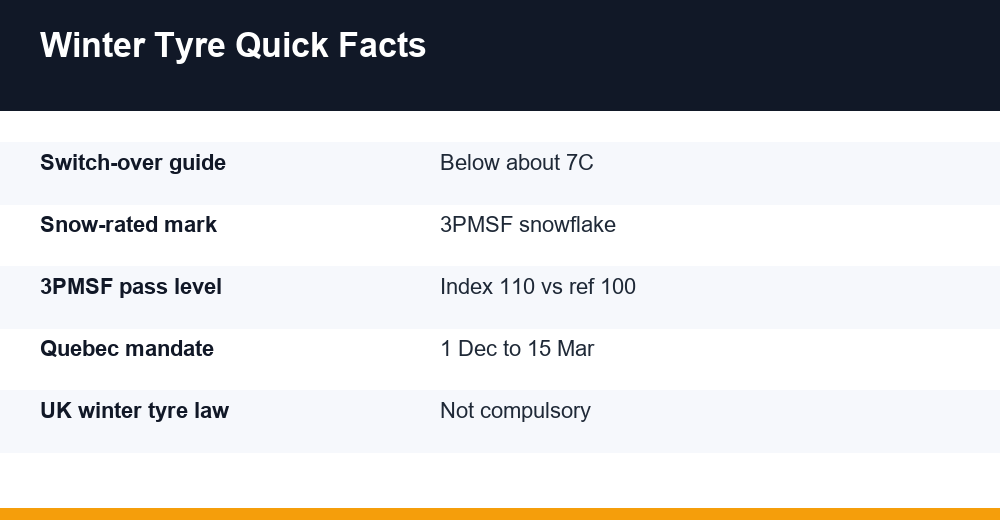
The three-peak mountain snowflake was introduced in 1999 by the Rubber Manufacturers Association (now the US Tire Manufacturers Association) and the Tire and Rubber Association of Canada as a performance-based standard. To earn it, a passenger tyre is tested for acceleration traction on medium-packed snow under an ASTM procedure and must score at least 110 against a standard reference tyre rated 100.
That is useful, but it is also a minimum. The test measures acceleration on packed snow only. Braking on snow, cornering on snow and grip on ice are not part of it. So a 3PMSF all-weather tyre and a premium dedicated winter tyre both pass, yet the winter tyre will usually stop shorter on ice and hold better through icy bends.
- It does confirm: the tyre has a tested baseline of snow traction, above a standard reference tyre.
- It does not confirm: ice braking, deep-snow ability, or how the tyre performs once the tread is half worn.
What about the ice grip symbol?
In the EU and UK, the tyre label introduced in 2021 can show a snow grip pictogram (the 3PMSF) and, separately, an ice grip pictogram. Ice grip is tested to its own standard and is mainly found on Nordic-style winter tyres designed for very cold, icy roads. Most drivers outside Scandinavia, Russia, Canada and similar climates will not need it.
If you are unsure which markings sit where on the tyre wall, our guide to tyre sidewall markings explained walks through the size code, load index, speed rating, date code and winter symbols.
At What Temperature Should You Switch to Winter Tyres?
The widely quoted guideline is the 7C rule (about 45F). Tyre makers commonly advise that once temperatures are consistently below around 7C, summer and many all-season compounds start to stiffen and lose grip, while winter compounds stay pliable.
Notice the word consistently. One cold morning in October is not a reason to book a fitting. A practical version many drivers use is to switch when average daytime temperatures sit at or below 7C for about a week, and to switch back in spring when they stay above it.
Treat 7C as a rule of thumb, not a hard line. It is a convenient point where compound differences start to show, but the benefit of winter tyres grows as temperatures fall further and as snow, slush or ice appear.
Timing tips that actually help
- Book your fitting early in autumn. Shops get busy after the first snowfall, and queues of a week or more are common.
- Check pressures after the swap. Cold air lowers inflation pressure, so set it to the vehicle maker’s figure on the door-frame label, not the maximum on the tyre.
- Do not leave winter tyres on all summer. Soft rubber on hot tarmac wears quickly and brakes less sharply than a summer or all-season tyre.
- Mark each tyre’s position when you remove it, so you can rotate them sensibly next season.
The US road-safety regulator’s winter driving tips from NHTSA are a useful pre-season reminder to check tyre pressure, tread and condition before the cold arrives.
All Season vs Winter Tyres: Which Suits Your Climate?
Here is where most generic advice goes wrong. The right answer to all season vs winter tyres depends far more on your local winter than on the car you drive. Use the profiles below as a starting point, then adjust for hills, rural roads and how flexible your schedule is.
| Your winter | Typical pattern | Sensible choice |
|---|---|---|
| Mild | Rarely below freezing, snow almost never settles | Summer or standard all-season |
| Cool and damp | Often 0-7C, occasional light snow, mostly wet roads | All-weather (3PMSF) |
| Moderate | Regular frosts, a few snow days, gritted main roads | All-weather, or winter tyres if hilly or rural |
| Harsh | Weeks below freezing, packed snow, ice | Dedicated winter tyres on a second set |
| Mountain or remote | Steep untreated roads, long cold spells | Winter tyres, plus chains or socks where required |
Are all-season tyres good enough for winter?
For a mild climate, often yes. For anything with regular snow or ice, a standard M+S all-season is a weak choice: it is not snow-tested and its compound firms up in the cold. Even tyre makers that sell 3PMSF all-weather models generally position dedicated winter tyres as the better choice for severe winter conditions.
A useful honesty check: ask yourself whether you can stay home on the worst days. If you can work from home or wait for the ploughs, an all-weather tyre covers most of your winter. If you must drive at 6am on untreated roads regardless, dedicated winter tyres are the safer bet.
Factors that push you towards winter tyres
- Hills: a steep drive or estate road that is never gritted.
- Rural or minor roads that are cleared last, if at all.
- Shift work or early starts, when roads are coldest and least treated.
- Rear-wheel-drive cars, which tend to struggle more for traction on snow.
- Regular trips to ski resorts or higher ground.
Do not forget the warm months
The trade-off runs both ways. Independent tests regularly show that all-season and all-weather tyres give up some wet and dry braking to good summer tyres in warm conditions. In a hot climate with almost no winter, a summer or high-quality all-season tyre is the better year-round pick, and an all-weather tyre gives away grip you will rarely need.
Do All-Season Tyres Wear Faster?
Not usually. Standard all-season tyres are often designed for long tread life, and many carry generous mileage warranties in markets like the US. The tyres that wear fastest are the ones used outside their temperature range.
- Winter tyres in summer: the soft compound scrubs away quickly on warm roads.
- All-weather tyres in hot climates: softer than a conventional all-season, so expect somewhat shorter life if summers are long and hot.
- Two-set owners: each set only covers part of the year, so the combined wear is spread out and both sets often last several seasons.
Tread depth matters even more in winter. The UK legal minimum for cars is 1.6 mm across the central three-quarters of the tread, and 2/32 inch (about 1.6 mm) is the common US benchmark. Grip in snow and slush drops well before either point, which is why many tyre makers suggest replacing winter tyres at around 4 mm.
| Tread depth | What it means in winter |
|---|---|
| 8-10 mm | Typical new winter tyre, full snow ability |
| 6 mm | Still good for snow and slush |
| 4 mm | Common replacement point for winter use |
| 3 mm | Wet and snow braking noticeably worse |
| 1.6 mm | UK legal minimum, poor in snow |
Measuring this takes two minutes with a cheap gauge. See how to check tyre tread depth for the coin test, the gauge method and how to read tread-wear indicator bars.
| Type | Typical wear pattern | Main wear risk |
|---|---|---|
| Summer | Moderate, varies with performance level | Used in cold weather |
| All-season | Often long-lasting | Aggressive driving, poor alignment |
| All-weather | Moderate | Long, hot summers |
| Winter | Good if used only in cold | Left on in warm months |
Whatever you fit, alignment and pressure affect wear more than tyre category. A car that pulls to one side or runs under-inflated will chew through any tyre.
The Real Cost of a Second Wheel Set
Retailers like to present a second set of winter tyres as obviously worthwhile. Sometimes it is. But the honest maths is more nuanced than “you are only using each set half the time”.
What you actually pay for
- Four winter tyres, which often cost about the same as a comparable set of all-season tyres.
- Optional second set of wheels. Steel wheels are cheaper than alloys and make seasonal swaps quicker and kinder to tyre beads.
- Swapping twice a year. Changing tyres on the same rims means fitting and balancing each time; swapping complete wheels is cheaper per visit.
- Storage. Somewhere cool, dry and dark at home, or a paid tyre-hotel service at a garage.
- TPMS sensors, if your car needs them on the second wheel set to avoid a warning light.
Because each set covers only part of the year, the extra spend is mainly the up-front cost of the second set, plus swap and storage costs. Over several years the tyre cost evens out somewhat, but wheels, sensors, swaps and storage are genuine extras.
| Approach | Up-front cost | Ongoing cost | Best for |
|---|---|---|---|
| One set of all-season | Lowest | Lowest | Mild winters |
| One set of all-weather | Low | Low | Cool, changeable winters |
| Winter tyres swapped on same rims | Medium | Fitting and balancing twice a year | Occasional harsh winters |
| Winter tyres on a second wheel set | Highest | Quick swaps, storage | Regular snow, ice, long cold seasons |
Check whether your insurer needs to be told about a tyre or wheel change. Many do not treat winter tyres as a modification, but non-standard wheel sizes can matter, so it is worth a quick call.
If your local winter is moderate and your car lives on a busy commuter route, a single set of quality all-weather tyres is often the more sensible spend. If you face weeks of packed snow, the second set pays for itself in safety long before it does in money, and the all season vs winter tyres decision becomes an easy one.
Check Local Winter Tyre Laws Before You Buy
Rules vary dramatically by country and even by province, so the all season vs winter tyres debate can be settled for you by the law. A few examples:
- Quebec, Canada: vehicles registered in the province must be fitted with winter tyres from 1 December to 15 March, and the tyres must carry the 3PMSF symbol.
- Germany: winter-capable tyres are required in wintry conditions. Since the transition period for older M+S tyres ended on 30 September 2024, only tyres with the 3PMSF symbol count.
- United Kingdom: winter tyres are not compulsory, though the normal minimum tread and roadworthiness rules still apply.
- Many other European and mountain regions: have seasonal or condition-based rules, sometimes with chain requirements on signed routes.
Rules change, so confirm the current position with the official transport authority before you travel. If you drive across borders in winter, check the rules for every country on the route, not just your home country. Hire cars and fleet vehicles are not always fitted to suit the destination.
Final checklist before winter
- Decide your tyre type using the climate table above.
- Confirm the 3PMSF symbol if you need winter or all-weather grip.
- Measure tread depth and check the date code on older tyres.
- Set pressures cold, using the vehicle’s door-frame figure.
- Fit before the first frost, not after the first snowfall.
Tyres are only one part of being ready. Our winter car preparation checklist covers the battery, coolant, wipers, lights and an emergency kit worth keeping in the boot.
Frequently Asked Questions
Are all-season tyres good enough for winter?
In a mild climate with rare snow, standard all-season tyres are usually adequate. Where you see regular snow, ice or long spells below about 7C, they fall short because their compound stiffens and most are not snow-tested. A 3PMSF all-weather tyre is the middle ground; dedicated winter tyres remain the safest option for harsh winters.
What is the difference between all-season and all-weather tyres?
Standard all-season tyres usually carry only the M+S marking, which has no standard performance test behind it. All-weather tyres also carry the three-peak mountain snowflake, meaning they passed a packed-snow traction test. They typically use a softer compound, giving better cold-weather grip at the cost of some summer tread life.
At what temperature should you switch to winter tyres?
The common guideline is around 7C (45F). Once daytime temperatures stay at or below that level for roughly a week, winter compounds grip better than summer or most all-season tyres. Switch back in spring once temperatures stay consistently above 7C, because winter tyres wear quickly and brake less sharply on warm roads.
What does the 3PMSF symbol mean?
The three-peak mountain snowflake shows a tyre has scored at least 110 against a reference tyre rated 100 in an acceleration test on medium-packed snow. It confirms a baseline of snow traction. It does not measure ice grip, snow braking or cornering, so not every 3PMSF tyre performs equally in severe winter conditions.