Most signs your brakes need replacing reach you through your ears and your right foot long before anything actually fails, which gives you time to act if you know what to listen and feel for. This guide covers seven warnings, from a thin squeal to a pedal that sinks, along with a simple visual check of pad thickness and the typical lifespans of pads, discs and brake fluid. Use it to judge how urgent a problem is, and whether the quote in front of you makes sense.
Table of Contents
Seven signs your brakes need replacing, at a glance
Brakes rarely give up without warning. Pads, discs (called rotors in North America) and fluid all wear gradually, and each part has its own way of telling you it is worn. The table below lists the seven most common signs your brakes need replacing, roughly in order of how quickly you should act.
| Warning sign | What you notice | Usual cause | How urgent |
|---|---|---|---|
| 1. High-pitched squeal | A thin, metallic squeal when braking that does not go away | Pad wear indicator touching the disc | Book a check within days |
| 2. Grinding or scraping | A harsh, gravelly noise, sometimes felt through the pedal | Pad material worn through: metal on metal | Have it inspected before driving further |
| 3. Soft or sinking pedal | Pedal travels further than usual or creeps towards the floor | Air or moisture in the fluid, a leak, or a master cylinder fault | Do not drive; arrange inspection or recovery |
| 4. Pulling to one side | Car drifts left or right only when you brake | Sticking calliper, uneven pad wear or a contaminated pad | Inspect promptly |
| 5. Pulsing or vibration | Pedal throbs or steering wheel shakes as you slow down | Uneven disc thickness or pad deposits | Inspect soon; worse at higher speeds |
| 6. Brake warning light | Red brake symbol or amber ABS light on the dashboard | Low fluid, pad sensor, ABS fault or handbrake left on | Red: stop safely. Amber: book a check |
| 7. Burning smell or longer stops | Acrid smell after driving, or the car takes longer to pull up | Overheating, a dragging brake or heavily worn parts | Let the brakes cool, then book an inspection |
Two of these, grinding and a sinking pedal, should never wait until next month. Either can mean the car will not stop the way it should, so treat them as urgent.
If a light on the dashboard is the first clue, our guide to what each dashboard warning light means explains the difference between the red brake symbol and the amber ABS one. Broadly, red means pull over when it is safe and get the car checked before driving on; amber means book a check soon.
Squealing, squeaking and grinding: what the noises mean
Not every brake noise is a problem. Steel discs pick up a film of surface rust overnight in damp air, and the first few stops scrape it off with a brief squeal. This is common in wet or humid weather and harmless if it fades quickly.
A squeal that returns every time you brake is different. Many pads carry a small steel tab called a wear indicator, designed to brush against the disc once only a few millimetres of friction material remain. The noise is deliberate: it is the pad asking to be replaced. Some cars use an electrical sensor that lights a dashboard warning instead.
Grinding is the noise to take most seriously. It usually means the friction material has gone and the pad’s steel backing plate is scraping the disc, which is metal-on-metal contact. Braking power drops and the disc is gouged quickly, turning a pads-only job into pads and discs. Occasionally a trapped stone is to blame, which a mechanic can usually clear quickly.
A quick guide to brake noises
- Squeal for the first few stops on a damp morning, then silence: surface rust. Normal.
- High-pitched squeal every time you brake: likely the wear indicator. Have the pads checked within days.
- Squeak at low speed with plenty of pad left: often glazed pads, dust or missing anti-squeal shims. Annoying rather than dangerous.
- Grinding, growling or scraping: worn-through pads or trapped debris. Have it looked at straight away.
- Clunk or knock as you start braking: loose calliper, worn mounting hardware or a suspension fault. Needs a proper inspection by a mechanic.
Soft, spongy or hard pedal: what your foot is telling you
A healthy brake pedal feels firm and consistent and stops at the same point every time.
A spongy pedal usually points to air in the brake lines or fluid that has absorbed moisture. Most brake fluid is hygroscopic, meaning it draws water from the air through seals and hoses over time. Under the US federal brake fluid standard, FMVSS No. 116, DOT 4 fluid must boil at no less than 230°C (446°F) when fresh, but the minimum falls to 155°C (311°F) once it has absorbed moisture.
On long mountain descents, when towing, or on a Gulf summer day above 45°C (113°F), moisture-laden fluid can boil in the callipers. Vapour compresses where liquid does not, so the pedal goes soft just when you need it most. That is a strong reason to change the fluid on schedule.
Pedal changes and what they suggest
- Soft or spongy throughout: air or moisture in the fluid. Book an inspection soon.
- Sinks slowly while you hold steady pressure at the lights: a possible leak or master cylinder fault. Do not drive the car; arrange an inspection where it stands or recovery to a garage.
- Very hard, needing far more effort than usual: often a brake servo (booster) problem. Have a mechanic check it before relying on the car; on hybrids and EVs, leave diagnosis to a qualified technician.
- Travels further, or improves if you pump it: low fluid or air in the system. Needs checking soon.
You can glance at the fluid reservoir under the bonnet (hood) with the engine off. The level falls slightly as pads wear, so a gradual drop between the MIN and MAX marks is normal; a sudden fall or a level below MIN suggests a leak or badly worn pads, so have it inspected rather than simply topping up.
Pulling, pulsing and shaking when you brake
If the car tugs to one side when you brake, rule out the simple cause first: tyre (tire) pressures. An under-inflated tyre on one side can make a car pull. Check pressures when the tyres are cold against the placard on the driver’s door frame or in the manual. Many cars sit somewhere around 30-36 PSI (roughly 2.1-2.5 bar), but your car’s figure is the one that counts.
If the pressures are right and the pull happens only when braking, the brakes themselves are the likely culprit. The usual suspects are a sticking calliper or seized slide pins, a perished brake hose, or a pad contaminated with oil or fluid. A sticking brake often leaves one wheel dustier than the others or smells hot after a drive. Do not touch the wheel or disc to test it; they can be hot enough to burn.
Pulsing is a rhythmic throb through the pedal, sometimes with the steering wheel shaking as you slow from speed. It is often blamed on warped discs, but the more common cause is uneven disc thickness from patchy pad deposits or repeated overheating, so the pads grip and release as the disc turns.
One pulse you should not worry about is ABS. In an emergency stop or on gravel, ice or wet leaves, the anti-lock system makes the pedal buzz rapidly and may make a grinding or rattling sound. That is the system working as designed, so keep firm pressure on the pedal and steer where you want to go.
Shaking under braking can also come from wheel balance or worn suspension. Our guide to why your car shakes when braking helps you tell the causes apart.
How to check brake pad thickness without lifting the car
On many cars with open-spoke alloy wheels you can see the outer brake pad without removing anything. A visual check will not replace a proper inspection, but it helps you match what you see with the signs your brakes need replacing that you have already heard or felt.
- Park on firm, level ground, apply the handbrake and select P (automatic) or first gear (manual).
- Wait at least 30 minutes after driving, because discs can easily pass 100°C (212°F).
- With the engine running, turn the steering to full lock so the front of one front wheel points outwards, then switch off. Front pads usually wear faster than rears, so start there.
- Shine a torch (flashlight) through the wheel spokes at the calliper, the clamp that sits over the edge of the disc.
- Find the pad: a steel backing plate with a block of friction material pressed against the disc. Judge the thickness of the friction material only, not the backing plate.
- Look at the disc face too. Fine, even lines are normal. Deep grooves, cracks, blue heat marks or a pronounced raised lip at the outer edge suggest the disc is worn.
- Repeat on the other side, then compare your estimate with the table below.
| Friction material left | Roughly in inches | What it typically means |
|---|---|---|
| 10-12 mm | About 3/8-1/2 in | New or nearly new |
| 6-8 mm | About 1/4-5/16 in | Healthy, plenty of life left |
| 4-5 mm | About 3/16 in | Around half worn; start planning |
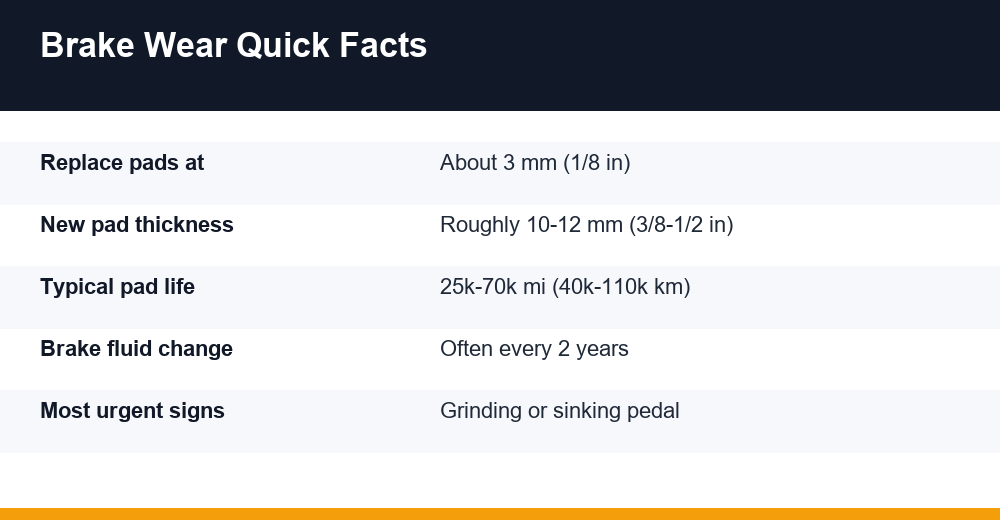
| About 3 mm | About 1/8 in | Most garages recommend replacing now |
| 2 mm or less | Under about 3/32 in | Replace without delay; disc damage is likely soon |
The inner pad often wears faster and is hidden from view, so a wheel-off inspection by a mechanic remains the proper check. If you cannot see the pads, leave wheel removal to a garage rather than working under a raised car, and never put any part of your body under a car held up only by a jack. The simplest option is to ask the garage to show you the pads when the wheels are next off.
Legal limits differ by country. In the UK, the MOT treats a pad worn down to its wear indicator as a major defect and one below 1.5 mm as dangerous. Some US states with safety inspections, such as Virginia, fail pads at 2/32 in (about 1.6 mm). Discs also have a minimum thickness, usually stamped on the disc or hub (often marked MIN TH). Garages usually replace parts well before these limits.
Typical lifespans of pads, discs and brake fluid
Driving style matters more than almost anything else. City traffic, hills, heavy loads and towing wear brakes quickly, while long motorway or highway runs barely touch them. The figures below are typical ranges, not guarantees, and your owner’s manual or service schedule takes priority.
| Component | Typical range | Wears faster when |
|---|---|---|
| Front pads | 25,000-70,000 miles (40,000-110,000 km) | City driving, hilly routes, heavy or late braking |
| Rear pads or shoes | Often longer than fronts; rear drums can last longer still | The stability control or electronic parking brake works the rear brakes hard |
| Discs (rotors) | Often every second pad change; roughly 30,000-80,000 miles (50,000-130,000 km) | Pads run down to metal, repeated overheating, corrosion |
| Brake fluid | Commonly every 2 years, but check the manual | Humid climates; fluid absorbs moisture whatever the mileage |
| Pads on hybrids and EVs | Can exceed 100,000 miles (160,000 km) | Rarely used friction brakes can corrode and stick instead |
On hybrids and electric cars, regenerative braking does much of the slowing, so pads last far longer, but discs that are rarely used can rust, pit and seize, especially at the rear and in wet or salty conditions. They still need regular inspection, and with high-voltage systems on board, the work belongs with a qualified technician.
How climate changes the picture
- Hot, dry climates such as the Gulf or inland Australia put more heat through the system and age the fluid faster.
- Humid and monsoon regions speed up disc rust and moisture uptake in the fluid.
- Winter road salt in the UK, northern US, Canada and much of Europe corrodes discs, slide pins and brake lines.
- Mountain and hill driving wears pads fastest of all. A lower gear on long descents lets the engine share the work.
How to judge a brake quote from a garage
Spotting the signs your brakes need replacing gets you through the garage door. Next, check that the work on the quote matches what is actually worn.
Questions worth asking
- What is the measured pad thickness on each axle? You should get numbers in millimetres, front and rear, not just “they’re getting low”.
- Are the discs below their minimum thickness, or badly scored? Ask for the figures.
- Why is the fluid being changed? Because it is due by date, or because it failed a moisture or boiling-point test?
- Can I see the old parts? A reputable workshop will happily show you.
- What quality of parts are being fitted? Parts of equivalent quality to the originals are a sensible standard.
Red flags on a brake quote
- New discs recommended on a low-mileage car with half-worn pads and no vibration or scoring.
- A brake fluid flush at every service when your manual specifies a longer interval.
- Callipers quoted for replacement with no evidence of sticking, leaking or seized pins.
- Pads or discs listed for one wheel only. They are replaced in axle pairs, both fronts or both rears, so the braking stays even.
Prices vary widely by country, car and garage, but pads and discs together on one axle often cost around twice as much as pads alone, and larger SUVs and performance cars cost more. If a quote seems high, asking another garage for a second written quote is perfectly normal.
For other extras on service sheets, our list of dealer service upsells you can usually refuse covers the common ones. Brakes are different: when measurements show real wear, pay for the repair. Worn brakes also risk failing a roadworthiness test, wherever you live.
Finally, when several signs your brakes need replacing show up together, such as grinding plus a car that pulls, treat it as urgent. Brake repairs belong with a qualified mechanic, and a prompt inspection nearly always costs less than letting worn pads wear grooves into a set of discs.
Frequently Asked Questions
How long can I keep driving once the brakes start squealing?
There is no safe fixed figure. A persistent squeal is one of the earliest signs your brakes need replacing, and wear indicators are designed to sound when only a few millimetres of pad remain, so book an inspection within days rather than weeks. Hills, heavy loads and hard braking use up that margin quickly, and waiting until grinding starts usually means paying for new discs too.
Do I need new discs every time I replace the pads?
Not necessarily. Many discs last through two sets of pads. They need replacing when worn below the minimum thickness stamped on them, when deeply scored or cracked, or when uneven thickness causes vibration. Ask the garage to show you the measurement before agreeing to new discs.
Is it normal for brakes to squeak or grind after rain?
Yes, usually. A thin layer of surface rust forms on the discs overnight in damp or humid weather, and the first few stops scrape it off with a light squeal or grind. If the noise lasts beyond a few stops or returns every time you brake, have the pads checked.
How often should brake fluid be changed?
Many manufacturers specify every two years, though some set different intervals by time or distance, so check your owner’s manual. Because the fluid absorbs moisture from the air, age matters more than mileage. A garage can test its moisture content or boiling point before recommending a change.