
If your car shakes when braking, the explanation you will hear most often is “warped rotors”, yet genuine warping is uncommon and the real cause is often simpler. This guide covers six common causes, from uneven pad deposits and sticking calipers to wheel balance and wheel-nut torque. It also lists the questions to ask your mechanic, so you pay only for the repair your car actually needs.
Table of Contents
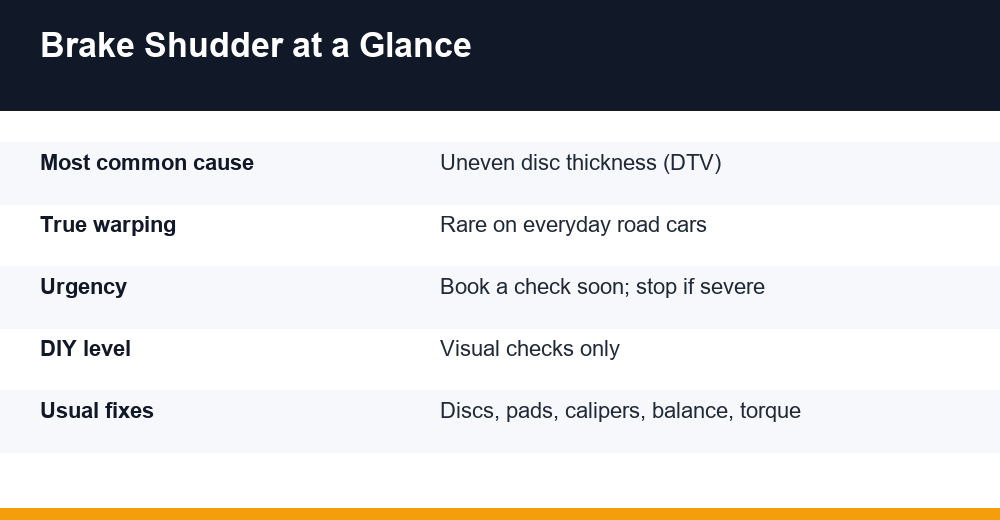
Car Shakes When Braking? Start With Where You Feel It
Before anyone picks up a spanner, the most useful clue is where the vibration reaches you. A shake through the steering wheel, a pulse under your foot and a shudder through the seat usually point to different parts of the car.
Spend a few journeys noticing the pattern. Does it happen at every speed, or only when slowing from a fast road? Is it worse after a long downhill stretch? Can you feel it without braking at all? A mechanic can diagnose faster, and often more cheaply, when you can answer these questions.
| What you notice | Most likely area | What it suggests |
|---|---|---|
| Steering wheel wobbles side to side | Front discs, front wheels or front tyres | A front-end issue; the most common pattern |
| Brake pedal pulses up and down | Disc thickness variation (front or rear) | Uneven discs are pushing the caliper pistons back and forth |
| Seat or whole body shudders | Rear discs or drums, rear tyres | Often subtler and easy to mistake for a rough road |
| Shake at speed without braking that gets worse when you brake | Wheel balance, a damaged tyre or worn suspension | Braking is exaggerating a problem that already exists |
| Shake plus a pull to one side | Sticking caliper or uneven braking | Have it checked promptly |
| Pulsing pedal only in a hard stop or on a slippery surface | Anti-lock brakes (ABS) working | Normal behaviour, not a fault |
That last row catches many drivers out. When ABS steps in during an emergency stop, or on gravel, ice or a wet painted line, the pedal buzzes and kicks back on purpose. If the pulsing happens during gentle, everyday stops on dry roads, something else is going on.
Timing matters too. A judder that built up over months suggests wear or deposits, while one that appeared straight after a tyre change, pothole strike or brake job often points to a lost balance weight or unevenly tightened wheel nuts.
The Warped Rotor Myth in Plain English
A quick word on names: Americans say brake rotors, while most of the English-speaking world says brake discs. They are the same metal plates that the pads squeeze to slow each wheel.
The popular story is that hard braking heats the disc until it bends. On ordinary road cars, that kind of true warping is rare. What usually happens is disc thickness variation (DTV): part of the disc ends up slightly thicker or thinner than the rest of it.
The differences involved are tiny. On some cars, a variation of around 0.015 mm, thinner than a typical human hair, is enough to cause judder. As that uneven band spins through the caliper, the pads are pushed apart and drawn back several times a second, and you feel it as a pulse in the pedal and a shake in the steering.
How the unevenness starts
- Pad deposits: brake pads leave a thin film of friction material on the disc. When that film is laid down evenly, braking is smooth. When it builds up in patches, the patches behave like raised bumps.
- Runout (a slight wobble): if the disc does not spin perfectly true, often because of rust on the hub or unevenly tightened wheel nuts, one spot brushes the pad on every rotation. Over thousands of miles that spot wears differently and turns into thickness variation.
- Uneven corrosion: a car left parked for weeks, especially in humid or coastal areas, can rust under the pads in one place, leaving a band that grips and wears differently from the rest of the disc.
If you want to see how official testers judge discs, the UK’s MOT inspection manual for brakes notes that a disc must be significantly worn, not merely below the maker’s limit, before it fails. The practical message is that, most of the time, a car shakes when braking because of uneven disc surfaces rather than a bent disc.
Does the label matter? For the repair, not much, since an uneven disc may still need skimming or replacing. For prevention, it matters a lot, because the habits behind deposits and runout are ones you and your garage can change.
6 Common Reasons a Car Shakes When Braking
Here are the usual suspects, roughly in order of how often they turn up. More than one can be present at once.
1. Disc thickness variation and worn discs
This is the classic cause of pedal pulsing and steering shimmy. Discs also wear thinner over time, and a thin disc runs hotter and is more prone to uneven wear. Every disc has a minimum thickness set by the manufacturer, usually stamped on the disc itself, and a mechanic measures against that figure.
If the shake arrives alongside squealing, grinding or a soft pedal, read our guide to the warning signs that your brakes need replacing, because worn pads and worn discs often go together.
2. Patchy pad deposits from heat or poor bedding-in
New pads and discs need a bedding-in period so the pads lay an even film on the discs. Skipping it, or braking very hard from high speed in the first few hundred miles, can leave patches behind.
Heat makes it worse. After a long mountain descent, discs can easily exceed 200°C (about 390°F). Holding the pedal down hard while stopped presses hot pad material onto one spot, leaving an imprint that you later feel as judder.
3. A sticking caliper or seized slider pins
The caliper is the clamp that pushes the pads against the disc. Its piston and slider pins need to move freely. When dirt, corrosion or split rubber boots make them stick, a pad keeps rubbing, overheats one disc and wears it unevenly.
Clues include the car pulling to one side, a burning smell, one wheel noticeably dustier or hotter than the others, and slightly worse fuel economy. A sticking caliper is a job for a qualified mechanic, not a weekend experiment, because the repair involves the hydraulic system.
4. Wheel balance and tyre problems
An out-of-balance wheel usually shakes the steering at particular speeds, often somewhere between 50 and 70 mph (about 80 to 113 km/h), whether you are braking or not. Braking can make it feel worse because weight shifts forward onto the front wheels.
Lost balance weights, a bulge in the sidewall, a flat spot from a locked-wheel stop or uneven tread wear can all produce a shake. Regular rotation keeps wear even, and our tyre rotation pattern guide explains which way to move them for your drivetrain.
5. Wheel-nut torque and rust on the hub
This cause rarely gets mentioned. Wheel nuts or bolts should be tightened to a specific torque in a star pattern. If they are fired on unevenly with an air gun, or some end up much tighter than others, the disc can be clamped slightly out of true.
Rust or dirt trapped between the hub and the disc has a similar effect, acting like a thin wedge. The result is runout, which slowly creates thickness variation. It explains why some cars develop judder a few thousand miles after new tyres or a brake job.
6. Worn suspension or steering joints
Braking sends a lot of force through the front suspension. Worn control-arm bushes, ball joints, track-rod ends (tie-rod ends in the US) or wheel bearings let the wheel shift slightly under load, turning a tiny disc imperfection into an obvious shudder. A clunk when you first brake or vague steering are typical hints, and these faults need a qualified mechanic.
Safe Checks You Can Do Before Booking a Garage
You do not need tools for these checks, and none of them involve getting under the car. Never work beneath a vehicle held up only by a jack; lifting and supporting a car is a job for a garage lift or proper axle stands used by someone trained.
- Check tyre pressures when the tyres are cold. Many cars sit somewhere around 30 to 35 PSI (about 2.1 to 2.4 bar), but always use the figure on your door-jamb sticker, fuel-filler flap or owner’s manual.
- Look at each tyre for bulges, cuts, flat spots or uneven wear across the tread. Legal minimum tread depth varies by country; in the UK it is 1.6 mm across the central three-quarters of the tread, and many experts suggest replacing tyres well before that, at around 3 mm.
- Check whether any wheel has a clean patch where a balance weight used to sit.
- After a normal drive, hold the back of your hand near (not on) each wheel. If one side gives off far more heat than the other, a caliper may be dragging. Discs can easily be hotter than 100°C (212°F), so do not touch them.
- Note any smells, noises or pulling to one side, and the speeds at which the shake starts and stops.
- Glance at the dashboard. A brake, ABS or stability-control light changes the urgency, and our guide to what dashboard warning lights mean explains which ones need immediate attention.
- If the wheels were removed recently, ask the garage whether the nuts were finished by hand with a torque wrench.
Anything beyond these visual checks, including removing wheels, inspecting pads or topping up brake fluid, is best left to a qualified mechanic. Jot down what you notice, such as “steering shake from about 60 mph (100 km/h), worse downhill”, because it gives the technician a head start.
Is It Safe to Drive When Your Car Shakes When Braking?
A mild pulse that has crept in over months is usually not an emergency, but it does mean something is wearing unevenly, and it will not fix itself. Braking can become less consistent, and an underlying fault such as a dragging caliper tends to get worse with use.
| What you are experiencing | How urgent | Sensible next step |
|---|---|---|
| Mild pulse at higher speeds only, no other symptoms | Moderate | Book a brake inspection within a week or two |
| Strong judder at most speeds | Soon | Drive gently and get it checked within days |
| Shake plus pulling to one side or a burning smell | Urgent | Keep driving to a minimum and see a mechanic as soon as possible |
| Grinding, a soft or sinking pedal, or a red brake warning light | Stop driving | Arrange recovery or towing to a garage |
| Violent shaking, a wheel that feels loose, or clunking | Stop driving | Pull over safely; a loose wheel is dangerous |
When in doubt, treat the problem as more serious, not less. Leave extra space to the vehicle in front until the brakes have been inspected, and if you are unsure whether to continue a journey, stop somewhere safe and call your breakdown provider.
What to Ask the Mechanic Before You Pay
A good mechanic will happily explain the diagnosis. These questions help you understand the work and avoid paying for parts that are not needed.
| Question to ask | Why it matters |
|---|---|
| Did you measure disc thickness and runout, or just look at the discs? | A micrometer and dial gauge give a real answer; a quick glance does not |
| Are the discs above minimum thickness? | Discs close to the limit are usually better replaced than skimmed |
| Can the discs be skimmed, and is it worth it here? | Skimming suits thick discs with surface problems, but it thins them further |
| Did you check the caliper slider pins and pistons? | New discs will judder again if a sticking caliper caused the problem |
| Will you clean the hub faces before fitting new discs? | Rust on the hub causes runout and repeat judder |
| Will the wheel nuts be finished with a torque wrench? | Uneven clamping can bring the shake straight back |
| Do I need to bed in the new pads, and how? | Correct bedding-in prevents patchy deposits |
Discs and pads are normally replaced in pairs across an axle so both sides brake evenly. Prices vary widely between countries, car types and garages, so the table below shows relative cost rather than exact figures.
| Typical fix | Typical relative cost |
|---|---|
| Re-torquing wheel nuts | Very low, sometimes free |
| Wheel balancing | Low |
| Cleaning and lubricating caliper sliders | Low to moderate |
| Skimming discs (where thick enough) | Low to moderate |
| New discs and pads on one axle | Moderate |
| Caliper replacement | Moderate to higher |
| Suspension joints, bushes or wheel bearings | Moderate to higher, depending on the car |
How to Stop the Shudder Coming Back
Once the fault is fixed, a few habits make repeat judder much less likely. None of them cost much, and some cost nothing at all.
- Bed in new brakes exactly as the pad maker or your garage advises. This usually means a series of moderate stops in a safe, quiet place, without coming to a complete halt each time.
- On long descents, use a lower gear (or a stronger regenerative braking setting on many hybrids and EVs) so the brakes do not overheat.
- After a hard stop, try not to hold the pedal down firmly while stationary; ease off slightly, or use the parking brake or auto-hold function if your car has one.
- Ask for wheel nuts to be finished by hand to the manufacturer’s torque figure whenever the wheels come off.
- Have caliper sliders cleaned and lubricated at each pad change, particularly where roads are salted in winter or the air is humid and salty.
- Drive the car at least once a week if you can, because cars left parked for long spells are prone to rust bands on the discs.
- Rotate tyres at the interval in your manual, commonly around every 5,000 to 8,000 miles (about 8,000 to 13,000 km).
Brakes are checked in roadworthiness tests in many places, such as the UK MOT, although rules differ by country. Fixing judder early keeps the car safer and avoids surprises at test time.
In short, if your car shakes when braking, treat it as a useful warning rather than a reason to panic. Note the symptoms, carry out the simple checks, ask the right questions and let a qualified mechanic measure the discs before anything is replaced.
Frequently Asked Questions
Can my brake discs be skimmed instead of replaced?
Often, yes, if they are comfortably above the minimum thickness and the problem is surface unevenness. Skimming removes metal, so thin discs are better replaced. Ask your mechanic to measure them first, and to check the calipers and hub faces too, otherwise the judder may return.
My car shakes when braking from motorway speeds only. Why?
Small amounts of disc thickness variation or a slight wheel imbalance are most noticeable at higher speeds, where the wheels spin faster and the brakes work harder. It is often an early warning, so have the brakes and wheel balance checked before it gets worse.
Why did the shaking start soon after new brakes were fitted?
Common reasons include skipped bedding-in, rust left on the hub face, unevenly tightened wheel nuts or a sticking caliper that was not serviced. Go back to the garage that did the work and ask them to check runout and wheel-nut torque.
Is a pulsing brake pedal in an emergency stop normal?
Yes, if the car has anti-lock brakes. ABS rapidly releases and reapplies the brakes to stop the wheels locking, which you feel as a buzzing or kicking pedal. Keep pressing firmly and steer around hazards. Pulsing during gentle everyday stops on dry roads is not normal.