
Learning how to check tyre tread depth takes five minutes, and the coin in your pocket is a good place to start. This guide walks through five coin tests used around the world, the tread-wear bars moulded into every car tyre and simple depth gauges, along with the legal minimums in different countries. It also explains why we suggest replacing tyres at around 3mm rather than waiting for the legal limit.
Table of Contents
Why Tread Depth Matters Most in the Rain
Tread grooves have a real job to do. They channel water out from under the tyre so the rubber stays in contact with the road. A new car tyre usually starts with around 7–8mm of tread (roughly 9/32–10/32 of an inch), and every millimetre you lose reduces how much water those grooves can move.
On a dry road, a worn tyre can feel perfectly normal. The difference shows up when it rains. With shallow grooves, a film of water can build up under the tyre and lift it off the surface, which is known as aquaplaning (hydroplaning in the US). Steering goes light, stopping distances grow and the car can slide.
That applies whether you drive through a British winter, an Indian monsoon or a Florida thunderstorm, and especially in the first downpour after a long dry spell, when dust and oil make roads slippery.
Worn tread typically affects:
- Stopping distances on wet roads, which get noticeably longer
- Grip when cornering in the wet
- Resistance to aquaplaning at motorway and highway speeds
- Traction in snow, slush and mud
- Puncture resistance, as there is less rubber between the road and the tyre’s internal structure
Once you know how to check tyre tread depth, the job takes only a few minutes a month. Depth is only part of the picture, though. Rubber ages even on a car that rarely moves, so it is also worth learning how to read the tyre date code on the sidewall to see how old your tyres really are.
Legal Tread Depth Minimums by Region
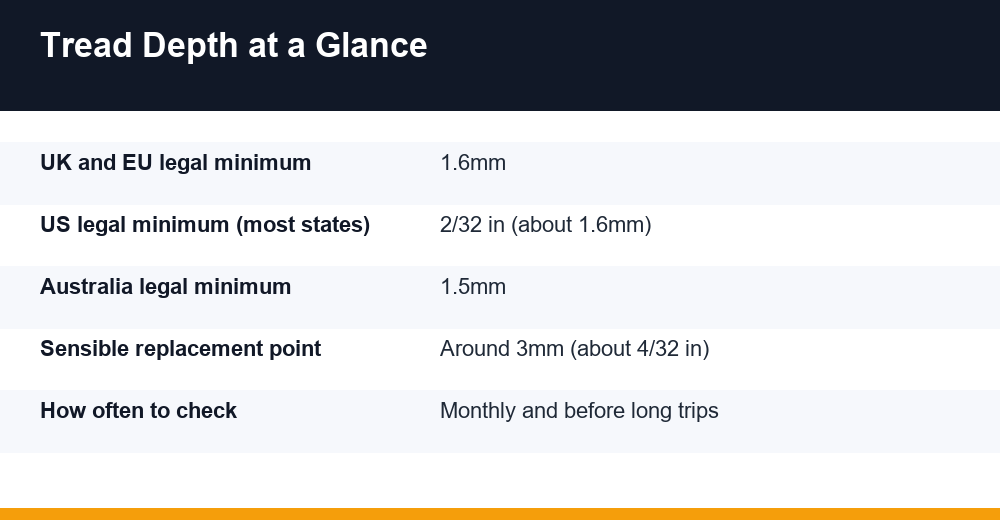
Before you start measuring, it helps to know the number you are measuring against. Legal requirements differ by country, and sometimes by state or province, so treat the table below as a general guide and confirm the rules where you live.
| Region | Typical legal minimum (cars) | Notes |
|---|---|---|
| United Kingdom | 1.6mm | Across the central three-quarters of the tread, around the whole circumference |
| European Union | 1.6mm | Some countries, such as Austria, require more for winter tyres during the winter season |
| United States | 2/32 in (about 1.6mm) in most states | Set by individual states; a few have no specific figure |
| Canada | Commonly 2/32 in (about 1.6mm) | Set by each province; winter tyre rules vary |
| Australia | 1.5mm | Tread-wear indicators are the usual visual reference |
| India | 1.6mm | Monsoon driving makes a higher personal limit sensible |
| UAE | 1.6mm for cars | Higher limits apply to larger vehicles; heat speeds up rubber ageing, so check age as well as depth |
| South-East Asia | Often 1.6mm | Varies by country; check your transport authority’s guidance |
In the UK, driving on tyres below the limit can bring a fine of up to £2,500 and three penalty points per tyre, so four worn tyres could add up to £10,000 and 12 points. Other countries have their own penalties, and a worn tyre could also complicate an insurance claim after a crash.
In the US, where the word is spelled “tire”, federal safety advice is that tyres are no longer safe at 2/32 of an inch and that tread should be checked at least once a month. You can read the official guidance on NHTSA’s tire safety page. Whatever your country, think of the legal figure as the absolute minimum, not a target to aim for.
How to Check Tyre Tread Depth With Five Coin Tests
Coin tests are quick, free and more useful than they sound. They will not give you an exact reading, but they tell you which side of an important line you are on. Set up like this first:
- Park on flat, level ground with the engine off and the handbrake (parking brake) on. None of these checks need the car lifted, so never crawl under a car supported only by a jack.
- Turn the steering to full lock before switching off, so the front tyres stick out and are easier to reach.
- Choose a main groove: the deep channels running around the tyre, not the thin slits (sipes) cut into the tread blocks.
- Test the inner, centre and outer grooves, then roll the car forward a little and repeat at two more points around the tyre.
1. The UK 20p test (about 1.6mm)
Push a 20p coin into a main groove. The raised outer band on the coin sits roughly 1.6mm from its edge. If the band is hidden, the tyre is above the UK legal minimum at that spot. If any of the band shows, the tyre may be at or below the limit and should be measured properly by a tyre fitter without delay.
2. The US penny test (2/32 inch)
Hold a US penny with Lincoln’s head upside down and facing you, then slide it into a groove. If you can see the top of his head, the tread is at or below about 2/32 of an inch (1.6mm) and the tyre needs replacing. Passing this test only tells you the tyre is not yet at the legal limit.
3. The US quarter test (4/32 inch)
Use a quarter the same way, with Washington’s head pointing down into the groove. If the tread reaches the top of his head, you have roughly 4/32 of an inch (about 3.2mm) or more. If there is a gap above his head, you are below that and it is time to plan for new tyres. Because it warns you earlier, many tyre experts now prefer the quarter to the penny.
4. The €1 coin test (about 3mm)
Many drivers in Europe use a €1 coin, whose gold outer ring is roughly 3mm wide. Stand the coin upright in a groove. If the gold ring disappears completely, you have about 3mm or more. If gold is visible, you are below that and closer to replacement time than the legal limit suggests.
5. Calibrate your own local coin
Many countries, including India, Australia and the Gulf states, have no widely used coin test, and coin designs change over time. The workaround is simple. Use a tread depth gauge once to measure how far a feature on a local coin sits from its edge, then make a note of it. From then on, that coin is your personal pocket gauge.
| Coin | What to look at | Depth it indicates | Passes if |
|---|---|---|---|
| UK 20p | Raised outer band | About 1.6mm | Band is hidden |
| US penny | Top of Lincoln’s head | 2/32 in (about 1.6mm) | Part of the head is covered |
| US quarter | Top of Washington’s head | 4/32 in (about 3.2mm) | Tread touches his head |
| €1 coin | Gold outer ring | About 3mm | Gold ring is hidden |
| Your local coin | The feature you measured | Whatever you measured | Feature is hidden |
A coin is a screening tool, not a measuring instrument. Worn coins, unusual groove shapes and the angle you hold the coin all affect the result. If a test is borderline, confirm it with a gauge or ask a tyre fitter to measure for you.
It also pays to test every tyre rather than just one. Front tyres on most cars wear faster than rears, and a single tyre can wear quickly if something is out of adjustment. The lowest reading you find on any tyre is the one that counts.
Tread-Wear Bars and Depth Gauges
Every modern car tyre has tread-wear indicators (often marked TWI) moulded into it. These are small raised bars of rubber running across the bottom of the main grooves, standing about 1.6mm (2/32 inch) high. When the surrounding tread wears down level with the bars, the tyre has reached the legal limit in most countries.
To find them, look around the shoulder of the tyre, where the tread meets the sidewall, for a small triangle, the letters TWI or a maker’s logo. Follow that marker into the nearest main groove and you will find the bar. There are usually several spaced evenly around the tyre.
Wear bars are handy because they are always there and need no tools. The catch is that once the tread is flush with them, you are already past the point where we would suggest replacing. Treat a bar that is close to level with the tread as a warning, not a deadline.
Using a tread depth gauge
If you want the most reliable answer to how to check tyre tread depth, a tread depth gauge beats any coin. Simple pen-style and digital versions are inexpensive, sold at most car parts shops and give you an actual number. To use one:
- Zero the gauge by pressing it flat against a hard surface and checking it reads 0.
- Push the probe to the bottom of a main groove and press the flat base firmly against the tread blocks on either side.
- Read the depth, then repeat on the inner, centre and outer grooves.
- Take readings at three or four points around each tyre and note the lowest figure.
- Avoid measuring on top of a wear bar, which gives a falsely low reading.
Gauges usually show millimetres, 32nds of an inch or both. A handy conversion: 1/32 inch is about 0.8mm, so 4/32 is roughly 3.2mm and 6/32 is roughly 4.8mm.
Why 3mm Beats the Legal Minimum as a Replacement Point
Tyre grip does not fade evenly. Independent wet braking tests have repeatedly shown that performance on a wet road falls away faster once tread drops below about 3mm. The tyre still looks usable, but its ability to clear water shrinks just when you need it most.
For that reason, many tyre and road safety organisations suggest replacing at around 3mm (about 4/32 inch) instead of running down to 1.6mm. The case is stronger still if you drive in heavy rain, cover lots of motorway or highway miles, or regularly carry a full load. For snow, around 4mm (about 5/32 inch) or more is a common recommendation.
| Tread depth | Approx. in inches | What it means | Suggested action |
|---|---|---|---|
| 8mm | 10/32 | Typical new car tyre | Check monthly |
| 5mm | 6/32 | Plenty of life left | Keep checking and rotate as your manual advises |
| 4mm | 5/32 | Wet grip starting to reduce; marginal for snow | Start budgeting for replacements |
| 3mm | 4/32 | Sensible replacement point for most drivers | Replace soon, ideally before the rainy season or winter |
| 2mm | About 2.5/32 | Close to the legal minimum | Replace now |
| 1.6mm | 2/32 | Legal limit in most countries (1.5mm in Australia) | Replace immediately |
Replacing a little early costs you only the last millimetre or so of a tyre’s life, and that is the stretch where wet grip is weakest. It usually makes sense to replace tyres in pairs on the same axle so the car handles predictably. Your owner’s manual or a tyre fitter can advise, particularly on all-wheel-drive cars, which can be sensitive to mismatched tread.
Reading Uneven Wear and What It Tells You
Part of knowing how to check tyre tread depth is comparing readings across the width of each tyre. Even wear is good news. A clear difference between the inner edge, centre and outer edge points to a cause that needs fixing, or your new tyres will wear out the same way.
| Wear pattern | Likely cause | What to do |
|---|---|---|
| Both outer edges worn | Under-inflation | Check and correct pressures |
| Centre worn more than edges | Over-inflation | Set pressures to your car’s recommended figures |
| One edge worn (inner or outer) | Wheel alignment out | Have alignment checked by a qualified mechanic |
| Patchy, scooped dips (cupping) | Worn shock absorbers, suspension parts or wheel imbalance | Have suspension and balance checked by a qualified mechanic |
| Tread blocks sharp on one side (feathering) | Alignment (toe) problem | Book an alignment check with a tyre or alignment specialist |
Pressure is the cause you can sort out yourself. Use the figures on the door-pillar sticker, fuel flap or in the owner’s manual, never the maximum printed on the sidewall. Our correct tyre pressure guide explains how to check pressures with the tyres cold. Many family cars sit somewhere around 30–36 PSI (about 2.1–2.5 bar), but always go by your own car’s figures.
Alignment, suspension and steering faults are jobs for a qualified mechanic, so do not try to adjust them yourself. If you spot bulges, deep cuts, exposed cords or cracking in the sidewall, stop driving on that tyre, fit the spare if you have one and have it inspected. Good tread depth cannot make a damaged tyre safe.
Front and rear tyres also wear at different rates, especially on front-wheel-drive cars. Swapping them around on a regular schedule, using a tyre rotation pattern that suits your car, helps all four wear evenly. Many manufacturers suggest rotating roughly every 5,000–7,500 miles (about 8,000–12,000 km), but check the interval for your vehicle, as some tyres and drivetrains have specific rules.
A Simple Monthly Tread Check Routine
Knowing how to check tyre tread depth only helps if you actually do it. A five-minute check once a month, and before any long journey, is enough for most drivers. Here is a routine that works:
- Check pressures first, with the tyres cold (parked for a few hours, or driven no more than a mile or two, about 2–3 km).
- Run a coin test or take gauge readings on the inner, centre and outer grooves of each tyre.
- Record the lowest reading for each tyre in a note on your phone so you can see the trend over time.
- Look along both sidewalls for cuts, bulges, cracks or embedded nails and stones.
- Glance at the date code, especially if the tyres are more than a few years old.
- Check the spare too, if your car has one.
Hot climates deserve a special mention. In parts of the Middle East, India and Australia, road surfaces can exceed 60°C (140°F) in summer when the air is around 45°C (113°F). That heat can harden and crack rubber sooner, so a tyre with plenty of tread may still be too old or too damaged to trust.
Cold climates bring their own issue. Tyre pressure drops by roughly 1 PSI (about 0.07 bar) for every 10°F (about 5.5°C) fall in temperature, so check more often as the weather turns from mild to near freezing, around 0°C (32°F). Low pressure then speeds up wear on the outer edges.
If readings fall quickly between checks, or one tyre is always lower than the rest, something else is going on, and a tyre specialist or qualified mechanic can find the cause. When in doubt, follow your owner’s manual and ask a professional to take a look.
Frequently Asked Questions
Is the 20p test accurate enough?
It is a dependable quick check against the UK legal limit of 1.6mm, but it is not a precise measurement. Coin wear and groove shape can affect the result. Since we suggest replacing at around 3mm, a hidden 20p band does not mean your tyres have plenty of life left. Use a gauge for a real figure.
How often should I check my tread depth?
Once a month and before long trips is a sensible habit, ideally at the same time as checking pressures. If you cover high mileage or are heading into a rainy season or winter, check more often. Writing down your readings helps you spot uneven or unusually fast wear early.
Are my tyres legal until the wear bars show?
Wear bars sit at about 1.6mm, so tread level with them means the tyre is at the limit in most countries (the limit is 1.5mm in Australia). UK law applies across the central three-quarters of the tread, so one worn patch can be enough to fail. In practice, replace well before the bars are flush.
Can I replace just one tyre?
Sometimes, but it depends on how worn the other tyre on that axle is and on the vehicle. Many fitters recommend replacing in pairs on the same axle, and some all-wheel-drive cars are sensitive to tread differences. Check your owner’s manual and ask a qualified tyre fitter before mixing new and worn tyres.