
Strange car noises are your vehicle’s earliest warning system, and most of them start quietly long before anything fails. The trick is not memorising a list of sounds but noting exactly when the noise happens and where it seems to come from. This guide gives you that lookup, with an honest urgency rating for each sound, including the ones you can safely ignore.
Table of Contents
How to Diagnose Strange Car Noises: When, Where, What
Most online lists group sounds by type: grinding here, squealing there. The problem is that the same squeal can be a harmless morning quirk or a worn-out part, depending on when it happens. A mechanic diagnoses by context first, then by sound, and you can do the same.
Before you guess at a cause, answer three questions. Write the answers down, because they are exactly what a workshop will ask you anyway.
- When does it happen? Braking, turning, accelerating, cold start, over bumps, at a steady speed, or all the time?
- Where does it seem to come from? Front or rear, left or right, under the bonnet, underneath the cabin, or from a wheel?
- How does it change? Does it follow road speed, engine speed (revs), steering angle, or temperature?
The third question is the most powerful. A noise that rises with road speed but ignores the revs points to the wheels, tyres or driveline. A noise that rises with the revs even when the car is parked points to the engine or its belt-driven accessories.
One quick test separates the two: with the car safely stopped in neutral or park and the handbrake on, gently raise the revs. If the noise follows, it lives in the engine bay. If it only appears on the move, look at brakes, bearings, tyres and suspension.
The Strange Car Noises Lookup Table
Use this table as a first-pass lookup. Find the row that matches when the sound happens, then read the likely causes and the urgency. The ratings are general guidance, not a diagnosis; any noise that comes with a warning light, a change in braking or steering feel, or smoke moves straight to stop now.
| Sound | When it happens | Likely cause | Urgency |
|---|---|---|---|
| Light squeal | First few stops on a damp morning | Surface rust on brake discs | Drive on |
| High-pitched squeal | While driving or braking, comes back every trip | Pad wear indicator touching disc | Book soon |
| Metal grinding | Braking | Pads worn to backing plate | Stop now |
| Groan | Gentle stops | Glazed discs or pads | Book soon |
| Squeal or chirp | Cold start, accelerating, A/C on | Loose or worn drive belt | Book soon |
| Clunk | Over bumps or potholes | Worn shocks, links, bushes, ball joints | Book soon |
| Rapid clicking | Tight turns while moving | Worn CV joint | Book soon |
| Whine | Turning the steering wheel | Low power steering fluid or failing pump | Book soon |
| Hum or drone | Rises with road speed | Tyre wear pattern or wheel bearing | Book soon |
| Light tick | Cold start, fades in seconds | Hydraulic lifters filling with oil | Drive on (check oil) |
| Deep knock | Under load or constant | Bearing wear, detonation, low oil | Stop now |
| Hiss | Engine running or just switched off | Vacuum leak or coolant leak | Book soon / stop if overheating |
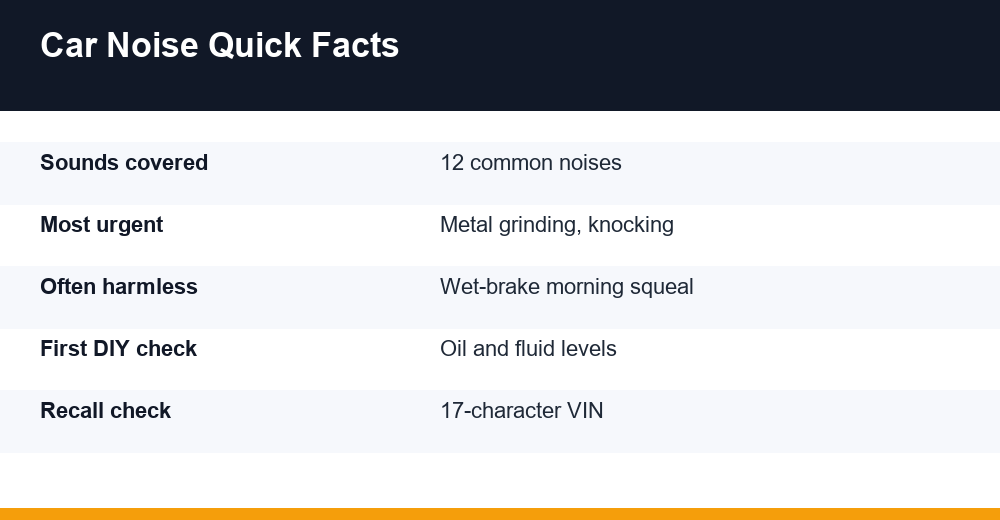
These twelve cover the noises drivers most often ask about. The sections below explain each one, starting with the system that matters most for safety: your brakes.
Grinding, Squealing and Groaning When You Brake
What does a grinding noise when braking mean?
A harsh, metallic grinding when you press the pedal usually means the friction material on the pads has worn away and the steel backing plate is scraping the disc. At that point stopping distances grow and the disc is being damaged with every stop.
Less often, grinding comes from a stone trapped between the disc and its dust shield. That sound tends to be constant, scratchy and may vanish suddenly. Either way, treat metal-on-metal grinding as a stop-now sound and have the brakes inspected before further driving.
The squeal that is designed to annoy you
Many pads carry a small metal tab called a wear indicator. When the pad gets thin, the tab touches the disc and produces a high-pitched squeal, sometimes even without braking. It is a deliberate audible warning: the noise means the pads are due for replacement, not that something has broken. Our guide to the signs your brakes need replacing covers the other clues, such as pedal travel and pad thickness. Some cars use an electronic sensor and a dashboard light instead.
Harmless: the wet-morning squeal
If the car sat outside overnight in rain or dew, a thin film of rust forms on the discs. The first few stops scrub it off with a light squeal or scraping sound. If it disappears within a few stops and braking feels normal, it is nothing to worry about.
Groaning, pulsing and shaking
A low groan during gentle stops often points to glazed discs or pads, usually from heavy or repeated braking. If the groan arrives with a pulsing pedal or a shaking steering wheel, the discs may be unevenly worn; see why a car shakes when braking for the full breakdown. A brief buzz or click just after pulling away can be the ABS system running its self-check, which is normal on many cars.
Why Your Car Squeals on Start-Up or Acceleration
A squeal or chirp from under the bonnet that appears on a cold start, when you accelerate, or when you switch on the air conditioning usually comes from the drive belt (often called the serpentine or auxiliary belt). This belt spins the alternator, A/C compressor and, on some cars, the water pump and power steering pump.
The belt slips and squeals when it cannot grip the pulleys under load. Common reasons include:
- Glazed, cracked or stretched rubber from age
- A weak automatic tensioner that no longer holds the belt tight
- Fluid contamination, such as oil or coolant dripping onto the belt
- A worn pulley bearing on the idler, tensioner or alternator
- Damp weather, which can cause a brief squeal that stops once the belt warms
A brief chirp on a cold, wet morning that stops within a minute is usually a nuisance rather than a fault. A squeal that is getting longer, louder or returns every drive deserves attention soon. If that belt snaps, you can lose battery charging and, on engines where it drives the water pump, cooling as well.
With the engine off, look at the belt for cracks across the ribs, shiny glazed sides or fraying edges. Never touch the belt or pulleys with the engine running.
Clunks Over Bumps and Whines When Turning
What does a clunking noise over bumps mean?
A dull clunk or knock from one corner when you drive over potholes, speed bumps or rough tarmac points to the suspension. The usual suspects are worn anti-roll bar links, tired shock absorbers or their top mounts, perished rubber bushes, or a worn ball joint.
Drop links are relatively cheap and a very common cause of a light, rattly clunk. A heavier clunk with vague or wandering steering is more serious, since a failed ball joint can let a wheel move out of position. Also check the obvious first: a loose item in the boot, a spare wheel not clamped down, or a loose exhaust bracket can mimic suspension noises.
Why does my car make a whining noise when turning?
On cars with hydraulic power steering, a whine or groan that rises as you turn the wheel, especially at parking speeds, usually means the fluid is low and the pump is drawing in air. Check the reservoir level against the min and max marks and look for leaks around hoses. Cold, thick fluid can cause a brief whine that fades as the car warms.
Many newer cars use electric power steering, which has no fluid at all. A whine on those systems is less common and usually needs a workshop to read fault codes. If the steering ever feels suddenly heavy, treat it as urgent.
Clicking on full lock
A rapid clicking or popping when you turn sharply while moving, for example in a car park, is the classic sign of a worn constant-velocity (CV) joint on a front-wheel-drive car. It typically starts after the rubber boot splits, letting grease out and grit in. Caught early, a new boot or joint is a routine job.
Humming That Gets Louder With Speed
A hum, drone or growl that rises and falls with road speed, regardless of which gear you are in, comes from something that rotates with the wheels. The two main candidates are tyres and wheel bearings, and telling them apart takes a little detective work.
| Clue | Points to tyres | Points to wheel bearing |
|---|---|---|
| Changes on different road surfaces | Yes, often clearly | Less so |
| Changes when swerving gently left or right | Rarely | Often louder on one side |
| Visible uneven wear or cupping | Yes | No |
| Gets worse over weeks | Slowly | Steadily, can turn to grinding |
For the swerve test, find a quiet, safe road and gently weave at roughly 40 to 50 mph (65 to 80 km/h). If the hum gets louder when the car leans its weight to the left, the right-hand bearing is often the culprit, and vice versa.
Tyre noise from irregular wear, often caused by misalignment or worn suspension, can be surprisingly loud. Check tread for feathered edges or scalloped patches and confirm pressures match the placard in the driver’s door jamb or the owner’s manual. On rear-wheel and four-wheel-drive cars, a whine that changes when you lift off the throttle can also come from the differential.
A bearing hum is not an emergency on day one, but bearings do fail. If the hum becomes a grinding noise or the wheel feels loose, stop driving.
Ticking, Knocking and Hissing From the Engine Bay
Is it safe to drive with a ticking noise from the engine?
It depends on how long the tick lasts. A light, fast tick for a few seconds after a cold start, which follows engine speed and then fades, is common on engines with hydraulic lifters as oil pressure builds. It is generally harmless.
A tick that continues once the engine is warm is different. First, check the oil level on level ground: low or old oil is a frequent cause, and topping up to the correct level costs very little. Other causes include a leaking exhaust manifold gasket (louder on cold starts), a worn lifter, or normal fuel injector clicking on direct-injection engines. Short trips are usually fine with a correct oil level, but book an inspection if it persists.
Knocking: the sound to take seriously
A deeper, heavier knock that gets louder under load or with revs can signal worn engine bearings, often due to oil starvation. Continuing to drive can wreck the engine. If you hear it alongside an oil pressure warning light, pull over safely and switch off.
Hissing
A hiss while the engine runs often comes from a split vacuum hose, which may also cause a rough idle or warning light. A hiss after switching off, with a sweet smell or steam, suggests a coolant leak onto hot parts. Watch the temperature gauge closely and never open a hot radiator or coolant cap. If a hiss comes with an acrid or rubbery odour, our guide to a burning smell from your car will help you narrow it down.
Drive On, Book Soon or Stop Now
Not every sound needs a tow truck. Grouping strange car noises by urgency helps you avoid both panic and dangerous procrastination.
Drive on (and keep listening)
- Light disc squeal on a damp morning that clears within a few stops
- Brief lifter tick on cold start, with a correct oil level
- Short belt chirp on a cold, wet start that stops within a minute
- A one-off buzz or click from the ABS self-check as you pull away
Book soon (days to a couple of weeks)
- Constant pad wear-indicator squeal
- Suspension clunks over bumps with normal steering feel
- CV joint clicking on full lock
- Steady hum that rises with speed
- Belt squeal that recurs every drive
- Power steering whine that persists after a fluid top-up
Stop now
- Metal grinding when braking, or any change in pedal feel
- Deep engine knock, especially with an oil warning light
- Any noise with steam, smoke, a hot temperature gauge or a burning smell
- Grinding from a wheel, or a wheel that feels loose
- Sudden heavy steering or a loud bang followed by vibration
It is also worth checking whether your car has an open safety recall linked to the component making the noise. In the US, you can enter your 17-character VIN at the NHTSA recall lookup; safety recall repairs are done by a dealer at no charge. Drivers elsewhere should use their national recall service or the manufacturer’s website.
How to Describe a Noise to Your Mechanic
Strange car noises have a frustrating habit of vanishing the moment you arrive at the garage. Giving the technician precise information saves diagnostic time, which saves you money.
- Note the conditions: cold or warm engine, speed, gear, weather, road surface.
- Note the trigger: braking, turning left or right, accelerating, over bumps.
- Describe the sound in plain words, such as squeal, grind, clunk, hum, tick or hiss, and compare it to something familiar.
- Record a short audio clip on your phone from a passenger seat while someone else drives, never while driving yourself.
- Mention any warning lights, smells, vibrations or changes in how the car feels.
- Ask for a road test with you in the car so you can point the noise out.
Be wary of anyone who quotes a large repair without hearing the noise or road-testing the car. A good workshop will confirm the source before replacing parts, and will tell you honestly when a sound is harmless.
Above all, trust your ears. Strange car noises rarely fix themselves, and most are far cheaper to deal with when they first appear than after they have had months to do damage.
Frequently Asked Questions
What does a grinding noise when braking mean?
It usually means the brake pads have worn through their friction material, so the steel backing plate is scraping the disc. Stopping distances increase and the discs are damaged with every stop. Occasionally a trapped stone causes it, but either way the brakes should be inspected before you continue driving.
Why does my car squeal when I start it or accelerate?
A squeal from under the bonnet on start-up, acceleration or with the A/C on is usually a slipping drive belt. Age, a weak tensioner, fluid contamination or a worn pulley bearing are common causes. A brief chirp on a damp morning is often harmless, but a recurring squeal should be checked soon.
Why does my car make a humming noise that gets louder with speed?
A hum that follows road speed rather than engine revs usually comes from tyres or a wheel bearing. Uneven tyre wear tends to change with road surface, while a bearing often gets louder when you gently swerve and load one side. A worsening hum or grinding needs prompt attention.
Is it safe to drive with a ticking noise from the engine?
A brief tick on cold start that fades within seconds is usually normal lifter noise. If it continues when warm, check the oil level first, as low oil is a common cause. Short trips are generally fine with correct oil, but a deeper knock or an oil warning light means stop driving.