This guide gives you tyre sidewall markings explained code by code, so you can read the side of any car tyre and know exactly what you are buying. We cover size, load index, speed rating, XL, winter symbols, run-flat codes and the carmaker approval marks most retailer pages leave out. We also show when it is safe to fit a tyre with a different rating, and when it is not.
Table of Contents
What do the numbers on a tyre mean?
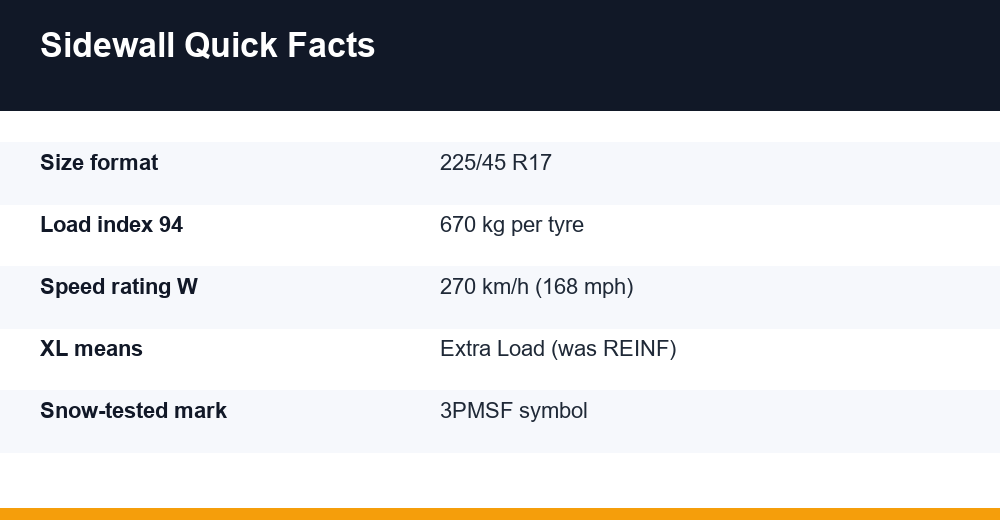
The largest string of characters on the sidewall is the size code. On most passenger car tyres sold in Europe, the UK, Asia and Australia it looks something like 225/45 R17. Every part of it means something specific, and getting any of them wrong means the tyre will not fit the rim, or will throw off your speedometer and the car’s stability systems.
- 225 is the section width in millimetres, measured from sidewall to sidewall at the widest point when fitted to the correct rim.
- 45 is the aspect ratio: the sidewall height as a percentage of the width. Here the sidewall is about 45% of 225 mm, so roughly 101 mm tall.
- R means radial construction, which is what almost every modern car tyre uses.
- 17 is the rim diameter in inches. Yes, tyre sizing mixes millimetres, percentages and inches in one code.
A lower aspect ratio means a shorter, stiffer sidewall. That sharpens steering response but gives a firmer ride and less protection for the wheel against potholes. Changing aspect ratio without also changing width or rim size alters the overall diameter, so stick to the sizes listed in your handbook or on the door-jamb placard.
Some tyres show a ZR inside the size (for example 225/45 ZR17). That is an older way of flagging a tyre rated above 240 km/h. Modern tyres still carry it, but the speed letter in the service description that follows is what tells you the actual limit.
US-market tyres sometimes add a prefix: P for passenger (P225/45R17) or LT for light truck. LT tyres are built and loaded differently, so do not treat a P-metric and an LT tyre as interchangeable just because the numbers match. Any guide to tyre sidewall markings explained for a global audience has to flag this, because imported cars and pickups often carry them.
What are a tyre’s load index and speed rating?
Right after the size you will find a number and a letter, such as 94W. Together they form the service description. The number is the load index and the letter is the speed rating. Neither is a direct measurement; both are codes you look up in a table.
What is a tyre load index?
The load index tells you the maximum weight a single tyre can carry when inflated correctly. A tyre marked 91 can carry 615 kg; one marked 94 can carry 670 kg. Multiply by four and you get the maximum the set can support. The UK government publishes the full reference in the MOT inspection manual load index tables, which are useful if your number falls outside the common range below.
| Load index | Max load per tyre | Speed rating | Max speed |
|---|---|---|---|
| 87 | 545 kg | Q | 160 km/h (99 mph) |
| 89 | 580 kg | R | 170 km/h (106 mph) |
| 91 | 615 kg | S | 180 km/h (112 mph) |
| 92 | 630 kg | T | 190 km/h (118 mph) |
| 94 | 670 kg | H | 210 km/h (130 mph) |
| 96 | 710 kg | V | 240 km/h (149 mph) |
| 97 | 730 kg | W | 270 km/h (168 mph) |
| 100 | 800 kg | Y | 300 km/h (186 mph) |
The two halves of this table are independent: a load index on one row has nothing to do with the speed letter beside it. They are paired here simply to save space.
What is a speed rating?
The speed rating is the highest speed at which the tyre can carry its rated load for a sustained period under test conditions. It is not a target, and it is not a promise of safety at that speed with worn tread, low pressure or an overloaded car. Note that H sits between T and V, out of alphabetical order. A rating shown in brackets, such as (Y), indicates a capability above 300 km/h.
Both figures assume correct inflation. An underinflated tyre flexes more and runs hotter, so it cannot be relied on to deliver its printed capability.
What does XL mean on a tyre?
XL stands for Extra Load. Older tyres may say REINF or Reinforced instead; the meaning is the same, and XL is now the usual marking on passenger tyres. The opposite is SL, for Standard Load, which is usually not printed at all.
An XL tyre has a stronger internal structure that lets it run at higher pressure and therefore carry more weight than a standard tyre of the same size. In a typical 205/55 R16 size, for example, the standard version is usually 91 (615 kg) while the XL version is 94 (670 kg).
Does an XL tyre need different pressures?
This is the part people miss. An XL tyre only delivers its extra capacity at its higher reference pressure. If your car was designed around XL tyres, the placard pressures already account for that. If you swap from SL to XL on a car that did not require XL, follow the carmaker or tyre maker pressure guidance rather than guessing. Our guide to correct tyre pressures explains where to find those figures and how to check them cold.
- Fitting XL where the car only needs SL is fine, provided pressures are set correctly.
- Fitting SL where the car specifies XL is not acceptable, because the load index will fall below the minimum.
- XL tyres can ride slightly firmer and may weigh a little more; on most cars the difference is small.
3PMSF and M+S: the weather symbols
Two markings deal with cold-weather capability, and they are not equal. Understanding the difference matters if you drive where it snows or regularly travel in Europe in winter.
| Marking | What it means | Tested? |
|---|---|---|
| M+S (also M/S, M&S) | Mud and Snow; tread pattern has more open grooves and sipes | No, the manufacturer declares it |
| 3PMSF (three-peak mountain snowflake) | Passed a standardised snow traction test against a reference tyre | Yes |
| Both together | Common on winter and many modern all-season tyres | The 3PMSF part is tested |
M+S is self-declared. A tyre maker can mould it onto a tyre based on the tread design alone, with no snow test required. Plenty of summer-biased SUV tyres carry it. 3PMSF is different: the tyre has to pass a defined snow-performance test before the symbol can appear. Most 3PMSF tyres also carry M+S, but many M+S tyres have no 3PMSF.
An all-season tyre with 3PMSF has passed the same snow test as a dedicated winter tyre, though that does not mean it matches a winter tyre on ice or in deep cold. For a fuller breakdown of the trade-offs, see our comparison of all-season vs winter tyres.
Countries with winter tyre rules increasingly require 3PMSF rather than M+S alone. Germany, for example, stopped accepting M+S-only tyres as winter tyres once its transition period ended in autumn 2024. Rules vary by country and change over time, so check official guidance for wherever you are driving before you set off.
Run-flat codes and OE marks like star, MO and AO
Most retailer pages offering tyre sidewall markings explained skip this part, yet it often explains why two tyres with the same size and the same name cost different amounts.
Run-flat codes
Run-flat tyres have reinforced sidewalls that let you keep driving a limited distance at reduced speed after a puncture. There is no single industry code, so each brand uses its own. Common ones include:
- RFT: Run Flat Tyre, Bridgestone (and used by some other brands)
- ROF: Run On Flat, Goodyear and Dunlop
- SSR: Self-Supporting Runflat, Continental
- ZP: Zero Pressure, Michelin
- DSST: Dunlop Self-Supporting Technology
- EMT: Extended Mobility Technology, Goodyear
- RSC: Run-flat System Component, seen on tyres approved for BMW run-flat fitments
Distance and speed limits after a puncture differ by brand and model, so check the tyre maker’s figures rather than assuming a fixed number. Cars designed for run-flats often have no spare wheel and suspension tuned for stiffer sidewalls. Swapping to conventional tyres is possible, but you would then need a spare, a repair kit or roadside cover.
What does the star or MO marking on a tyre mean?
These are original equipment (OE) approval marks. They show the tyre was developed or homologated to a specific carmaker’s specification and tested on that maker’s vehicles. The tyre model name may be identical to the unmarked version, but the construction, compound or noise treatment can differ to suit the car.
| Mark | Carmaker | Notes |
|---|---|---|
| ★ (star) | BMW and MINI | Run-flat versions often also carry RSC |
| MO | Mercedes-Benz | MOE = run-flat; MO1 = Mercedes-AMG; MO-S = noise-reducing foam |
| AO | Audi | Variants such as AO1 also exist |
| N0, N1, N2… | Porsche | Number is the approval revision, not a quality grade |
Are OE-marked tyres compulsory? Generally not by law. But carmakers recommend them because suspension, ABS and stability control were signed off on those exact tyres. Porsche advises keeping matching N-numbered tyres on the car. As a sensible minimum, never mix an OE-marked tyre with an unmarked one on the same axle.
Tyre sidewall markings explained with a worked example
Here is a realistic sidewall read left to right, the way you might see it on a premium hatchback or small saloon: 225/45 R17 94W XL ★ RSC 3PMSF M+S. It is a busy line, but every element now has a meaning.
- 225: 225 mm wide.
- 45: sidewall height about 45% of the width, roughly 101 mm.
- R17: radial construction for a 17-inch rim.
- 94: load index, 670 kg per tyre, so about 2,680 kg across four tyres at the correct pressure.
- W: rated to 270 km/h (168 mph).
- XL: Extra Load structure; the 94 figure depends on running XL pressures.
- ★: approved original equipment for BMW.
- RSC: a run-flat tyre.
- 3PMSF + M+S: passed the snow traction test, so most likely an all-season or winter tyre.
With tyre sidewall markings explained this way, you can compare a quote against your current tyres in seconds. If a fitter offers 225/45 R17 91W, you would spot straight away that 91 (615 kg) is lower than your 94 (670 kg) and ask why.
Elsewhere on the same sidewall you will find the four-digit manufacture date at the end of the DOT code. We cover that in detail in how to read a tyre date code, so we will not repeat it here.
Can I fit a different load or speed rating?
The rule of thumb is simple: equal or higher is fine, lower needs a good reason. The minimum load index and speed rating for your car are in the handbook and often on the door-jamb or fuel-flap placard. Those minimums are what matter, not necessarily what is currently fitted.
| Change | Generally acceptable? | Why |
|---|---|---|
| Higher load index | Yes | More capacity than needed; set pressures per guidance |
| Lower load index | No | Tyre may be overloaded, especially when the car is full |
| Higher speed rating | Yes | No downside beyond cost and sometimes a firmer feel |
| Lower speed rating (summer tyres) | No | Below the car’s specified capability |
| Lower speed rating (winter tyres) | Often, with conditions | Permitted in many countries if you respect the tyre’s limit |
Can I fit tyres with a different speed rating?
Going higher is always acceptable. Going lower is the grey area. Many tyre makers and carmakers allow winter tyres marked M+S or 3PMSF to carry a slightly lower speed rating than the original summer tyres, on the condition that you never exceed the winter tyre’s limit.
Some countries, including Germany, require a sticker in the driver’s field of view showing the maximum permitted speed when the car can go faster than its tyres are rated for. Check local rules, because the details are set nationally rather than in one EU-wide law.
Insurance, inspections and mixing ratings
- Tell your insurer if you fit tyres below the manufacturer’s specification; undisclosed changes can cause problems with a claim.
- Roadworthiness tests check that tyres suit the vehicle, and an undersized load rating can count against a vehicle, particularly vans and other heavier vehicles.
- If ratings differ between axles, the lower figure effectively sets the limit for the whole car.
- Keep the same size, type and rating across an axle. Mixing on one axle can upset handling.
Other sidewall codes worth knowing
Beyond the headline codes, a sidewall carries regulatory and practical information. These rarely change your buying decision, but they help you check a tyre is legitimate and suited to your market.
- E-mark (a circled E followed by a number): shows type approval under UN ECE regulations. The number identifies the approving country.
- DOT code: required for tyres sold in the US; it identifies the factory and ends with the manufacture week and year.
- UTQG (US): treadwear, traction (AA to C) and temperature (A to C) grades assigned by the manufacturer under NHTSA rules. Treadwear numbers are relative, not a mileage promise.
- TWI or a small triangle: marks where the tread wear indicators sit in the grooves.
- Outside / Inside: asymmetric tyres must be mounted with the correct face outward.
- Rotation arrow: directional tyres must roll in the arrow’s direction.
- Tubeless: standard on modern car tyres.
- Max load and max pressure: absolute limits for the tyre, not the pressure you should run day to day.
One common mistake is inflating to the maximum pressure printed on the sidewall. That figure is the tyre’s structural limit. Your running pressure always comes from the vehicle placard or handbook, adjusted for load where the carmaker says so.
That completes tyre sidewall markings explained from size to small print. With the codes decoded, you can check a quote, spot a wrong fitment and talk to a fitter on equal terms. Snap a quick photo of your current sidewall next time you are at the car; it makes comparing replacement tyres far quicker.
Frequently Asked Questions
What do the numbers on a tyre mean?
In a code like 225/45 R17 94W, 225 is the width in millimetres, 45 is the sidewall height as a percentage of that width, R means radial, and 17 is the rim diameter in inches. The 94 is the load index (670 kg per tyre) and W is the speed rating (270 km/h). Your handbook lists the sizes and minimum ratings approved for your car.
What does XL mean on a tyre?
XL means Extra Load, the modern marking for what older tyres labelled REINF or Reinforced. An XL tyre has a stronger structure and a higher load index than a standard-load tyre of the same size, so it can carry more weight. It only reaches that capacity at its higher reference pressure, so set pressures from the carmaker or tyre maker guidance.
Can I fit tyres with a different speed rating?
A higher speed rating is always acceptable. A lower one is generally not, except for winter tyres marked M+S or 3PMSF, which many carmakers and tyre makers allow to be slightly lower provided you never exceed the tyre’s limit. Some countries, such as Germany, require a speed sticker in the driver’s view. Tell your insurer about any rating below specification.
What does the star or MO marking on a tyre mean?
They are original equipment approval marks. A star means the tyre was approved for BMW or MINI, while MO means Mercedes-Benz approval, with MOE indicating a run-flat version and MO1 for Mercedes-AMG. AO is Audi and N0, N1 and so on are Porsche. These tyres were developed and tested to that carmaker’s specification, so manufacturers recommend them.