Dashboard warning lights are your car’s way of telling you something has changed, but a glowing symbol can mean anything from ‘your headlights are on’ to ‘stop the engine now’. This guide sorts 25 common symbols by colour and gives each one an honest ‘can I keep driving?’ verdict, so you know whether to pull over, book a garage visit or simply carry on.
Table of Contents
How Dashboard Warning Lights Are Colour-Coded
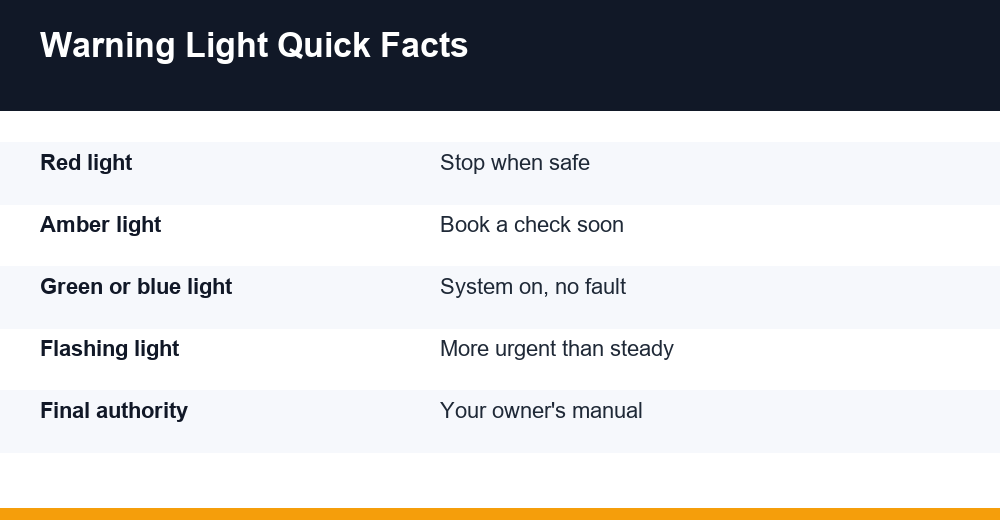
Most carmakers use a simple traffic-light logic, and many symbols are based on an international standard (ISO 2575), so an oil can looks much the same in Delhi as it does in Dubai. Colour is your fastest clue to how serious a problem is.
| Colour | What it signals | Can I keep driving? | What to do |
|---|---|---|---|
| Red | A serious fault or an immediate safety risk | Usually no | Stop somewhere safe, switch off and check the handbook |
| Amber / yellow | A fault, or a system working at reduced capacity | Usually yes, with care | Book a check within days, not weeks |
| Green / blue | A system is switched on and working | Yes | Nothing, beyond switching it off when not needed |
Steady or flashing?
A flashing light is generally more urgent than a steady one; a flashing engine light, for example, can mean damage within minutes. The harmless exceptions are indicators, which flash by design, and a traction control light that flickers while the system is gripping a slippery road.
The start-up bulb check
When you turn the ignition on, many lights glow for a few seconds while the car runs a self-test. That is normal. What matters is a light that stays on once the engine is running, or one that comes on while you are driving.
If a light such as the airbag or engine symbol never appears during the self-test, the bulb may have failed or been disconnected to hide a fault. Watch for this when viewing a used car.
Symbols and colours do vary between brands and models, and many newer cars show a text message alongside the icon. Treat this guide as a triage tool and your owner’s manual as the final word on what dashboard warning lights mean in your particular car.
Red Lights: Stop Safely and Find Out Why
Red means a problem that can harm the engine, the brakes or the people inside. Your job is not to diagnose it at 70 mph (110 km/h); it is to get off the road safely and then work out what happened.
| # | Symbol | What it usually means | Can I keep driving? |
|---|---|---|---|
| 1 | Oil can with a drip | Engine oil pressure is too low to protect the engine | No. Stop and switch off as soon as it is safe |
| 2 | Thermometer in wavy lines | Engine is overheating | No. Pull over, switch off and let it cool |
| 3 | ‘!’ or ‘BRAKE’ inside a circle | Handbrake on, low brake fluid or a brake system fault | No, unless it goes out once the handbrake is fully released |
| 4 | Battery shape | Charging fault: alternator, drive belt or wiring | Only a short distance to a safe stopping place |
| 5 | Seated person with a circle in front | Airbag or seatbelt pretensioner fault | Yes, carefully, but airbags may not deploy. Book an urgent check |
| 6 | Steering wheel with ‘!’ | Power steering fault | Slowly, to the nearest safe spot; steering may become very heavy |
| 7 | Seated person wearing a belt | Someone is not buckled up | Yes, once everyone is belted in |
| 8 | Car outline with a door or bonnet open | A door, bonnet (hood) or boot (trunk) is not fully shut | Stop and close it properly |
Some makers show the airbag and power steering symbols in amber rather than red. Whatever the colour, both involve safety systems that only a qualified mechanic should repair.
Oil and temperature: protect the engine first
The red oil light warns about pressure, not just level, and without oil pressure an engine can be badly damaged very quickly. Stop, switch off, wait a few minutes on level ground and check the dipstick. If the level was fine but the light was on, do not restart the engine; call for recovery instead.
For overheating, switch off and leave the bonnet closed until any steam stops. Never open the radiator or expansion tank cap on a hot engine: the coolant is under pressure and can scald badly. Give it at least 30 minutes, longer in hot weather. If you are still moving and need a few hundred metres to reach safety, turning the heater to full heat can draw a little warmth away from the engine.
Brakes and battery
If the brake light is on, first make sure the handbrake (parking brake) is fully released. If the light stays lit, it often means low brake fluid, which can point to a leak or badly worn pads. Do not drive on it. Brakes are a job for a qualified mechanic, and our guide to the signs your brakes need replacing explains the sounds and pedal feel worth mentioning when you call.
A battery light while driving means the battery is not being recharged. Switch off air conditioning, heated seats and the radio, and head for the nearest safe place without stopping the engine, as it may not restart. If a snapped drive belt also runs the water pump, watch the temperature gauge closely.
If your problem is the opposite, a car that is dead in the morning with no warning the day before, see our guide on why a car battery dies overnight and how to fix it.
Amber Lights: Keep Going, but Book a Check
Amber (or yellow) lights are the ‘deal with me soon’ group. The car is usually safe to drive, but small faults left alone tend to turn into large repair bills.
| # | Symbol | What it usually means | Can I keep driving? |
|---|---|---|---|
| 9 | Engine outline (check engine) | Engine or emissions fault stored | Steady: yes, gently, and get it read soon. Flashing: no, ease off and stop |
| 10 | ‘ABS’ inside a circle | Anti-lock braking fault; normal braking still works | Yes, leaving extra stopping distance. If the red brake light is also on, stop |
| 11 | Horseshoe shape with ‘!’ | Tyre pressure low in one or more tyres, or a sensor fault | Yes, slowly, to the nearest air line to check all four |
| 12 | Car with wavy skid lines | Flashing: traction or stability control working. Steady: system off or faulty | Yes, but drive gently in wet or icy conditions |
| 13 | Coiled spring (diesel only) | Glow plugs preheating; flashing while driving can mean an engine fault | Wait for it to go out before starting. If it flashes, book a check |
| 14 | Box with dots inside (diesel) | Diesel particulate filter (DPF) is clogging | Yes; a steady, faster drive often clears it |
| 15 | Fluid drop or ‘AdBlue’ / ‘DEF’ | Diesel exhaust fluid is running low | Yes, but top up before the range countdown reaches zero |
| 16 | Fuel pump | Fuel is low | Yes, straight to a fuel station |
| 17 | Windscreen with a spray fan | Washer fluid is low | Yes; top up soon |
| 18 | Circle with dashed brackets either side | Brake pads are nearing their minimum thickness | Yes for now; book a brake inspection within days |
| 19 | Spanner or ‘SERVICE’ | Scheduled service is due | Yes; book the service |
| 20 | Snowflake | Outside temperature is near freezing, often around 3-4°C (37-39°F) | Yes, but expect ice on bridges and shaded roads |
Check engine light: steady versus flashing
A steady engine management light means the car’s computer has logged a fault code. It might be something as small as a loose fuel cap or a tired sensor, or something bigger. Any garage can read the code through the diagnostic socket, which has been standard on US cars since the 1996 model year and on new European petrol cars since 2001 (diesels followed in 2004).
A flashing engine light is different. It usually signals a severe misfire, where unburnt fuel reaches the exhaust and can overheat the catalytic converter, one of the more expensive parts to replace. Lift off the accelerator, avoid overtaking or towing, and stop when safe. If it keeps flashing, arrange recovery rather than driving on.
Tyre pressure light
In the US, a tire pressure monitoring system must warn you once a tyre is 25% or more below its recommended pressure, so by the time the light shows, the tyre is already noticeably soft. Check all four tyres with a gauge, ideally when cold, and inflate them to the figure on the door pillar, fuel flap or handbook, not the maximum printed on the sidewall.
Many family cars sit somewhere around 30-35 PSI (roughly 2.1-2.4 bar), but that is only a typical range. Our guide to finding the correct tyre pressure shows where to look for your exact figures. If one tyre keeps losing air, have a tyre specialist inspect it rather than topping it up every week.
DPF and AdBlue (diesel owners)
A DPF traps soot and burns it off on longer, faster runs, which short town trips never provide. Many handbooks suggest a steady drive at around 40 mph (65 km/h) or more for 10-20 minutes on a main road, within the speed limit. If the light stays on afterwards, or the engine light joins it, see a garage.
AdBlue, also sold as DEF, cleans up diesel exhaust. Cars give plenty of warning, usually with a countdown in miles or kilometres, because once it runs dry most will refuse to restart. Fill only through the AdBlue filler (often blue-capped) and never pour it into the fuel tank.
Green and Blue Lights: Information, Not Problems
These lights confirm that something you switched on is working. Keep driving, but use the feature considerately.
| # | Symbol | What it means | Can I keep driving? |
|---|---|---|---|
| 21 | Green lamp with angled lines | Dipped (low-beam) headlights on | Yes |
| 22 | Blue lamp with straight lines | Main (high) beam on | Yes, but dip it for oncoming traffic and cars ahead |
| 23 | Green arrows | Indicators or hazard lights on | Yes. Unusually fast flashing often means a bulb has failed |
| 24 | Speedometer with an arrow | Cruise control set or ready | Yes |
| 25 | Green lamp with a wavy line through the beams | Front fog lights on | Yes, but switch off once visibility improves |
The rear fog light uses a similar symbol in amber, facing the other way. It is very bright, and in several countries, including the UK, using fog lights when visibility is not seriously reduced can bring a fine. Many hybrids and EVs also show a green ‘READY’ light, which means the car will move when you press the accelerator, even though it is silent.
What to Do When Dashboard Warning Lights Come On
A calm routine helps you make a sensible decision and gives a mechanic far more to go on.
- Note the colour and whether the light is steady or flashing.
- Check the other gauges and your senses: temperature needle, unusual noises, burning smells, smoke, heavy steering or a soft brake pedal.
- For any red or flashing light, stop somewhere safe and legal and switch on your hazard lights. On a fast road, get everyone out on the side away from traffic.
- Look the symbol up in the owner’s manual, or the digital manual in the car’s screen or app.
- Do only the simple checks you can do safely: handbrake fully off, fuel cap clicked shut, oil on the dipstick once the engine has rested, coolant level visible in the tank (cap closed), and tyre pressures.
- Write down when the light appeared, your speed, the weather and anything else you noticed.
- If a red light will not clear, call your breakdown or recovery service rather than driving on.
What not to do
- Do not disconnect the battery or use a cheap code reader just to make dashboard warning lights disappear. The fault is still there.
- Do not keep topping up oil, coolant or brake fluid that keeps dropping. Find the leak.
- Do not restart a car that has been through deep floodwater and is now showing lights. Water in the engine or electrics needs a qualified mechanic.
- Do not try to fix airbag, brake, steering or fuel system faults yourself.
Hot, Cold, Hybrid and Electric: Extra Things to Know
Cold climates
The tyre pressure light often appears on the first frosty morning of the year. Air contracts as it cools, and pressure falls by roughly 1 PSI for every 10°F drop, or about 0.07 bar for every 5-6°C. Check and adjust, but do not simply ignore it because ‘it’s just the cold’. Weak batteries also struggle below freezing (32°F / 0°C).
Hot and dusty climates
In 40-45°C (104-113°F) summers across the Gulf, India and inland Australia, cooling systems work hard in stop-start traffic, so glance at the temperature gauge often. Heat also shortens battery life, and monsoon flooding can let water into sensors and connectors, bringing up ABS, airbag or engine lights.
Hybrids and electric cars
- A turtle or ‘reduced power’ symbol means the car is limiting performance, often because of low charge or a fault. Find a safe place to stop and charge.
- A car symbol with ‘!’ or a ‘check hybrid system’ message points to the drive system. Stop and consult the manual.
- EVs still have a small 12-volt battery, and when it weakens it can trigger a confusing mix of lights.
- High-voltage parts, usually marked by orange cables, are strictly for qualified technicians. Never open or touch them.
Warning Lights, the Law and Roadworthiness Tests
The rules differ from country to country, so check what applies where you live. In the UK, an MOT tester checks that key warning lamps work and are not showing a fault, and the official MOT inspection manual on GOV.UK covers lamps such as the engine malfunction indicator, ABS and airbag warnings.
Elsewhere, US states with emissions testing commonly fail a car with the check engine light on, and roadworthiness or pollution checks in places such as Australia and India can flag similar faults.
What a diagnosis typically costs
Prices vary widely by country. As a rough guide, a basic fault-code read is often cheap or even free, while a full diagnostic check typically costs around an hour of garage labour. Ask for the actual code in writing so you can get a second opinion.
Used-car buyers can put their knowledge of dashboard warning lights to work: confirm the self-test lights appear and go out, then take a test drive long enough for intermittent faults to show.
Frequently Asked Questions
Can I drive with the check engine light on?
If it is steady and the car feels normal, you can usually drive gently for a short while, but get the fault code read within a few days. If it is flashing, ease off and stop when safe, because a severe misfire can quickly damage the catalytic converter.
Why did a warning light come on and then go off again?
Many faults are intermittent: a sensor that misbehaves in the damp, a loose connection or a momentary pressure drop. The car usually stores a code even after the light goes out, so mention it at your next garage visit, or sooner if the light was red.
Is it safe to reset dashboard warning lights myself?
Resetting a service reminder by following the handbook is fine. Clearing fault lights with a code reader or by disconnecting the battery only hides the symptom, and the light will usually return. It can also erase information a mechanic needs to find the fault.
Why does my car’s symbol look different from the ones described here?
Manufacturers tweak icons, colours and wording, and newer cars often add text messages or brand-specific symbols for driver-assistance systems. The colour logic usually holds, but your owner’s manual, printed or on-screen, is the definitive guide for your exact model.