
Sensible winter car preparation is less about gadgets and more about a handful of checks done before the first hard frost. Cold weather exposes weak batteries, watery coolant, worn tyres and tired wiper blades, while road salt slowly eats at the metal underneath. This 10-point checklist works whether you face British sleet, a Himalayan pass, Canadian snow or a surprisingly cold desert night.
Table of Contents
Why Winter Car Preparation Matters Wherever You Live
Cold changes a car in predictable ways. Oil thickens, battery chemistry slows, rubber hardens and moisture freezes in locks, seals and washer bottles. Together, that explains why so many breakdowns happen on the first properly cold mornings of the year.
Once air temperatures sit around 7°C (45°F) or lower, tyre grip, battery output and visibility all start to suffer. That covers most of Europe, North America and northern Asia, plus hill stations in India, the Australian Alps, and desert regions where nights can drop close to freezing.
Drivers in hot climates often skip winter car preparation entirely, then head into the mountains on tyres and coolant chosen for 40°C (104°F) summers. If a trip involves serious altitude, treat it as a winter journey.
Rules differ by country. Some European countries require winter tyres or snow chains in wintry conditions, and minimum tread depths vary. Check your local transport authority before travelling, and treat your owner’s manual as the final word on fluids, tyre sizes and pressures.
The 10 points at a glance
| # | Check | Who does it? |
|---|---|---|
| 1 | Battery health and terminals | DIY check; garage load test |
| 2 | All exterior lights | DIY |
| 3 | Antifreeze (coolant) level and strength | Level DIY; strength via tester or garage |
| 4 | Engine oil and screenwash | DIY |
| 5 | Tyre type for your climate | Tyre specialist fits |
| 6 | Tread depth and pressure | DIY |
| 7 | Wiper blades, glass and demisting | DIY |
| 8 | Salt protection and washing | DIY |
| 9 | Brakes, steering, heater, exhaust | Qualified mechanic |
| 10 | Winter emergency kit | DIY |
Points 1-2: Battery Testing and Lights
Winter is hard on batteries. The chemical reaction inside a lead-acid battery slows as it gets colder, so less power is available at exactly the moment a cold engine with stiff oil needs more of it. Widely quoted AAA figures suggest a battery loses about 35% of its strength at 0°C (32°F) and around 60% at -18°C (0°F).
Warning signs include a slow, laboured start, headlights dimming while you crank, or a battery warning light. Many batteries last roughly three to five years, though heat in places like the Middle East or northern Australia can shorten that.
How to check your battery
- Leave the car off for a few hours, then measure across the terminals with a basic multimeter. On a typical lead-acid battery, about 12.6 volts suggests a full charge, around 12.4 volts is roughly three-quarters, and 12.2 volts or below means it needs charging and a closer look.
- Look for white or green crusty deposits on the terminals. If you’re not confident cleaning them safely, with gloves, eye protection and the disconnection order from your manual, ask a garage.
- Ask for a load test. Many garages and parts counters can test a battery in a few minutes. A battery can show a healthy resting voltage and still collapse under the strain of starting a cold engine.
If your car starts fine on Friday but is flat by Monday, the problem may be a parasitic drain rather than the cold alone. Our guide on why a car battery dies overnight and how to fix it walks through the usual culprits.
Hybrids and EVs still rely on a small 12V battery to wake up, so test that too. The high-voltage system is strictly for a qualified technician.
Point 2 is quick: walk round the car with a helper. Check dipped and main beams, indicators, hazards, brake lights, fog lights, reversing lights and the number plate lamp. Clean the lenses too, because road grime cuts light output noticeably.
Points 3-4: Antifreeze Ratio, Oil and Screenwash
Coolant is a mix of antifreeze and water. It stops the engine’s water passages freezing, protects against internal corrosion and raises the boiling point in summer. Too weak a mix can freeze and expand, which in the worst cases cracks a radiator or engine block.
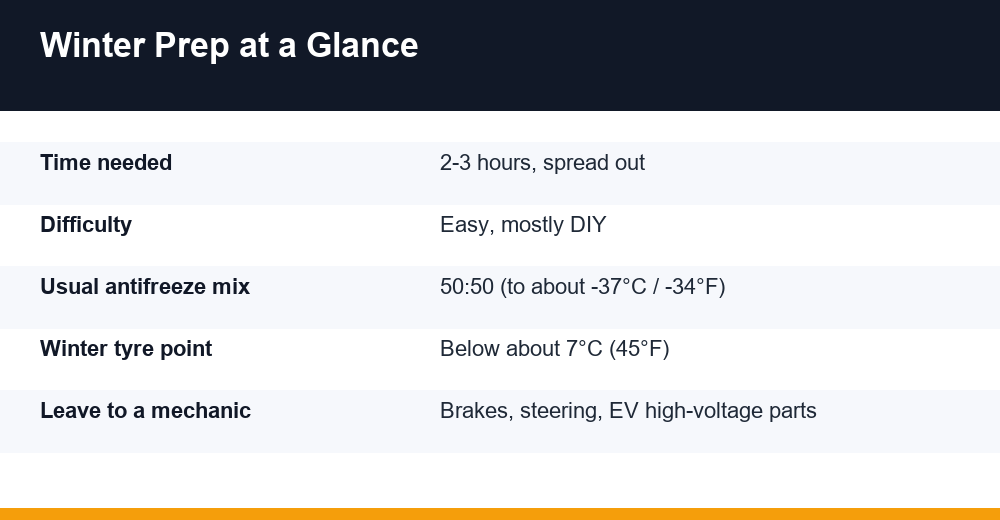
Most manufacturers specify roughly a 50:50 antifreeze ratio, which typically protects down to around -37°C (-34°F). In very harsh climates a stronger mix may be recommended, but there’s a ceiling: beyond about 70% antifreeze, freeze protection actually gets worse, and neat concentrate is never the answer. Many coolants are sold pre-mixed, which removes the guesswork.
| Antifreeze : water | Approximate freeze protection | Typical use |
|---|---|---|
| 30 : 70 | About -15°C (5°F) | Too weak for most winters |
| 40 : 60 | About -24°C (-11°F) | Mild winters only |
| 50 : 50 | About -37°C (-34°F) | Standard for most cars and climates |
| 60 : 40 | About -50°C (-58°F) or lower | Severe cold, only if your manual allows |
| 100 : 0 (neat) | Worse than a proper mix | Never use undiluted |
These figures are typical for ethylene-glycol coolant and vary by product, so check the label. Only check the level when the engine is fully cold, because opening a hot cooling system can cause serious burns. The level should sit between the MIN and MAX marks on the expansion tank.
To check strength, use an inexpensive coolant hydrometer or refractometer, or ask a garage to test it. Top up with the coolant type named in your manual; colour is not a reliable guide, and mixing types can cause problems. If you keep needing to add fluid, there’s a leak, and that’s a job for a mechanic.
Engine oil and screenwash
Check the oil on level ground with the engine off, using the dipstick or electronic gauge. The first number in an oil grade, such as 0W or 5W, describes how easily it flows when cold. Stick to the grade in your handbook.
Swap plain water in the washer bottle for a winter-rated screenwash, diluted for the lowest temperature you expect. Water alone can freeze in the reservoir or smear into ice on the glass. Never pour engine antifreeze into the washer bottle; it damages paint and rubber and is toxic. Good winter car preparation also means carrying a spare bottle, because salty roads use far more.
Points 5-6: Winter vs All-Season Tyres, Tread and Pressure
Tyres are the only part of the car touching the road. Standard summer tyres stiffen as temperatures fall below about 7°C (45°F), losing grip on cold, wet tarmac well before any snow appears.
Winter tyres use a softer compound and many fine slits (sipes) that bite into snow and slush. All-season tyres are a compromise. Look for the three-peak mountain snowflake (3PMSF) symbol on the sidewall: it shows the tyre has passed a standardised snow traction test, whereas the older M+S marking alone has no such performance test behind it.
| Feature | Summer tyre | All-season tyre | Winter tyre |
|---|---|---|---|
| Best temperatures | Above about 7°C (45°F) | Mild winters, occasional frost | Regularly below about 7°C (45°F) |
| Snow and ice grip | Poor | Fair to good (better with 3PMSF) | Best |
| Sidewall markings | None for snow | M+S, often 3PMSF | 3PMSF, usually M+S too |
| Hot-weather wear | Good | Good | Wears faster when warm |
Which tyre should you choose?
- If you face regular snow, ice or long spells below 7°C (45°F), a dedicated winter set is the safest choice.
- If winters are mostly cold and wet with the odd frost, a good all-season tyre carrying the 3PMSF symbol is a sensible middle ground.
- If you live somewhere hot but drive into the mountains, carry snow chains or textile snow socks where they’re permitted, and practise fitting them at home on a dry day.
- Fit winter tyres as a set of four. Mixing grip levels between front and rear axles can make the car unstable.
Point 6 is condition. The legal minimum tread in the UK and much of Europe is 1.6mm across the central three-quarters of the tyre, and many US states use 2/32 inch (about 1.6mm). Some countries demand more for winter tyres, and many tyre safety groups suggest replacing at around 3mm (about 4/32 inch) if you drive in winter conditions.
Pressure drops as air cools, by roughly 1 PSI (about 0.07 bar) for every 10°F (about 5.6°C) fall. Check first thing in the morning against the door-pillar sticker or handbook, not the maximum on the sidewall. Our guide to finding the correct tyre pressure explains PSI, bar and where to look. Don’t let air out for ‘extra grip’ on snow. Bulges, cuts or repeated slow punctures need a tyre professional.
Point 7: Wipers, Glass and Demisting
Low winter sun, spray from lorries and a film of salt can turn a smeared windscreen into a real hazard. Wiper blades typically need replacing every six to twelve months, and intense sun in hot countries perishes rubber quickly.
- Lift each blade and run a finger along the rubber edge. Nicks, splits or hardened rubber mean it’s time for new blades.
- On frosty nights, cover the windscreen or lift the blades away from the glass if your car allows it.
- Never use the wipers to clear ice. It tears the rubber and can strain the wiper motor or linkage.
- Never pour boiling water on frozen glass; the sudden temperature change can crack it. Use a scraper, a de-icer or the car’s heater.
- Clean the inside of the glass too. A greasy film inside is a major cause of fogging and glare.
Check that the heater, rear window heater and any heated mirrors all work. Running the air conditioning with the heat on dries the air and clears misting faster, even in cold weather.
Clear every window, mirror, light and number plate before setting off, plus roof snow that could slide over the windscreen when you brake. In many countries, driving without a clear view is an offence.
Point 8: Washing Off Road Salt to Prevent Rust
Gritting salt and brine keep roads usable, but salty slush speeds up rust on the underbody, wheel arches, sills, subframes, exhaust and brake lines. The damage is slow and out of sight, which is why washing belongs in any winter car preparation plan.
Before winter: protect
- Give the car a thorough wash and add a coat of wax or paint sealant for a protective layer.
- Touch up stone chips so bare metal isn’t exposed to salt.
- Ask your garage to look for existing rust underneath during a service, especially on older cars.
During winter: rinse regularly
- Aim to rinse the car every week or two while roads are being salted, and soon after any heavy gritting spell.
- Start with plenty of plain water on the wheel arches, sills and behind the wheels to loosen salt before touching the paint.
- Wash the bodywork using the two-bucket wash method so you aren’t dragging gritty salt across the paint.
- For the underside, angle a garden hose or pressure-washer lance underneath while standing beside the car, or choose a car wash with an underbody rinse. Never crawl under a car supported only by a jack.
- Keep pressure-washer jets away from door seals and sensors, then dry seals and locks so they don’t freeze shut overnight.
In spring, give the car a final underbody rinse and full wash to clear the season’s build-up.
Points 9-10: Mechanic Checks and an Emergency Kit
Brakes, steering, suspension, airbags, fuel systems and hybrid or EV high-voltage parts are jobs for a qualified mechanic, not DIY. Many garages offer a low-cost pre-winter check.
- Brakes: pad and disc wear, fluid condition and any pulling or grinding.
- Exhaust: leaks can let carbon monoxide into the cabin, which is especially risky in a stationary car.
- Auxiliary belt and hoses: cold makes perished rubber crack.
- Recalls: check for outstanding safety recalls with the manufacturer or your national road safety authority.
Point 10 is your emergency kit. Breakdowns are more serious in winter because waiting in a cold car quickly becomes uncomfortable, then dangerous. NHTSA’s winter driving tips include a useful list, adapted below for drivers anywhere. A kit is the cheapest part of winter car preparation and possibly the most valuable.
Winter emergency kit list
- Ice scraper, snow brush and a small folding shovel
- Jump leads (jumper cables) or a charged portable jump starter
- Torch with spare batteries
- Blankets, a warm hat, gloves, a spare coat and waterproof boots
- Phone charger and a charged power bank
- Bottled water and non-perishable snacks
- First aid kit and any regular medication
- Sand, grit, cat litter or traction mats for getting moving on ice
- Hi-vis vest and warning triangle, which are mandatory in some countries
- Snow chains or socks for mountain trips or where required
Keep the tank at least half full in cold weather, and ideally close to full before a long trip, or keep a healthy charge in an EV, so a long delay doesn’t leave you without heat.
If you get stuck
- Stay with the car unless help is close and safe to reach; it’s shelter and easier to spot.
- Keep the exhaust pipe clear of snow to stop carbon monoxide building up inside.
- Run the engine only in short bursts for warmth, with a window slightly open.
- Make the car visible with hazard lights, the interior light or a bright cloth, and call for help with your exact location.
When to Do Each Check: A Seasonal Timeline
Winter falls roughly from December to February in the Northern Hemisphere and from June to August in Australia, New Zealand, South Africa and South America. Booking garage jobs early avoids the rush when the first cold snap hits.
| When | What to do |
|---|---|
| 4-6 weeks before winter | Book a winter check: battery load test, coolant strength and brakes |
| 2-4 weeks before winter | Fit winter or 3PMSF tyres once temperatures sit near 7°C (45°F); replace wipers; switch to winter screenwash; pack the kit |
| Weekly through winter | Check tyre pressures and lights; top up screenwash |
| Every 1-2 weeks on salted roads | Rinse salt from the underbody, arches and sills |
| Early spring | Swap tyres back once it stays above about 7°C (45°F); full wash with underbody rinse; restock or unpack the kit |
Finish your winter car preparation before the first frost rather than after a dead battery or a slide, and the cold months become far less stressful.
Frequently Asked Questions
When should I fit winter tyres?
A good rule is to fit them once daytime temperatures regularly sit around 7°C (45°F) or below, and take them off when spring temperatures stay above that. In the Northern Hemisphere this is often October or November; in Australia and New Zealand, around May. Check local rules, as some countries set legal dates or conditions.
Is it necessary to warm up a modern car by idling?
Usually not. Most modern fuel-injected engines need less than a minute before you can drive off gently, and they warm up faster on the move than at idle. Long idling wastes fuel and adds wear. Never run an engine in an enclosed garage, because carbon monoxide builds up quickly.
Do electric cars need winter preparation too?
Yes. Tyres, wipers, screenwash, the 12V battery and salt washing all apply. Expect reduced range in the cold, pre-heat the cabin while plugged in where possible, and keep a higher charge before long trips. Leave anything to do with the high-voltage battery or wiring to a qualified EV technician.
How often should I wash my car in winter to remove salt?
As a typical guide, rinse it every week or two while roads are being salted, and soon after heavy gritting. Focus on the wheel arches, sills and underbody, where salt collects and rust starts.